

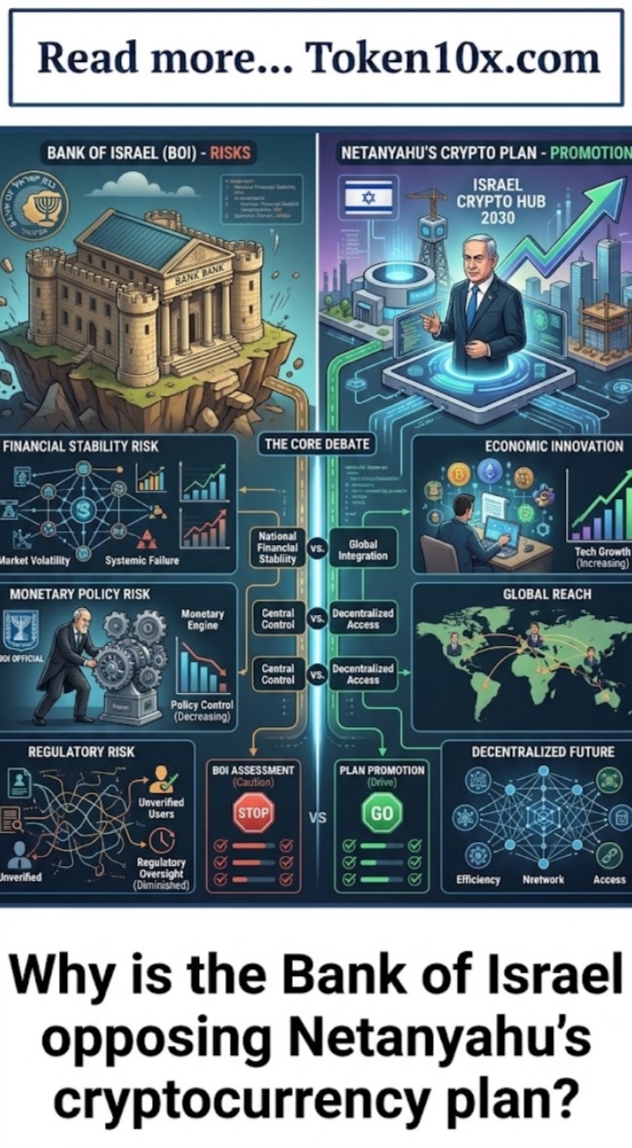
Prime Minister Benjamin Netanyahu said in a Channel 10 interview that Israel must prepare for possible international banking sanctions and develop an alternative economic framework that could bypass them. He identified blockchain and cryptocurrencies as one option and stated that he had already asked advisers to prepare a related plan. The Bank of Israel responded the following day with a public statement rejecting the idea, declaring that cryptocurrencies “cannot be used as a route for bypassing sanctions” or “cannot serve as a means of circumventing sanctions.”
The central bank argued that the correct course for Israel’s economy is to preserve economic relationships with its principal trading partners and to focus on preventing sanctions and their negative effects. It emphasized that this responsibility belongs to the political leadership. Netanyahu later said he heard the resistance and was taking it into account, while describing crypto as only one tool among others and noting it was not certain the approach would be used. Opposition figures and economists also criticized the proposal, warning of economic isolation risks.
The Drivers of the Current Situation
The main issue is Netanyahu’s suggestion that Israel prepare cryptocurrency and blockchain mechanisms as a contingency against potential banking sanctions, which the Bank of Israel framed as impractical and misdirected. The central bank quantified its position by stating that digital currencies cannot serve as a bypass route and that priority must remain on maintaining trade ties and preventing restrictions.
Related factors frame the narrative. Concerns over possible international pressure, recent sanctions discussions involving settlements, and the proximity to elections have reinforced debate over contingency planning versus prevention. Only Netanyahu’s Channel 10 remarks about banking sanctions and requesting a blockchain plan, the Bank of Israel’s explicit rejection that crypto cannot circumvent sanctions, its call to preserve economic relations with main trading partners, the assignment of responsibility to the political echelon, and Netanyahu’s subsequent acknowledgment that he was taking the criticism into account are established in the statements and contemporaneous coverage. Broader warnings from former officials and economists about isolation or investor flight provide additional context without independent verification of any formal plan details.
Continued monitoring requires observation of further official statements, any concrete planning documents, political reactions, and market or diplomatic responses. Limited immediate detail on the precise scope of the requested plan or whether it would involve specific cryptocurrencies forms a narrower path for assessing feasibility. Officials and commentators continue addressing the exchange. The situation is the Bank of Israel opposing Netanyahu’s cryptocurrency plan for potential sanctions circumvention.
Impact and Broader Context
Questions about why the Bank of Israel is opposing Netanyahu’s cryptocurrency plan keep growing. The exchange creates uncertainty about whether the proposal signals prudent contingency thinking or a risky shift that could undermine confidence in Israel’s integration with global finance. It also elevates attention on the reliability of viewing crypto as a sanctions workaround. Economists, opposition leaders, and market observers continue to assess the implications.
The issue drives debate on the interpretive limits of alternative-finance ideas during periods of geopolitical tension. It raises questions about the durability of prevention-focused strategies, the limits of attributing practical utility to blockchain for large-scale national trade, risks of misreading public discussion as actual policy, effects on near-term investor and partner sentiment, and competition among political and institutional signals for economic direction. The Bank of Israel and secondary commentary stress the need to protect trade relationships while noting the absence of evidence that crypto could replace conventional banking channels. Coverage highlights the distinction between documented contingency talk and unverified assumptions about operational readiness.
The late-October statements forced renewed focus on Israel’s economic resilience options. The current review shows how subsequent political developments, any detailed planning, or international reactions will determine the lasting effect.
New Bank of Israel comments, government clarifications, or election-related developments will clarify the contribution of this disagreement to broader discussions of sanctions preparedness and financial strategy.
This analysis uses the Bank of Israel’s public statement, Netanyahu’s Channel 10 and follow-up remarks, and contemporaneous reporting. Plan details, practical viability, and longer-term economic consequences remain subject to further evidence and political conditions.