

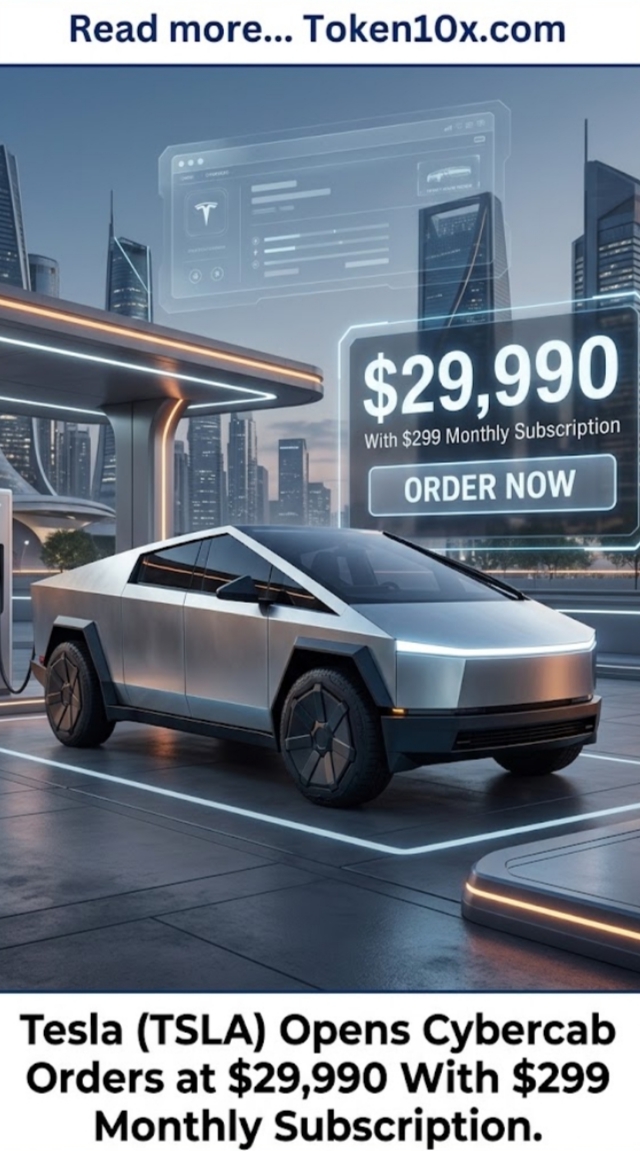
Tesla began inviting select customers on November 13, 2026, to order the Cybercab for personal use at a base price of $29,990 before taxes. A mandatory $299 monthly Autonomy Subscription is required for the vehicle to operate, with the first month included. Orders require a $1,000 non-refundable deposit, and estimated deliveries begin in December 2026, initially focused on Austin, Texas.
The two-seat Cybercab has no steering wheel or pedals and functions only within Tesla’s existing Robotaxi service areas in parts of Texas and Florida. Commercial use is prohibited under the terms. Elon Musk later commented that the $299 subscription “should match the cost of Tesla FSD and connectivity for other models, which is more like ~$115/month,” and stated that wider nationwide availability would follow regulatory approval.
**The Drivers of the Current Situation**
The main issue is Tesla’s decision to open limited personal ownership of the Cybercab while tying its core autonomous functionality to a recurring subscription. The vehicle cannot operate without an active Autonomy Subscription, and availability is restricted to geofenced Robotaxi zones where Tesla already runs unsupervised service.
Related factors shaped the offering. Tesla has been operating a small Robotaxi fleet and previously indicated most Cybercabs would remain company-owned for transport-as-a-service. The personal-use program starts small and invitation-only, with regular vehicle maintenance also listed as required for operation. Only the confirmed $29,990 price, the $299 monthly subscription, the $1,000 non-refundable deposit, the December 2026 delivery estimate, the geofence limitations, and Musk’s subsequent remarks on pricing and expansion are verified. Broader regulatory progress on unsupervised autonomy and the company’s production ramp contributed to the timing of the invite.
Continued monitoring requires observation of order volume among invited customers, any adjustment to the subscription price, expansion of service areas, and regulatory developments. Limited public detail on the exact number of invites and the long-term pricing trajectory forms a narrower path for assessing demand. Tesla, prospective buyers in the current zones, and regulators remain the primary parties tracking residual effects. The situation is an early, restricted personal-ownership test of a purpose-built autonomous vehicle that monetizes software capability through a mandatory subscription.
**Impact and Broader Context**
Questions about the economics of personal autonomous-vehicle ownership keep growing. The combination of a relatively low purchase price and a high mandatory monthly fee creates uncertainty about total cost of ownership and about how many buyers will accept a vehicle that cannot operate outside defined zones or without ongoing payments. It also elevates attention on the shift from traditional vehicle sales toward software- and service-based revenue models. Tesla shareholders, potential early adopters, competing autonomous-vehicle developers and transportation regulators continue to assess the implications.
The issue drives debate on the commercialization of unsupervised autonomy. It raises questions about the durability of the current $299 price point, the limits of geofenced operation for personal use, risks of limited demand outside dense Robotaxi markets, effects on near-term Cybercab production allocation between fleet and private buyers, and competition among mobility providers offering robotaxi versus owned autonomous vehicles. Coverage notes that Musk’s public suggestion of a lower subscription fee already signals potential flexibility in the commercial terms.
The November 13 invitation launch forced renewed focus on Tesla’s dual fleet-and-ownership strategy for the Cybercab. The current terms show how subsequent pricing changes, service-area expansion, or regulatory clearances will determine the lasting effect.
New order data, subscription-price adjustments, or broader geographic availability will clarify the practical contribution of the personal-use program.
This analysis uses Tesla’s official order-page details, the Robotaxi account announcement, and contemporaneous reporting including Musk’s comments. Future pricing, delivery volumes and regulatory scope remain subject to company decisions and external approvals.