

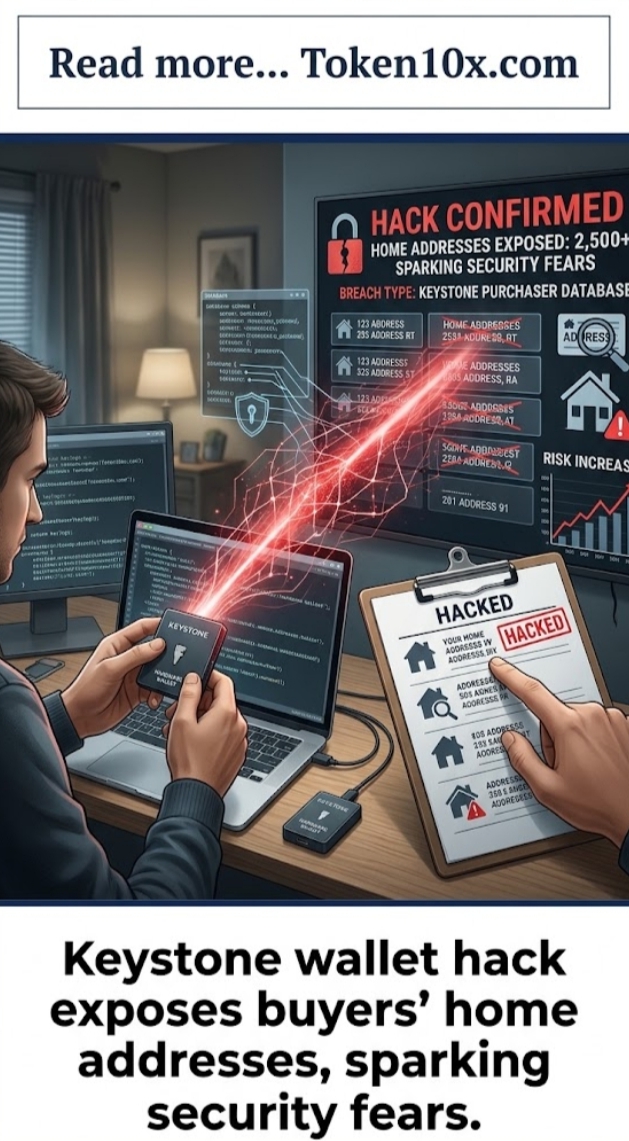
Keystone Hardware Wallet confirmed that unauthorized access to its official website on October 20, 2026, allowed a third party to obtain customer shipping information. After reviewing Shopify API activity, the company verified the exposure on October 23 and publicly disclosed it on October 24. The compromised records included customer names, contact details, shipping addresses (home addresses), and order details such as products purchased and prices paid.
Keystone stated that payment card or bank details, recovery phrases, private keys, and wallet passwords were not compromised. The company blocked the access, patched the vulnerability, opened an investigation, and began emailing affected customers. It warned that scammers may impersonate Keystone via phone, text, email, or mail by offering refunds, replacement devices, or “fixes” related to orders or addresses. The incident has raised concerns about phishing and potential physical security risks for hardware-wallet owners, drawing comparisons to earlier breaches such as Ledger’s 2020 data exposure.
The Drivers of the Current Situation
The main issue is the unauthorized website access that exposed Keystone customers’ personal and order data, which security observers and the company itself have framed as creating elevated phishing and targeting risks. Keystone quantified the exposure as names, contact details, shipping addresses, and order information (items and prices), while confirming that cryptographic credentials and payment data remained unaffected.
Related factors frame the narrative. The combination of identifiable home addresses with proof of hardware-wallet ownership has reinforced fears of sophisticated social-engineering attacks and possible physical threats. Only the October 20 detection date, the October 23 confirmation via Shopify API review, the specific categories of exposed data, the explicit statement that private keys and recovery phrases were not compromised, the company’s apology and remediation steps, and the absence of a disclosed customer count or attacker identity are established in the official disclosure and contemporaneous coverage. Broader references to prior hardware-wallet incidents provide additional context without independent verification of scale or ongoing exploitation.
Continued monitoring requires observation of further customer notifications, any detailed incident report, reports of follow-on scams, and security community analysis. Limited immediate detail on the number of affected buyers or the exact duration of unauthorized access forms a narrower path for assessing the full impact. The company and commentators continue addressing the breach. The situation is the Keystone wallet hack that exposes buyers’ home addresses, sparking security fears.
Impact and Broader Context
Questions about the Keystone wallet hack exposing buyers’ home addresses and sparking security fears keep growing. The outflows of personal data create uncertainty about whether the incident primarily enables remote phishing or also elevates physical-risk concerns for cryptocurrency holders. They also heighten attention on the reliability of e-commerce platforms used by hardware-wallet makers. Users, analysts, and security researchers continue to assess the implications.
The issue drives debate on the interpretive limits of “air-gapped” device security when customer metadata is compromised. It raises questions about the durability of trust in hardware-wallet vendors, the limits of attributing direct fund risk versus secondary targeting risk, risks of misreading order-data leaks as key compromises, effects on near-term buyer caution, and competition among on-chain and off-chain security signals. Keystone and secondary coverage stress that private keys remained safe while noting the practical value of names, addresses, and purchase details to scammers. Coverage highlights the distinction between documented data exposure and unverified claims of widespread physical attacks.
The mid-to-late October disclosure forced renewed focus on supply-chain and website security for crypto hardware providers. The current review shows how subsequent scam reports, the promised detailed investigation, or customer responses will determine the lasting effect.
New Keystone updates, verified phishing campaigns, or industry analyses will clarify the contribution of this breach to broader hardware-wallet security narratives.
This analysis uses Keystone’s official October 24 disclosure, Shopify-related verification details, and contemporaneous reporting. The exact number of affected customers, attacker identity, and any real-world exploitation remain subject to further evidence and investigation outcomes.