

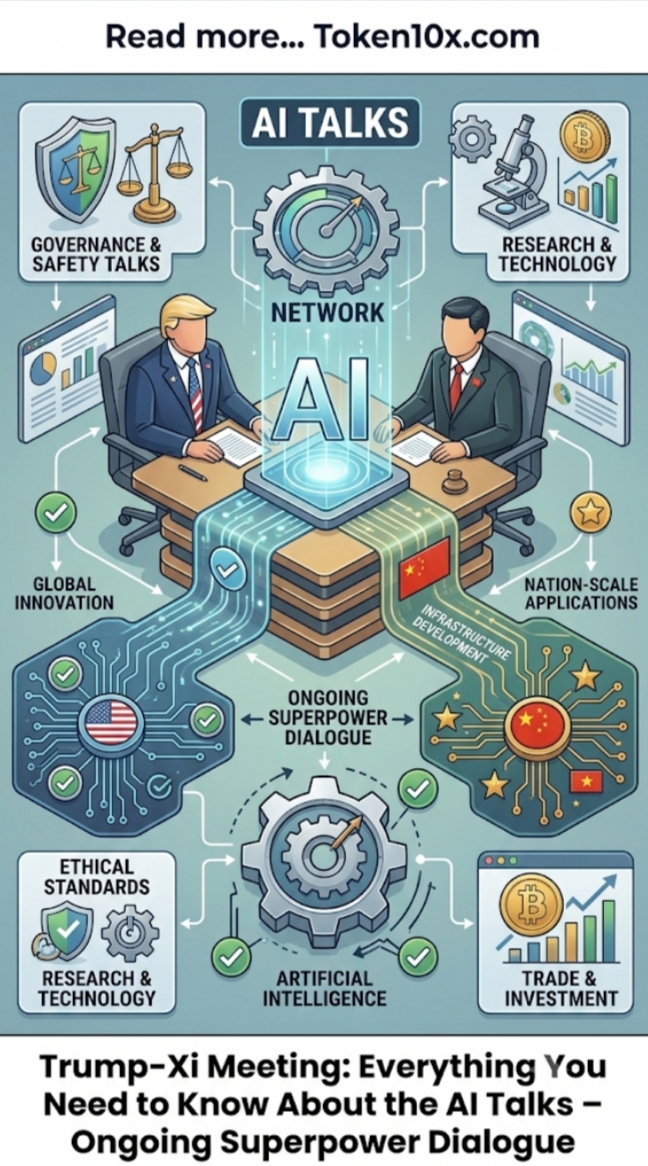
U.S. President Donald Trump and Chinese President Xi Jinping addressed artificial intelligence as a central topic during their summit in Washington around September 24–25, 2026. The discussions marked the first high-level joint engagement by the two leaders on AI risks, benefits, and governance amid intense bilateral technological competition.
The talks still highlighted clear differences in approach while opening a path for continued communication. Trump emphasized unrestricted development to maintain American leadership, while Xi stressed the shared responsibility of the two leading AI powers to keep the technology under human control. This comparison underscores both the competitive stakes and the emerging recognition of mutual interest in managing advanced AI.
The Drivers of the AI Discussions
The key factor remains the strategic rivalry over artificial intelligence capabilities, including advanced models, computing power, and semiconductor supply chains. Trump, who has referred to the technology as “super intelligence” (SI), stated prior to and during the visit that he wants to “leave it exactly where it is,” opposing new regulatory guardrails and pointing instead to existing tools such as the Department of Justice. He framed the discussion around security, technology, and maintaining U.S. advantage.
This stacks with Xi’s public remarks emphasizing that both nations “have both the capability and responsibility to develop and manage AI for good” and must “ensure the development of AI is always under human control and serves the well-being of the people.” Chinese readouts indicated Xi proposed continued dialogue on risks and benefits, along with joint efforts to prevent misuse and abuse. Tech executives from major U.S. AI and semiconductor firms attended related events, underscoring the commercial dimension. Only high-level personal engagement of this type typically elevates AI from technical and export-control issues into direct leader-to-leader discussion; lower-level talks had previously been more limited.
It is essential to distinguish: the summit produced statements supporting ongoing AI dialogue and, according to post-meeting reports, agreement on a bilateral communication channel for AI-related incidents, whereas it did not yield binding rules, development pauses, or resolution of underlying export-control disputes. The AI portion is mostly a diplomatic exchange linked to broader strategic, trade, and security talks.
Impact and Broader Context
As the world’s two leading AI powers, the Trump-Xi engagement advances formal recognition that competition coexists with shared stakes in preventing catastrophic misuse. Establishing or reinforcing a communication channel grows the potential for incident management and risk discussion even as both sides continue rapid domestic development. Market and policy observers continue to monitor whether the dialogue produces concrete working groups or remains largely rhetorical.
This sustained high-level attention fuels debates on global AI governance, the effectiveness of export controls versus unrestricted innovation, the role of private-sector leaders in bilateral diplomacy, and the balance between national advantage and collective risk reduction. Advocates of dialogue highlight the value of direct leader engagement on a technology with systemic implications. Critics note the absence of stronger commitments given warnings from some technologists about existential risks.
Analysts emphasize that personal rapport between the leaders provided a platform for these exchanges, yet structural competition over talent, chips, and model capabilities persists. The September 2026 summit offers insight into how the United States and China are beginning to frame AI as both a domain of rivalry and a subject requiring managed interaction.
As further details from official readouts, follow-up meetings (including planned encounters later in 2026), or technical working groups emerge, the practical outcomes of the AI talks will become clearer.
This analysis draws from contemporaneous reporting of the leaders’ statements, official readouts, and post-summit announcements for precision. Positions and any agreed mechanisms remain subject to ongoing diplomatic implementation.