

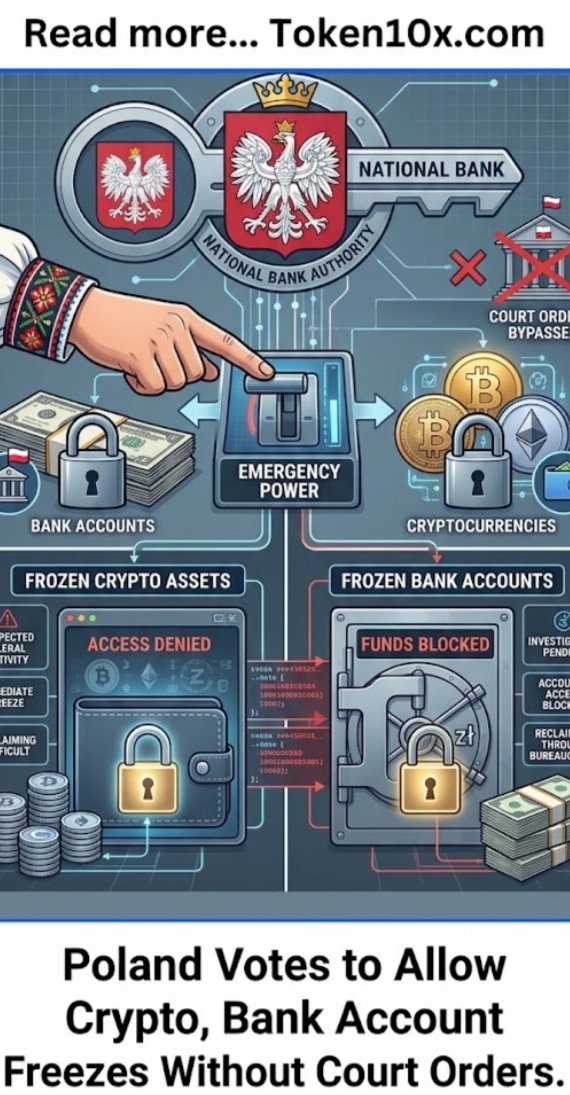
Poland’s lower house of parliament, the Sejm, approved on November 6, 2026, a government-backed bill that would allow administrative freezes of bank accounts, cryptocurrency holdings and other property without a prior court order. The Act on Restrictive Measures passed by a vote of 240 in favor, 202 against and one abstention. It establishes a national sanctions list of individuals and organizations deemed threats to national security, including those involved in foreign interference. The interior minister would have authority to place names on the list and order immediate asset restrictions.
Crypto assets are explicitly included under the definition of financial assets subject to freezing, covering holdings on trading platforms. Affected parties could appeal to an administrative court, but an appeal would not automatically suspend the freeze. Banks and crypto service providers would be required to implement the orders. The legislation now moves to the Senate and would still require presidential signature before becoming law.
The Drivers of the Current Situation
The main issue is the expansion of Poland’s sanctions toolkit to permit rapid administrative freezes of both traditional and digital assets without first obtaining judicial authorization. The bill is framed as a response to security concerns, including foreign interference and the need for faster restrictive measures.
Related factors shaped the vote. Crypto assets were deliberately brought within the scope of freezeable property, aligning with EU MiCA definitions. Opposition lawmakers and legal groups raised concerns about property rights, due process and potential impacts on freedom of expression. Only the November 6 Sejm vote totals, the explicit inclusion of crypto holdings, the non-suspensive nature of appeals, the requirement for Senate and presidential approval, and the interior minister’s listing authority are confirmed. Broader geopolitical tensions and prior debates over Polish crypto regulation contributed to the constructive framing of the security rationale.
Continued monitoring requires observation of Senate deliberations, any presidential decision, and the practical implementation of listing criteria if the bill advances. Limited detail on enforcement mechanisms against self-custody wallets and the continued need for final approval form a narrower path for immediate effect. Polish lawmakers, the interior ministry and crypto platforms remain the primary parties tracking residual effects. The situation is a significant expansion of administrative power over assets that has passed the lower house but is not yet law.
Impact and Broader Context
Questions about the balance between security and property rights keep growing. The bill creates uncertainty about how broadly the national sanctions list will be applied and about the speed with which freezes could be imposed on crypto accounts. It also elevates attention on the treatment of digital assets under national security measures and the absence of automatic judicial suspension. Crypto users, exchanges operating in Poland, civil-liberties groups and European regulators continue to assess the implications.
The issue drives debate on administrative asset freezes in the digital age. It raises questions about the durability of due-process safeguards when freezes take effect immediately, the limits of appeals that do not halt restrictions, risks of over-broad application to crypto holdings, effects on near-term confidence in Polish crypto markets, and competition among EU member states in designing sanctions tools that cover digital assets. Coverage notes that opponents highlighted risks to property rights while supporters emphasized national-security needs.
The November 6 Sejm vote forced renewed focus on Poland’s approach to crypto under sanctions regimes. The current status shows how Senate review, presidential action, or subsequent implementing rules will determine the lasting effect.
New parliamentary developments, presidential decisions, or detailed implementing regulations will clarify the practical reach of the proposed freeze powers.
This analysis uses the Sejm voting record, the text of the Act on Restrictive Measures and contemporaneous reporting. Final enactment and the scope of any freezes remain subject to further legislative and presidential steps.