

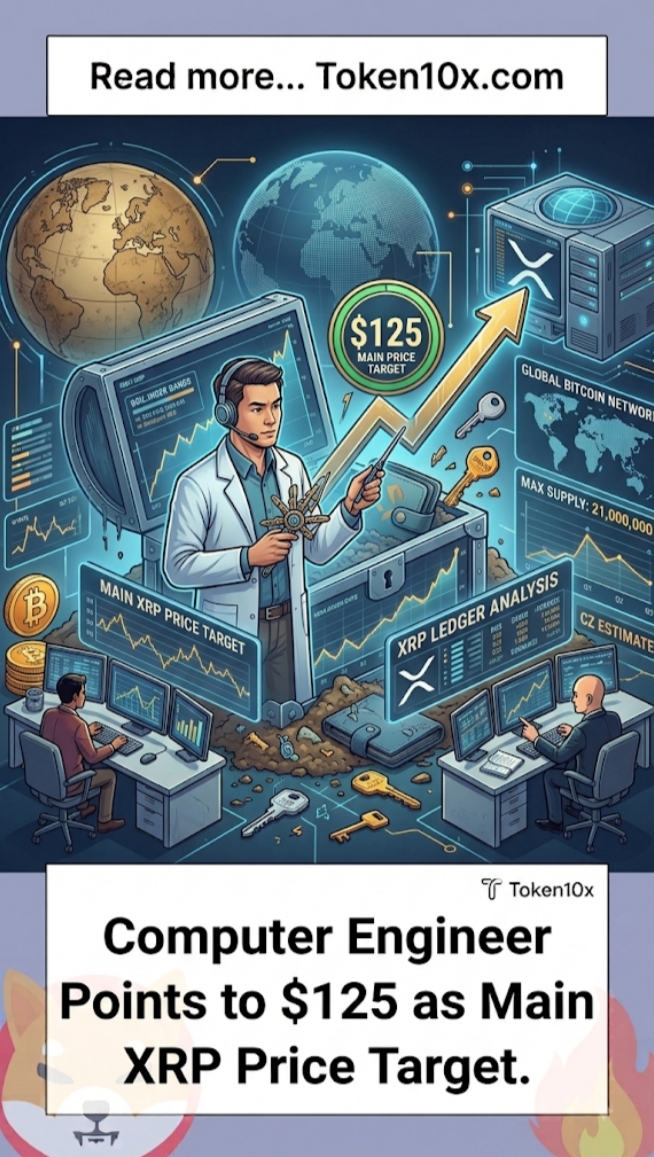
A computer engineer and long-time XRP observer has outlined why $125 stands as his primary long-term price target for the token. The projection rests on XRP’s potential role in global payments and the liquidity required to support large-scale transaction volumes.
The analysis focuses on utility-driven valuation rather than short-term market cycles.
The Drivers of This Activity
The engineer’s reasoning centers on the scale of the foreign-exchange market and XRP’s circulating supply. Global FX trading volumes have historically reached several trillion dollars per day. Dividing a multi-trillion-dollar daily volume by XRP’s circulating supply of roughly 60 billion tokens produces a theoretical per-token value in the region of $125 if the asset were to facilitate a meaningful share of that flow.
Supporters of this view argue that XRP’s design for fast, low-cost cross-border settlement positions it to capture a portion of existing payment corridors currently handled by legacy systems. They emphasize that the target assumes significant real-world adoption, deep liquidity, and sustained institutional usage rather than pure speculation.
The same logic has circulated in the community for several years, with variations depending on the exact FX volume figure and the percentage of market share assumed.
Impact and Broader Context
A $125 valuation would imply a market capitalization measured in the trillions and would require XRP to function as core settlement infrastructure for a substantial slice of global value transfer. Critics note that such outcomes depend on regulatory clarity, bank adoption, competition from other networks and stablecoins, and the actual velocity of tokens rather than simple supply division.
Proponents counter that even partial capture of existing payment volumes could support much higher prices than current levels. The discussion underscores the gap between utility-based models and prevailing market pricing.
Readers should treat extreme long-term targets as speculative scenarios. Price outcomes will ultimately depend on measurable adoption metrics, liquidity depth and broader market conditions over time.
Source: Public XRP utility and volume-based valuation discussions