

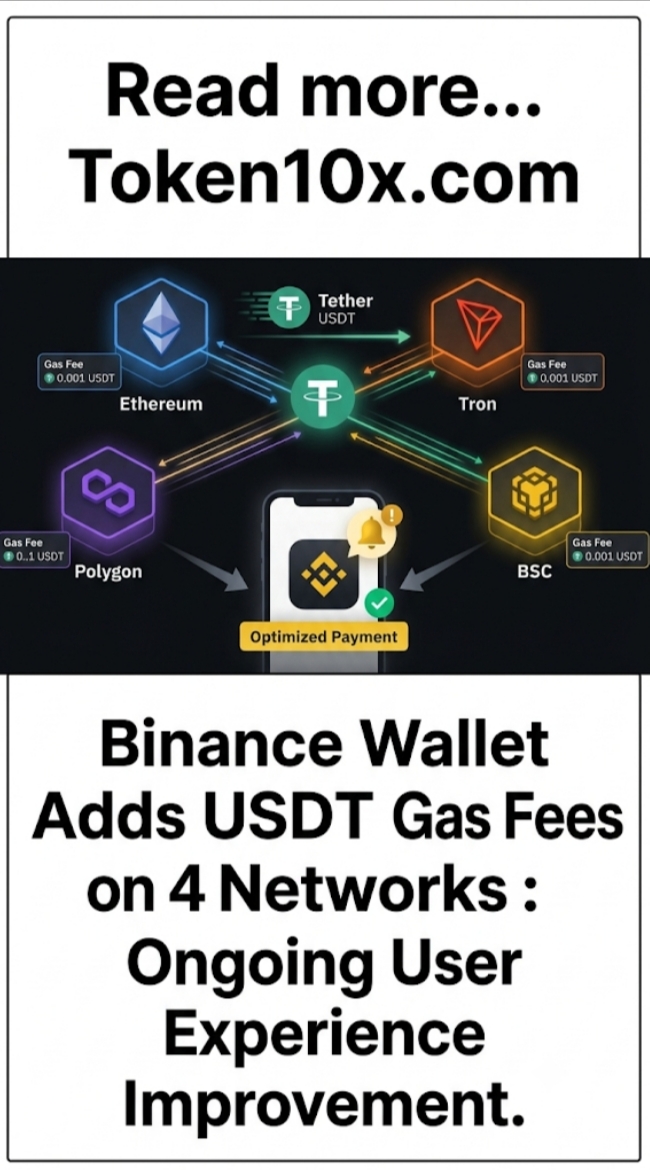
Binance Wallet continues to expand payment options for on-chain transactions, now allowing users to cover gas fees with USDT across multiple major networks. As of the feature rollout around September 25–28, 2026, the self-custody wallet supports USDT as a gas payment method on BNB Smart Chain, Ethereum, Solana, and TRON.
The update still eliminates a common friction point for users who previously needed to hold each network’s native token solely to pay transaction fees. Binance has indicated that additional networks may be added in the future. This comparison underscores the growing role of stablecoins in simplifying everyday blockchain interactions.
The Drivers of the USDT Gas Feature
The key factor remains the desire to reduce operational hurdles for retail and multi-chain users. Instead of requiring separate balances of BNB, ETH, SOL, or TRX for gas, Binance Wallet can deduct the equivalent fee in USDT and handle the underlying native-token payment on the user’s behalf. The feature applies to both USDT transfers and transactions involving other tokens on the supported chains.
This stacks with a time-limited promotion on TRON. From September 23 through December 22, 2026, qualifying TRON transfers through Binance Wallet incur zero gas fees, backed by TRON DAO support. After the promotional period ends, the standard fee for those TRON transactions is set at 1 USDT per transaction. Users may also draw gas payments from certain Binance Exchange balances in some cases. Only the four listed networks currently support the USDT gas option; broader coverage remains on the development roadmap.
It is essential to distinguish: the feature allows users to pay the gas cost in USDT within Binance Wallet, whereas the actual network validators still receive the native-token equivalent. The change is mostly a user-interface and liquidity convenience layer linked to improving accessibility rather than altering underlying blockchain fee mechanisms.
Impact and Broader Context
As Binance Wallet enables USDT gas payments on four major networks, the update advances efforts to make multi-chain activity more seamless. Removing the need to acquire and manage native gas tokens grows accessibility, particularly for users primarily holding stablecoins or assets on high-USDT-volume chains such as TRON and Solana. Market participants and wallet users continue to evaluate the practical fee conversion rates and any future network expansions.
This sustained product improvement fuels discussions on the utility of stablecoins beyond simple transfers, the competitive pressure on wallets to abstract away chain-specific friction, the concentration of USDT liquidity on certain networks, and the broader trend toward gas abstraction solutions. Advocates highlight the reduction in failed transactions and onboarding barriers. Observers note that conversion mechanics and any associated spreads will influence the net cost to users.
Wallet and infrastructure providers emphasize that stablecoin gas options can accelerate mainstream adoption by aligning payment methods with the assets users already hold. The September 2026 rollout offers insight into how a major exchange-affiliated wallet is addressing one of crypto’s persistent usability challenges.
As additional networks are potentially added and usage data emerges, the reach and effectiveness of USDT gas payments will become clearer.
This analysis draws from Binance Wallet documentation and contemporaneous reporting for precision. Feature availability and exact fee conversion details remain subject to the wallet’s current implementation and network conditions.