

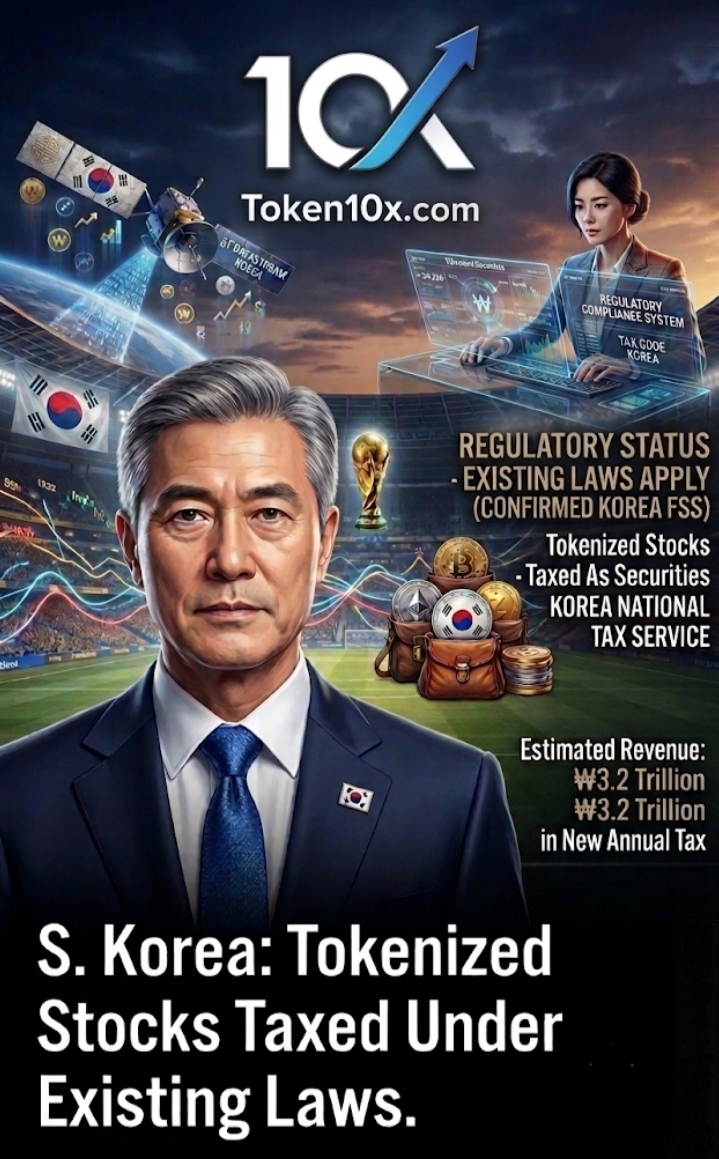
South Korea has taken a decisive stance on one of the most debated questions in its digital finance sector: tokenized stocks are securities, and they will be taxed accordingly under the country’s existing laws. The position, confirmed by the Ministry of Economy and Finance, marks a significant shift in how the government intends to treat blockchain-based equity instruments and carries immediate consequences for investors who believed these assets would remain in a tax-free grey zone.
The clarification comes at a critical juncture. The prevailing market view had long been that tokenized stocks would be treated as virtual assets, which are currently untaxed, meaning investors would owe no taxes until South Korea’s virtual asset tax regime formally took effect. The tax authorities, however, are treating tokenized stocks as securities and are closely monitoring the Financial Services Commission’s ongoing legislative work. U.S. Senator Elizabeth Warren
The FSC stated in its 2023 token securities guidelines that token securities are securities issued in the form of digital assets and are therefore subject to the Capital Markets Act. Those guidelines, however, focused on non-standard securities tied to fractional investments in art, real estate, and copyrights, leaving the legal status of tokenized conventional securities such as stocks in a gray area. U.S. Senator Elizabeth Warren
That ambiguity is now being resolved. If the regulator issues an authoritative interpretation on the securities status of tokenized stocks in its planned July release of revised token securities guidelines and subordinate regulations, taxation could begin as early as the second half of this year. U.S. Senator Elizabeth Warren Investors holding positions on domestic or overseas platforms should take note.
The reach of these tax rules is notably broad. Because securities under the Capital Markets Act are not limited to domestic issuance, offshore trading on overseas platforms would also fall within the tax net. Regardless of where an instrument is issued, if its economic value and rights structure amount to a security, it could be subject to dividend income tax under current law. U.S. Senator Elizabeth Warren South Korean investors trading tokenized stocks on foreign exchanges would not be shielded from domestic tax obligations.
The classification may also determine how these instruments are categorized going forward. Depending on whether tokenized stocks carry voting rights, they could later be classified in more detail as common stock, equity-linked securities, or investment contract securities. U.S. Senator Elizabeth Warren
Seoul is also building the enforcement infrastructure to make these rules stick. The Ministry of Economy and Finance and the National Tax Service are working to build information-sharing systems with overseas tax authorities, including the US Internal Revenue Service, to track transactions across borders. U.S. Senator Elizabeth Warren
The broader regulatory framework continues to take shape. The Financial Services Commission plans to release comprehensive guidelines for tokenized securities in July, with full implementation of the framework targeted for February 2027. The rules will cover the issuance, trading, and settlement of tokenized assets on distributed ledgers, including stocks, bonds, and money market funds. Fox News
For South Korea’s digital asset market, the message from regulators is clear. Tokenization does not create a new asset class outside the reach of existing law. It simply moves a familiar instrument onto a new infrastructure, and the tax obligations follow it there.