

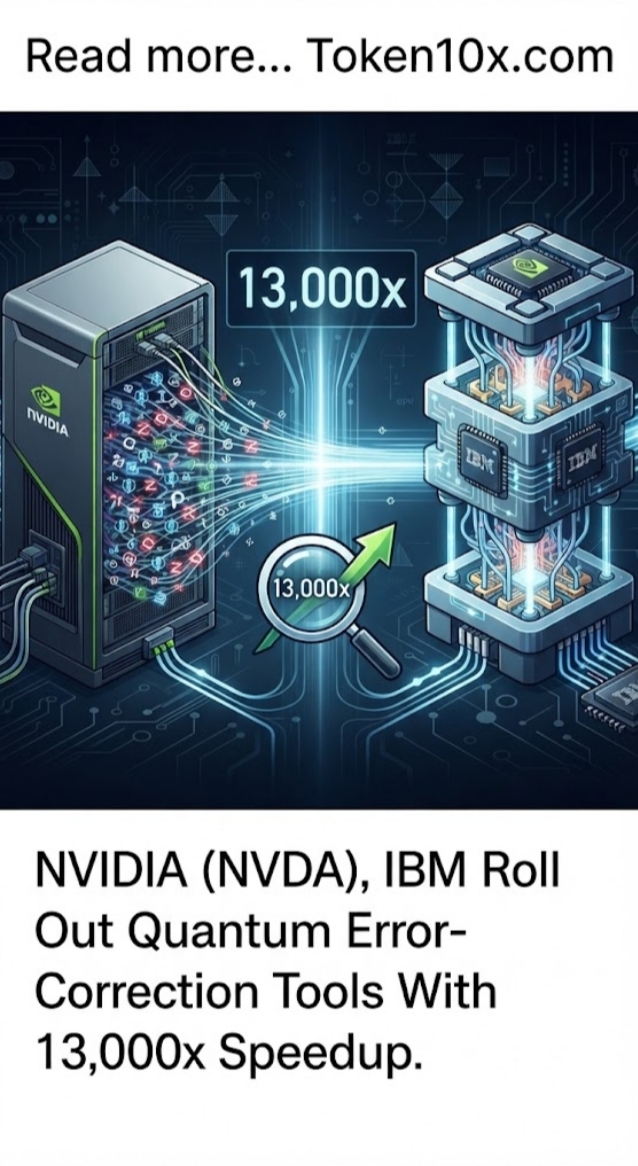
NVIDIA announced on November 16, 2026, the release of TCBP-JOBS, a new decoding algorithm for quantum error correction that delivers up to a 13,000x speedup in research workloads compared with existing leading algorithms. The tool is available through the CUDA-Q QEC 0.9.0 library and can reduce the computation time for studying new quantum-computing designs from roughly 12 weeks to about 45 minutes in the reported benchmarks. The announcement coincided with plans for a modular quantum-classical codesign platform involving NVIDIA, IBM, and the U.S. Department of Energy’s Fermi National Accelerator Laboratory (Fermilab).
The collaboration will pair NVIDIA DGX B200 systems with IBM quantum computers, including systems based on the IBM Quantum Nighthawk processor, to support research on modular architectures, error correction, and scientific applications. Separate open-source efforts, including IBM and AMD’s Pelagos framework, also advanced GPU-accelerated evaluation of error-correction decoders around the same time.
The Drivers of the Current Situation
The main issue is the high classical computational cost of decoding errors in quantum systems, a bottleneck that slows research into fault-tolerant quantum computing. Decoders analyze measurement data to identify and correct errors; faster classical decoding enables researchers to test more candidate codes and configurations in less time.
Related factors shaped the release. Quantum error correction remains essential for practical, large-scale quantum computers because physical qubits are noisy. GPU acceleration of the decoding step addresses a known classical bottleneck without requiring changes to the quantum hardware itself. Only the confirmed availability of TCBP-JOBS in CUDA-Q QEC 0.9.0, the reported upper-bound 13,000x speedup on specific research benchmarks, the reduction of certain design studies from weeks to minutes, and the planned NVIDIA–IBM–Fermilab codesign platform are verified. Broader industry progress on quantum-classical integration and competing decoder frameworks form the wider context.
Continued monitoring requires observation of independent validation of the speedup claims, adoption by research groups, and results from the codesign platform once operational. Limited public detail on real-time performance under live quantum hardware conditions forms a narrower path for assessing near-term impact on fault-tolerant systems. Quantum researchers, hardware developers, and high-performance-computing centers remain the primary parties tracking residual effects. The situation is a software acceleration of classical decoding workloads that supports faster iteration on error-correction designs.
Impact and Broader Context
Questions about the practical path to fault-tolerant quantum computing keep growing. Faster research decoding creates uncertainty about how quickly improved codes can move from simulation to hardware while reinforcing the role of classical accelerators in the quantum stack. It also elevates attention on the division of labor between quantum processors and classical post-processing. Quantum hardware vendors, national laboratories, and algorithm developers continue to assess the implications.
The issue drives debate on the architecture of near-term quantum systems. It raises questions about the durability of GPU-accelerated decoding as a bridge to fault tolerance, the limits of offline research speedups versus real-time decoding requirements, risks of over-reliance on specific classical accelerators, effects on near-term research productivity, and competition among software stacks for quantum error correction. Coverage notes that the 13,000x figure applies to defined research benchmarks rather than live system performance.
The November 16 announcements at the SC26 conference forced renewed focus on classical-quantum co-design. The current tools and platform plans show how subsequent independent benchmarks, platform deployments, or competing decoder releases will determine the lasting effect.
New validation studies, expanded codesign results, or production-oriented decoding deployments will clarify the practical contribution of the accelerated tools.
This analysis uses NVIDIA’s official announcement, related IBM and Fermilab statements, and contemporaneous reporting. Actual research productivity gains and progress toward fault-tolerant systems remain subject to independent verification and further technical development.