

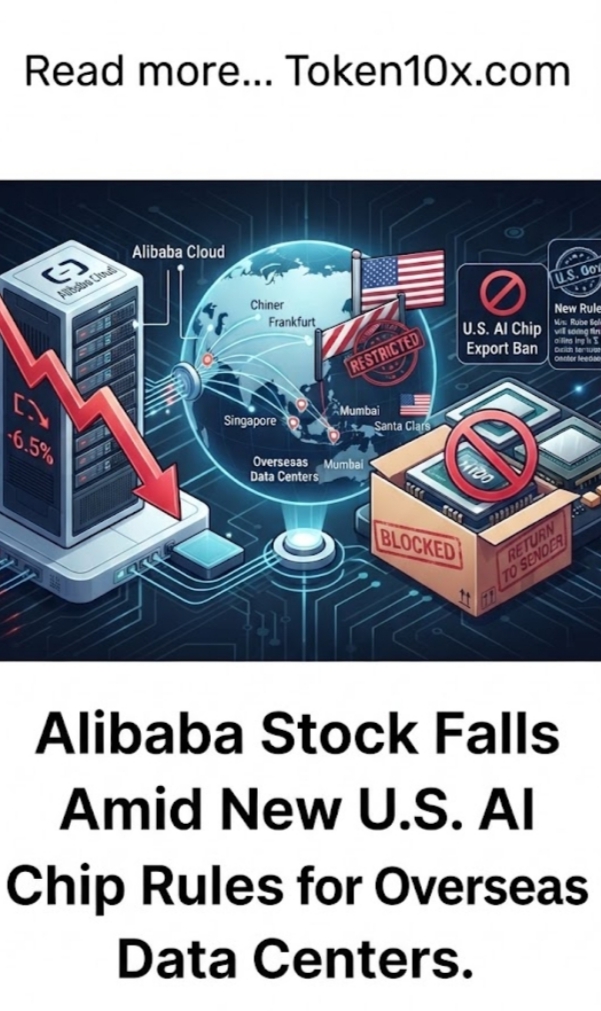
Alibaba Group Holding Ltd. shares fell about 5% in Hong Kong trading on November 17, 2026, after the United States issued new rules restricting advanced AI chip exports to data centers in several countries, including Singapore, Malaysia, Thailand, Indonesia and Brazil. The measures require licenses for shipments of high-end chips to those locations and impose additional requirements on overseas facilities that supply significant computing power to China-headquartered companies. The rules aim to close a loophole that had allowed Chinese firms to rent advanced U.S. chips, such as Nvidia processors, through foreign data centers rather than importing them directly.
Other Chinese AI and tech stocks also declined, with Baidu dropping more than 5% and model developers such as MiniMax and Z.AI falling similarly. Domestic Chinese chipmakers, by contrast, saw gains as investors anticipated accelerated self-reliance efforts. Southeast Asian data-center operators linked to the AI build-out also faced share-price pressure.
The Drivers of the Current Situation
The main issue is the U.S. decision to extend export controls beyond direct sales into China and target remote access to advanced compute via third-country data centers. Chinese hyperscalers and AI labs had used overseas facilities, including in Singapore, to obtain Nvidia and similar chips otherwise restricted for domestic use.
Related factors shaped the market reaction. Alibaba has been identified as a significant customer of certain Singapore-based providers of remote compute capacity. The new licensing requirements raise costs and uncertainty for Chinese cloud and model-training operations that relied on those routes. Only the confirmed issuance of the rules covering multiple Southeast Asian countries and Brazil, the roughly 5% drop in Alibaba shares, parallel declines in other Chinese AI names, and gains in some domestic semiconductor firms are verified. Broader U.S.–China technology competition and earlier chip export controls formed the backdrop.
Continued monitoring requires observation of how strictly the licensing regime is applied, any exemptions granted, and the impact on Alibaba’s upcoming earnings. Limited immediate detail on the volume of affected compute capacity forms a narrower path for assessing operational disruption. Chinese tech firms, Southeast Asian data-center operators, and U.S. policymakers remain the primary parties tracking residual effects. The situation is a tightening of export controls that closes an offshore access channel for advanced AI chips.
Impact and Broader Context
Questions about the resilience of China’s AI compute supply keep growing. The rules create uncertainty about near-term training capacity and cloud growth for companies such as Alibaba while reinforcing the U.S. focus on limiting China’s access to frontier hardware. It also elevates attention on the role of third-country data centers in global AI infrastructure. Investors, cloud providers, and semiconductor suppliers continue to assess the implications.
The issue drives debate on the effectiveness of layered export controls. It raises questions about the durability of overseas compute workarounds, the limits of enforcement across multiple jurisdictions, risks of accelerated Chinese domestic chip development, effects on near-term valuations of Chinese AI stocks, and competition among Southeast Asian nations for remaining unrestricted AI infrastructure investment. Coverage notes that domestic Chinese foundries benefited in the session as relative winners.
The November 17 market moves forced renewed focus on U.S. chip policy and Chinese tech exposure. The current sell-off shows how subsequent licensing decisions, earnings guidance, or further rule clarifications will determine the lasting effect.
New guidance from the Commerce Department, Alibaba’s next results, or shifts in Southeast Asian data-center investment will clarify the practical contribution of the expanded controls.
This analysis uses contemporaneous market reports and coverage of the U.S. Commerce Department rules. Actual operational impacts and longer-term market adjustments remain subject to implementation details and company responses.