

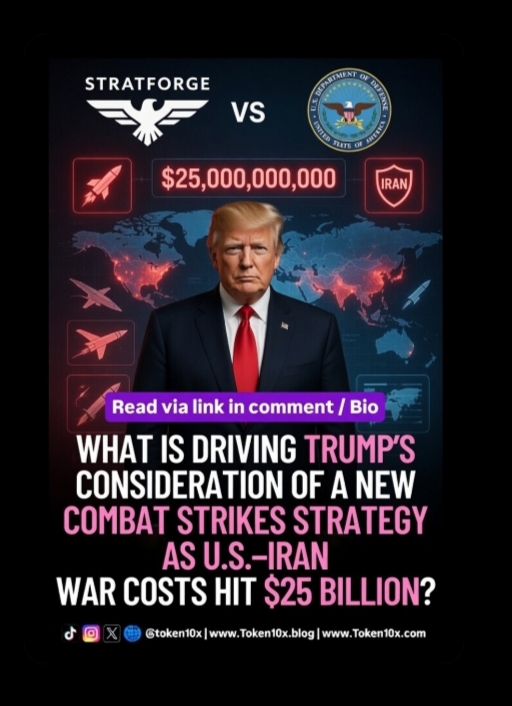
President Donald Trump is reportedly considering a revised combat strikes strategy as the financial and geopolitical costs of the ongoing U.S.–Iran war surge past $25 billion, according to Pentagon disclosures and congressional testimony. The shift in strategy comes amid mounting pressure from lawmakers, rising operational expenses, and evolving battlefield dynamics that have challenged initial expectations of a short, decisive campaign.
At the core of this development is the rapidly escalating cost of the war. Pentagon officials confirmed that U.S. military operations have already consumed approximately $25 billion, with the majority of spending attributed to munitions, aircraft operations, troop deployments, and equipment losses. This figure represents the first official estimate and is expected to rise significantly as the conflict continues and reconstruction costs are factored in.
Trump’s consideration of a new combat strategy is largely driven by the need to balance military effectiveness with cost efficiency. Early phases of the war relied heavily on high-intensity airstrikes and naval operations, but analysts note that these tactics are expensive and difficult to sustain over prolonged periods. Reports indicate that alternative strategies—potentially involving more targeted strikes, expanded use of drone warfare, or economic warfare through blockades—are being evaluated to maintain pressure on Iran while reducing operational costs.
The broader geopolitical situation is also influencing strategic recalibration. The conflict has triggered major disruptions in global energy markets, particularly through tensions in the Strait of Hormuz, a critical oil transit chokepoint. These disruptions have contributed to rising fuel prices and inflationary pressures worldwide, intensifying domestic political scrutiny of the war’s economic impact.
Domestically, the rising cost and unclear endgame have sparked bipartisan concern in Congress. Lawmakers have questioned the administration’s long-term objectives, lack of a clear exit strategy, and the absence of formal congressional authorization for the conflict. Defense officials, however, continue to defend the campaign as necessary to prevent Iran from acquiring nuclear capabilities and to maintain U.S. strategic dominance in the region.
Military realities on the ground are another key factor. Despite early claims of success, the conflict has evolved into a more complex and prolonged engagement than initially anticipated. Iran’s retaliatory actions, including regional strikes and disruptions to U.S. infrastructure, have increased operational risks and costs. Internal estimates suggest the true financial burden could eventually reach $40–50 billion when broader damage and reconstruction are included.
Additionally, Trump has emphasized alternative pressure tactics such as naval blockades and economic strangulation, arguing these measures may be more effective than continuous large-scale bombing campaigns. This signals a potential strategic pivot toward hybrid warfare—combining military, economic, and psychological pressure.
This development aligns with historical patterns of mid-conflict strategic reassessment, where rising costs, shifting battlefield conditions, and political pressure force governments to adapt their military approach. Investors and analysts are closely watching how these changes could impact defense spending, oil markets, and global risk sentiment.
Explore the latest geopolitical market analysis, macro war impacts, and high-conviction trading opportunities: www.Token10x.com
Read our full breakdown of the U.S.–Iran war strategy shift and macro implications: Trump Iran War Strategy Analysis at Token10x.blog
Several Factors Are Reinforcing This Story Right Now
Several factors are reinforcing this story right now. The $25 billion cost milestone highlights the accelerating financial burden of modern warfare, while ongoing geopolitical tensions and energy market disruptions amplify its global impact. Rising inflation, political scrutiny, and uncertainty around military objectives are intensifying pressure on policymakers. Historical parallels with prolonged conflicts show that cost overruns and strategic pivots often occur simultaneously, signaling a critical inflection point in the war’s trajectory.
Random Investment Trading Secrets for Higher Yields
Here are powerful, battle-tested strategies for navigating macro-driven volatility:
- Secret #1 – War Volatility Trader: Trade commodities like oil during conflict escalation phases.
- Secret #2 – Defense Sector Rotation: Allocate capital into defense stocks during prolonged conflicts.
- Secret #3 – Macro Sentiment Tracker: Follow geopolitical headlines to anticipate market moves.
- Secret #4 – Risk Hedging Strategy: Balance exposure across crypto, commodities, and equities.
Live Top 20 Cryptocurrencies by Market Cap (Updated: April 30, 2026 ~16:20 UTC)
| Rank | Crypto | Price (USD) | Market Cap |
|---|---|---|---|
| 1 | BTC | $75,900 | $1.52T |
| 2 | ETH | $2,275 | $275B |
| 3 | USDT | $1.00 | $189B |
| 4 | XRP | $1.40 | $86B |
| 5 | BNB | $628 | $87B |
| 6 | SOL | $88 | $50B |
| 7 | USDC | $1.00 | $78B |
| 8 | DOGE | $0.096 | $16B |
| 9 | TRX | $0.332 | $31B |
| 10 | ADA | $0.258 | $9.3B |
| 11 | AVAX | $9.50 | $4.2B |
| 12 | SHIB | $0.000029 | $16B |
| 13 | LINK | $19.30 | $12.3B |
| 14 | BCH | $518 | $10.1B |
| 15 | DOT | $7.08 | $10.3B |
| 16 | LEO | $9.80 | $9B |
| 17 | NEAR | $1.37 | $1.76B |
| 18 | UNI | $3.28 | $2.48B |
| 19 | LTC | $77.20 | $5.1B |
| 20 | TON | $1.36 | $3.3B |
Last Updated: April 30, 2026 ~16:20 UTC
Trading Tips for 1000x Profits
Want to position yourself for massive gains in macro-driven markets?
- Follow geopolitical capital flows
- Buy during uncertainty spikes
- Combine macro + on-chain data
- Diversify across sectors
- Manage downside risk aggressively
Read News from previous week from www.Token10x.blog
- Cloudflare, ServiceNow, and Guardant Health were among the top 10 large-cap losers last week
- Lockheed Martin Nails Historic Orion Splashdown With NASA, Paving Way for Moon Return
- US-Iran Talks Fail After 21 Hours, With Vance Calling It ‘Bad News for Iran’
- Nvidia’s CEO Encourages California Relocation Despite Billionaires’ Plans to Flee the State’s Proposed Wealth Tax
- Trump Warns China of ‘Big Problems’ Over a Reported Plan to Supply Iran with Anti-Air Missiles
- US Official Rejects Iranian Media Report Claiming It Agreed to Unfreeze Iranian Assets
- Michael Saylor’s Strategy May Surpass BlackRock’s BTC Holdings in Weeks
- Disney Announces Plan to Cut Nearly 1000 Jobs Under New CEO
- Binance April Delisting: Six Cryptocurrencies in Pipeline
Positive sentiment is emerging around defense sector growth, commodities volatility, and macro trading opportunities as the war evolves. Strategic shifts like reduced-cost strike methods or hybrid warfare approaches could reshape both geopolitical dynamics and financial markets.
Want a breakdown of war strategy shifts and market positioning? Watch this:
Trump Iran War Strategy & Market Impact Analysis
🚀 Full analysis + exclusive high-conviction ideas at www.Token10x.com
Daily guides, free resources & deep dives → www.Token10x.blog
Join for Exclusive Alpha & Free Training
Join WhatsApp channel + group for free trading education → Click Here
🚨 Missing gains? Follow @token10x on TikTok → Click Here
Secret plays daily on Instagram! Follow @token10x → Click Here
Explosive strategies & live trades on YouTube! Subscribe @Token10x → Click Here
Live signals in Discord! Join @token10x server → Click Here
Disclaimer: This article is for informational purposes only and not financial advice. Always do your own research before investing.