

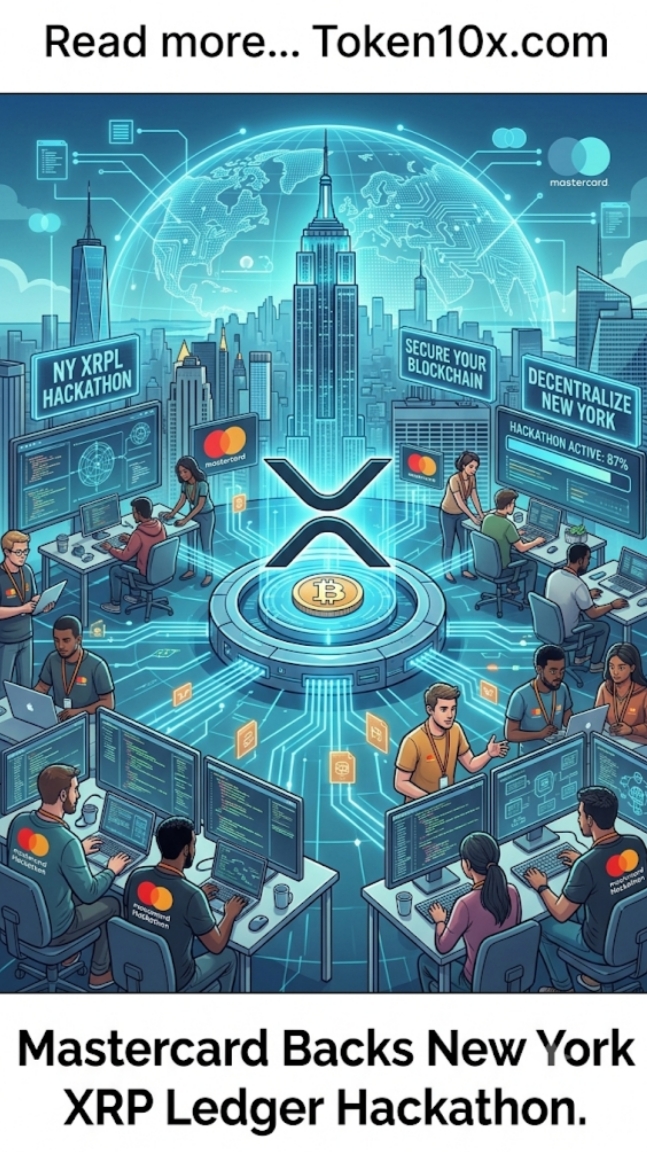
Mastercard will sponsor a 36-hour XRP Ledger hackathon in New York scheduled for October 24–25, 2026. XRPL Commons announced the sponsorship on August 26, positioning the payments giant alongside developers building on the network just before Ripple’s Swell conference.
The event features four tracks—protocol innovation, agentic finance, lending and borrowing, and an open category—aimed at advancing applications in payments, stablecoins, AI-driven transactions, and on-chain credit. It reflects growing institutional interest in the XRP Ledger as a potential settlement layer.
The Drivers of This Development
Mastercard’s involvement is driven by its broader exploration of blockchain-based payments and regulated stablecoin settlement, including support for RLUSD across the XRP Ledger and other networks. The company has also examined RLUSD use in credit-card settlement scenarios with partners such as Gemini. Hosting the hackathon allows Mastercard to engage directly with developers working on agentic finance (autonomous AI agents handling transactions) and emerging lending protocols, areas aligned with its interest in programmable and machine-to-machine payments. For perspective, traditional payment networks increasingly view public ledgers as complementary rails rather than pure competitors when compliance and settlement efficiency improve.
It is important to note the fundamental difference between simple event sponsorship and deeper commercial integration: the current commitment confirms participation in the developer gathering but does not announce a new Mastercard product or production deployment on the XRP Ledger itself.
Impact and Broader Context
The sponsorship raises the profile of the XRP Ledger within institutional circles and may help promising hackathon projects gain visibility among payments executives, investors, and financial institutions attending the surrounding Swell events. It could accelerate experimentation in AI payments and on-chain lending while signaling continued traditional-finance openness toward select blockchain infrastructures.
This development sparks important discussions about the pace and depth of traditional finance engagement with public ledgers. Supporters view the move as validation of the XRP Ledger’s utility for real-world finance and a practical bridge between established payment networks and emerging decentralized tools. Critics caution that sponsorship alone does not guarantee lasting adoption or resolve outstanding regulatory and scalability questions. Analysts observe that such corporate participation often functions as ecosystem signaling—encouraging developer activity and talent inflow—while actual product integrations typically follow only after further technical and compliance validation.
Looking ahead, the October hackathon and subsequent Swell conference will offer clearer signals on which projects attract follow-on interest from Mastercard and other institutions. This analysis is based on announcements from XRPL Commons and related industry reporting for accuracy and reliability. Specific outcomes and any future commercial steps remain subject to ongoing developments.