

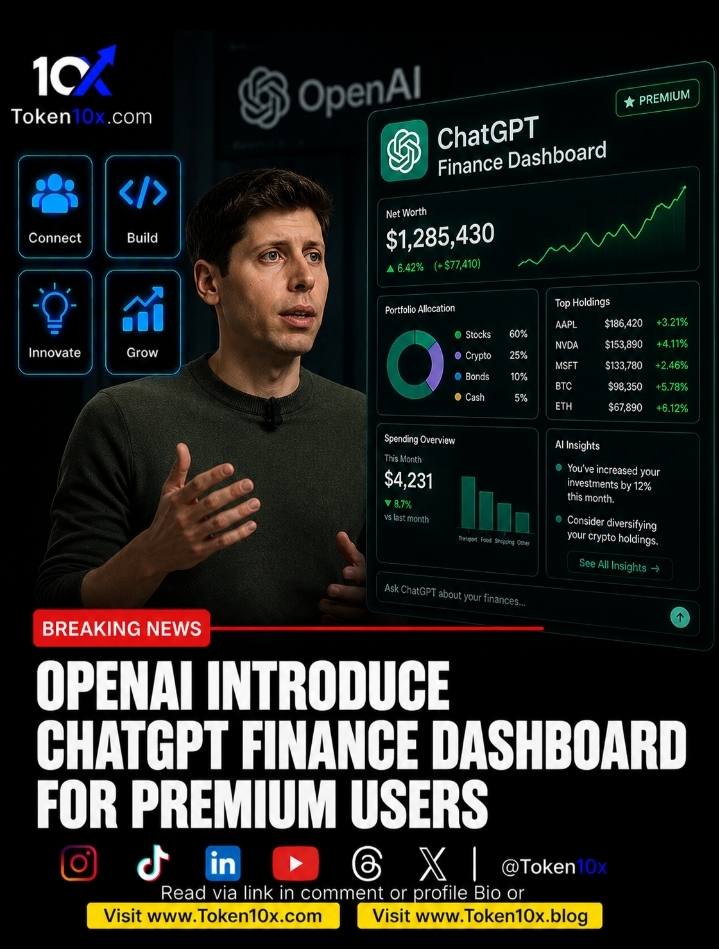
A quiet but powerful shift. OpenAI has begun rolling out a dedicated Finance Dashboard for ChatGPT Premium users (ChatGPT Plus, Team, and Enterprise), marking the company’s most direct move yet into personal and small-business financial management.
The dashboard, which appeared for select users over the weekend and is expected to reach all premium subscribers by June 2026, allows ChatGPT to analyze uploaded bank statements, track spending categories, flag unusual transactions, and generate basic budget forecasts. Unlike generic financial chatbots, OpenAI’s version operates within a privacy-shielded environment where user data is not used for model training.
“People have been using ChatGPT for financial advice unofficially for two years,” said an OpenAI product manager in a limited release statement. “We decided to build something official, safe, and actually useful—not a replacement for a fiduciary, but a serious assistant for everyday money decisions.”
What the Dashboard Actually Does
The Finance Dashboard adds four core capabilities to ChatGPT Premium:
· Automated transaction categorization – Upload a CSV or PDF statement, and ChatGPT sorts every line item into IRS-style categories (travel, utilities, dining, subscriptions, etc.)
· Spending pattern alerts – The system learns your baseline spending and flags deviations, such as a sudden 40% rise in grocery expenses or a forgotten subscription renewal
· Natural language budget queries – You can ask “What did I spend on ride-sharing last quarter?” or “Show me my three largest discretionary expenses this month” and receive instant answers
· Forecasting scenarios – Type “If I cut dining out by 30%, when can I save $5,000 for a vacation?” and the dashboard builds a projection based on your actual historical data
Notably, the dashboard does not connect directly to bank APIs. Users must manually upload statements, a deliberate design choice that OpenAI says prioritizes security over convenience.
Why This Matters for Crypto Users
For cryptocurrency holders, the Finance Dashboard offers one particularly useful feature: it recognizes and categorizes crypto exchange transactions from major platforms including Coinbase, Binance, Kraken, and Gemini. Transfers to self-custody of digital assets appear as “wallet outflow” events, while realized gains from trades are flagged for tax tracking.
This is significant because most mainstream finance tools still mishandle crypto data. The ChatGPT dashboard, by contrast, treats crypto exchange activity as normal financial behavior rather than an exotic edge case.
Privacy and Security Trade-Offs
OpenAI has made several unusual promises regarding the Finance Dashboard:
Feature What OpenAI Promises
Data retention User-deleted after 90 days unless saved
Model training Financial data never used to train models
Encryption AES-256 at rest, TLS 1.3 in transit
Human access No OpenAI employee can view your dashboard data
However, privacy advocates note a tension: to provide accurate forecasting, ChatGPT must retain and analyze sensitive information. A misconfigured account or internal breach could expose spending habits, income details, and even debt levels.
OpenAI counters that the dashboard operates under the same security protocols as its healthcare pilot with Hippocratic AI, which has processed over 100,000 patient interactions without a confirmed data breach.
The Regulatory Backdrop
The dashboard arrives as financial regulators worldwide debate how to govern AI-driven financial advice. In the United States, the bipartisan crypto market structure bill includes language that would require AI financial tools to disclose when they are not acting as fiduciaries—a standard OpenAI meets with prominent disclaimers.
In the European Union, the dashboard has been delayed pending review under the EU AI Act’s “high-risk” classification for financial services. OpenAI is reportedly negotiating a risk management certification that would allow a mid-2026 EU launch.
What It Costs and Who Gets It
The Finance Dashboard is included at no additional charge for existing ChatGPT Premium subscribers:
· ChatGPT Plus – $20/month (dashboard access with 10 statement uploads per month)
· ChatGPT Team – $25–$30 per user/month (unlimited uploads, team budget sharing)
· ChatGPT Enterprise – Custom pricing (API access, custom category rules, audit logs)
Free tier users do not receive dashboard access. OpenAI has not announced plans to change this, suggesting the computing cost of analyzing financial data remains too high for unpaid accounts.
Early User Reactions
Early testers have reported mixed results. The categorization engine is reportedly accurate for standard expenses like rent, utilities, and groceries. However, it struggles with split transactions (e.g., a single $200 Target purchase that includes groceries, clothing, and household supplies) and occasionally mislabels crypto transfers as “gambling” or “gifts.”
One small business owner testing the dashboard told a tech blogger: “It caught a $49/month software subscription I forgot about for two years. That alone paid for my Plus subscription for six months. But it also told me my mortgage payment was ‘dining’ once, so you still need to double-check its work.”
The Competition
OpenAI is entering a crowded field. Dedicated tools like Monarch Money, YNAB, and Copilot already offer similar categorization and forecasting. However, those tools require separate subscriptions ($8–$15/month) and lack ChatGPT’s conversational interface. By bundling finance tools into an existing $20/month product, OpenAI is betting that convenience outweighs specialized features.
Potential Risks and Limitations
Users should be aware of three important limits:
- Not a financial advisor – The dashboard cannot recommend specific investments, tax strategies, or retirement plans. OpenAI explicitly disclaims any fiduciary duty.
- No real-time data – Because the dashboard relies on manual uploads, it cannot alert you to fraud as it happens. For that, you still need bank alerts or credit monitoring.
- Institutional skepticism – Some banks’ terms of service prohibit uploading statements to third-party AI tools. Users should review their agreements.
In extreme cases, if a user uploads statements connected to illegal activity, law enforcement could potentially seek access through court-ordered asset freezes or similar legal processes targeting OpenAI. The company says it complies with valid legal requests but has not yet faced a test case involving financial dashboard data.
The Bottom Line
OpenAI’s Finance Dashboard is not a revolution—yet. It is a thoughtful, cautious entry into a market that desperately needs better tools for normal people who find spreadsheets tedious and professional software expensive. For ChatGPT’s 10 million-plus premium users, it adds real value at no extra cost. For everyone else, it signals where AI assistants are headed: not just answering questions, but actively helping manage the boring, critical details of everyday life.