

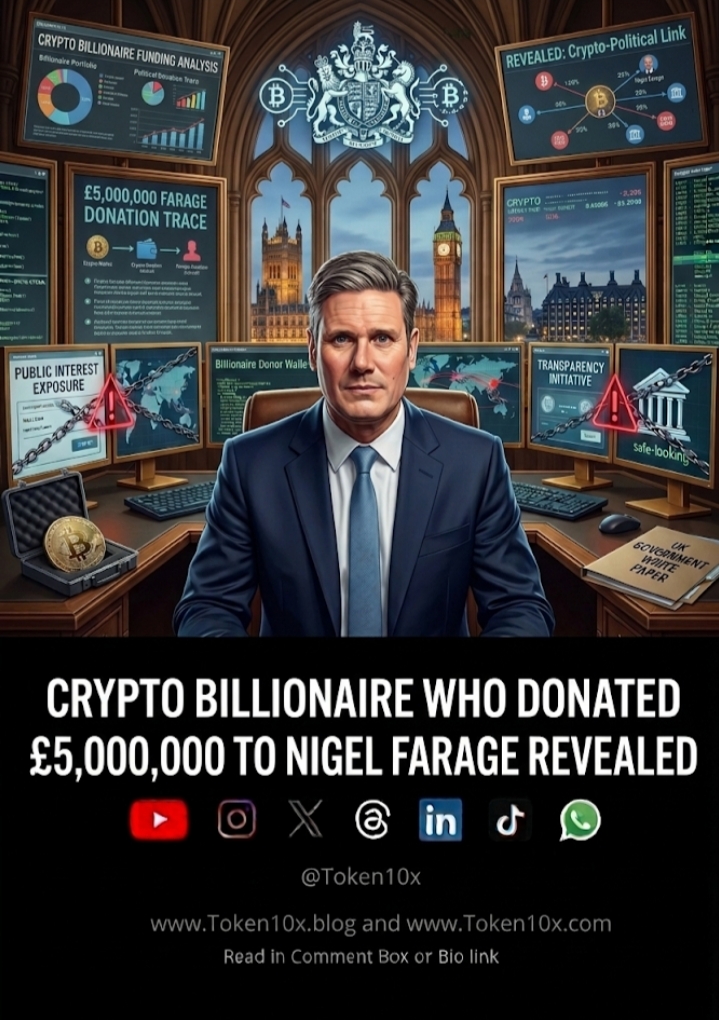
A bombshell disclosure. After months of speculation and legal battles, the identity of the cryptocurrency billionaire who donated £5,000,000 to Nigel Farage’s political movement has been uncovered by investigative journalists.
The donor is Christopher Harborne, a 78-year-old British-born Thai-based aviation fuel entrepreneur and early Bitcoin adopter. Harborne, who made his fortune through his company AML Global, has been quietly accumulating cryptocurrency since 2013 and now holds an estimated £1.2 billion in digital assets.
The £5 million donation, processed through a series of crypto transfers in late 2024, was initially hidden behind a shell company registered in the British Virgin Islands. A recent ruling by the UK’s Electoral Commission forced the disclosure after a six-month freedom of information battle.
Why the Secrecy Mattered
Harborne’s identity matters because he is not a typical political donor. He holds significant business interests in Thailand, Singapore, and the United Arab Emirates—jurisdictions that have no extradition treaties with the European Union on certain financial matters.
“The question isn’t whether the donation was legal,” said a former Electoral Commission official who spoke on condition of anonymity. “The question is whether UK voters had a right to know who was funding a major political figure before the last general election. They didn’t. And that’s a problem.”
Nigel Farage has defended the donation, calling Harborne “a patriotic British businessman who believes in sovereignty, free markets, and controlled borders.” Farage’s spokesperson added that all donations were declared properly under the rules that existed at the time.
Who Is Christopher Harborne?
Harborne’s path to crypto wealth is unconventional. He sold his aviation fueling business in 2018 for a reported £380 million, then immediately converted 70% of the proceeds into Bitcoin and Ethereum. That decision, made when Bitcoin was trading near $6,000, has since multiplied in value by nearly seven times.
Beyond crypto, Harborne owns a chain of luxury hotels in Southeast Asia and holds a minority stake in a Thai Premier League football club. He has never held elected office and has made only three political donations in his life—all to Brexit-supporting candidates.
The Regulatory Gray Area
The donation has reignited debates about bipartisan crypto market structure bill style regulations, though in a UK context. Currently, crypto assets are treated as property under UK law, not as money or securities. This distinction means crypto donations face looser disclosure requirements than cash or stock donations.
Labour MPs have called for an urgent review, arguing that anonymous crypto wallets could allow foreign actors to funnel undisclosed sums into British politics. Harborne’s donation was traced, but critics warn that smaller untraceable donations using privacy coins like Monero would evade detection entirely.
How the Donation Was Structured
According to the leaked documents, Harborne’s team used a multi-step process:
- Conversion of Bitcoin to USDC on a decentralized exchange
- Transfer of USDC to a UK-registered company he controlled
- Cash conversion through a licensed crypto off-ramp
- A standard bank transfer to Farage’s political party account
Each step complied with existing anti-money laundering rules. However, the use of an intermediary shell company meant Harborne’s name never appeared on any disclosure form until a journalist traced the company’s ultimate beneficial owner through a corporate registry in the Cayman Islands.
The Self-Custody Question
Harborne reportedly controls his crypto fortune using self-custody of digital assets across multiple hardware wallets. This level of control is precisely what privacy advocates celebrate—but what transparency advocates fear.
When a person holds £1.2 billion in crypto that no bank, government, or exchange can freeze or monitor, political donations become nearly impossible to trace until someone voluntarily discloses them. Harborne did not voluntarily disclose. He was outed by investigative reporting.
What Happens Next
The UK’s Electoral Commission has announced it will review whether existing disclosure rules are adequate for crypto donations. Separately, the Conservative Party has signaled it may introduce a “Crypto Donor Transparency Act” requiring any political donation over £500 converted from crypto to be reported with the original wallet address.
Farage has called the proposed crackdown “anti-British and anti-freedom,” arguing that Harborne followed every rule and should be praised, not punished. Meanwhile, Harborne himself has not commented publicly, though a spokesperson said he “stands by his support for Farage and for Britain’s future outside EU regulatory overreach.”
The Broader Pattern
This is not an isolated incident. Across the United States and Europe, crypto billionaires have become major political donors—often through layered corporate structures that delay disclosure by months or years. In some cases, court-ordered asset freezes have been used to trace frozen funds in fraud cases, but political donations occupy a legal gray zone that courts have been reluctant to enter.
For now, Harborne’s identity is public. But the larger question remains: how many other crypto billionaires are funding politicians quietly, and will voters ever know before they cast their ballots?
The Bottom Line
The revelation that Christopher Harborne gave £5 million to Nigel Farage changes little for the donor or the recipient. Farage keeps the money. Harborne keeps his privacy—what’s left of it. But for UK election law, it’s a warning shot. Crypto is not going away. And neither is the question of who really pays for British politics.