

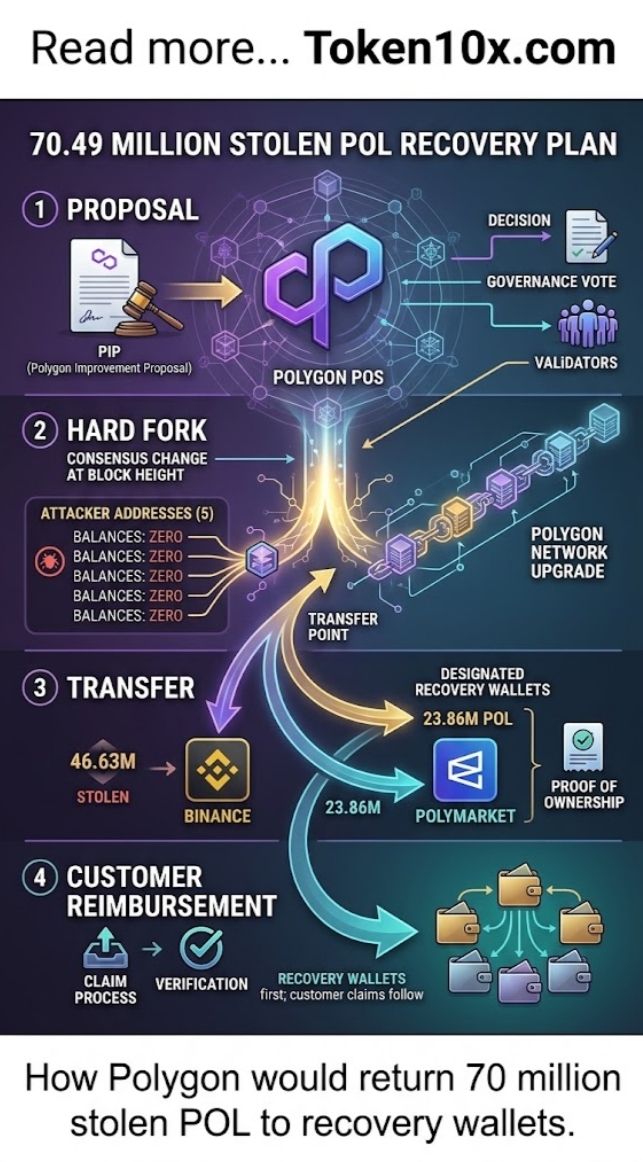
A Polygon Improvement Proposal posted on the governance forum on November 4, 2026, seeks a coordinated hard fork of the Polygon PoS network to recover approximately 70.49 million POL (valued at roughly $6.5–$7 million) held in five attacker-controlled addresses. The tokens stem from separate security incidents involving Polymarket and Binance in late October 2026: about 23.86 million POL across four addresses linked to Polymarket and about 46.63 million POL in one address linked to Binance.
Polygon block producers had already added the addresses to a transaction block list, freezing the funds but leaving them inaccessible for return. Under the proposal, at a predetermined activation block the native POL balances of the listed addresses would be set to zero and the identical amounts credited to verified recovery wallets designated by the affected parties (Polymarket at 0x3dcE0a29139A851Da1dFCa56Af8e8a6440b4D952 and Binance at 0xd9fd39103674cb061d64d9c3b73b878dbe610b80). Total POL supply would remain unchanged. Both companies must first prove control of their recovery addresses and provide written confirmation of ownership. Other tokens, such as already-frozen USDT, fall outside the scope of the fork.
The Drivers of the Current Situation
The central issue is a governance proposal for a one-time hard-fork balance adjustment that would transfer frozen stolen POL from five blocked attacker addresses to recovery wallets controlled by Polymarket and Binance. Confirmed elements include the November 4 proposal, the approximate 70.49 million POL total split between the two incidents, the existing block-list freeze that prevents further movement but does not enable recovery, the planned zeroing of attacker balances and corresponding credit to verified recovery addresses, the requirement for ownership proof from the companies, the unchanged total supply, and the need for validator approval, testing, and a still-undecided activation block. The measure is presented as an exceptional recovery step rather than a routine upgrade.
Further discussion at governance calls, validator signaling, testnet validation, or formal activation details will determine whether and when the fork proceeds.
Impact and Broader Context
The proposal highlights the tension between immutability and practical recovery of stolen native tokens on a proof-of-stake network. It raises questions about the precedent of ledger-level balance reassignments, the role of validators and governance in intervening after security incidents, the distinction between freezing addresses and actively returning funds, the verification process required from affected platforms, potential effects on perceptions of network neutrality, and the limits of block-list measures when permanent recovery is sought. Coverage notes that the change would reassign existing balances without minting or burning tokens and would leave other network components (such as bridges and staking contracts) untouched.
Subsequent community feedback, engineering confirmation, or any approved client release and activation schedule will clarify the path forward.
This analysis draws from the November 4 Polygon governance proposal, related forum details, and contemporaneous reporting. Whether the hard fork receives sufficient support, the precise activation parameters, and the successful transfer of the recovered POL remain subject to governance processes, technical validation, and confirmation of recovery-address ownership.