

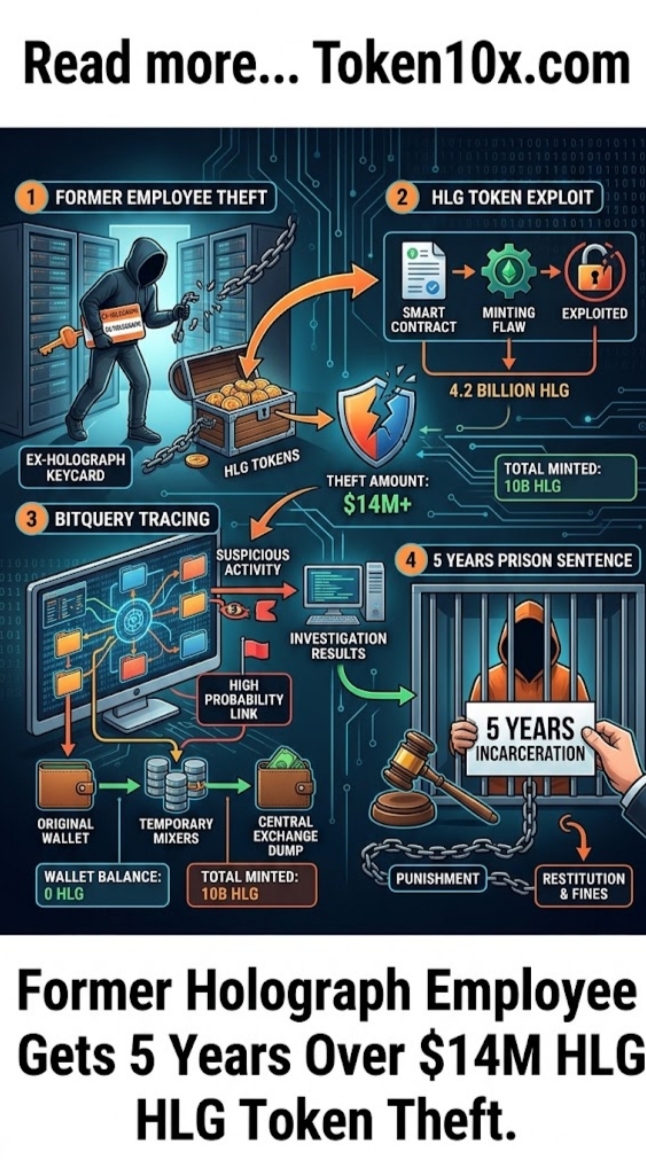
A Paris criminal court sentenced former Holograph Foundation employee Vitaliy K., a Ukrainian national who lived in France, to five years in prison on November 6, 2026, over the illegal minting and theft of 1 billion HLG tokens. Two years of the term must be served; the remaining three are suspended. The court also imposed a €600,000 fine. The tokens were valued at approximately $14 million (€12.5 million) at the time of the offense. Two accomplices received lighter sentences and fines for helping move the assets through exchange accounts. As of the ruling, the foundation’s claim for compensation tied to the subsequent price collapse of HLG was rejected.
The conviction covers unauthorized access to an automated data-processing system, organized fraud, money laundering, and membership in a criminal association. The defendant had been arrested in Italy in September 2024 and extradited to France. No network-level protocol upgrade was required to address the underlying access controls that were abused.
The Drivers of the Current Situation
The main issue is insider abuse of token-minting privileges at the Holograph Foundation. Between May and August 2024 the defendant modified the rules governing HLG issuance, generated 1 billion unauthorized tokens, transferred them into a wallet under his control, and, with two accomplices, dispersed the proceeds across multiple cryptocurrency-exchange accounts. Prosecutors valued the tokens at roughly $14 million when they were created.
Related factors shaped the outcome. The court treated the episode as organized fraud and system interference rather than a smart-contract exploit. Accomplices received two-year terms (one partially suspended with an €80,000 fine; the other fully suspended with a €40,000 fine). Holograph sought damages linked to the token’s price decline—from nearly $0.03 in May 2024 to about $0.001 by year-end—but judges found insufficient evidence of a direct causal connection, noting that HLG had already been falling. The foundation’s counsel told the court that operations had stalled and liquidation was under consideration. Only the November 6 verdict, the sentence structure, the fine amounts, and the rejection of the price-decline claim are confirmed. Broader concerns about insider risk in token-issuance systems and the difficulty of proving market-impact damages contributed to the measured framing of the judgment.
Continued monitoring requires observation of any residual asset recovery, the foundation’s financial status, and whether similar insider-minting cases produce comparable sentences. Limited public detail on the exact recovery of the stolen tokens forms a narrower path for precise forecasting. French authorities and the Holograph Foundation remain the primary parties tracking residual effects. The situation is a targeted criminal conviction that closes the legal chapter on a 2024 insider mint while leaving the project’s commercial future unresolved.
Impact and Broader Context
Questions about the Paris sentencing of the former Holograph employee keep growing. The five-year term creates uncertainty about residual recovery of the $14 million in value and about the foundation’s ability to continue operations. It also elevates attention on the risks that arise when employees retain or regain privileges over token-minting parameters. Token holders, other cross-chain projects, exchanges that received the funds, and regulators continue to assess the implications.
The issue drives debate on insider controls and accountability in crypto foundations. It raises questions about the durability of permissioned minting systems, the limits of civil recovery when price declines predate the fraud, risks of similar privilege abuse at other protocols, effects on near-term confidence in HLG and related interoperability tokens, and competition among post-incident governance reforms. Coverage notes that the court treated the mint as organized fraud rather than a pure technical exploit and that the foundation’s operations have been described as stalled.
The November 6 ruling forced renewed focus on the 2024 incident. The current judgment shows how subsequent recovery efforts, any liquidation proceedings, or further insider-risk disclosures will determine the lasting effect.
New recovery announcements, updated foundation status reports, or comparable sentences in other jurisdictions will clarify the practical contribution of this conviction.
This analysis uses contemporaneous reporting of the Paris tribunal judiciaire decision and earlier accounts of the 2024 mint. Asset-recovery rates and the ultimate commercial fate of the Holograph Foundation remain subject to further legal and operational developments.