

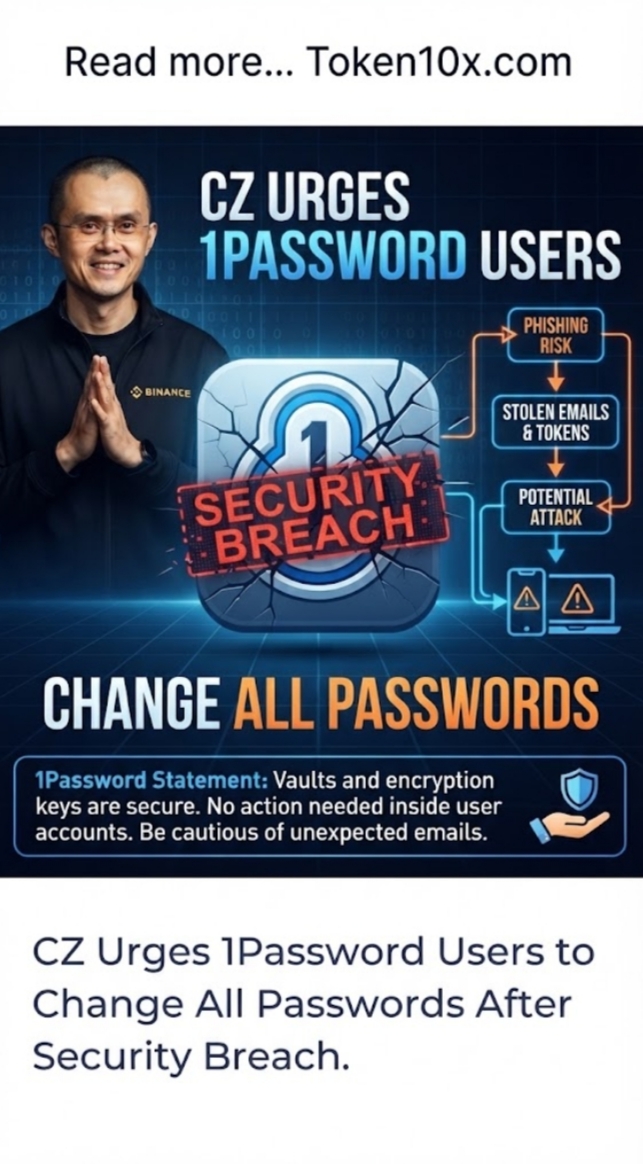
Binance founder Changpeng Zhao has urged 1Password users to change every password stored in the service following a disclosed security incident. On November 26, 2026, Zhao posted on X that users should reset all passwords, describing the step as a “pain in the neck” but necessary.
1Password disclosed the incident on November 25. An attacker gained access to an employee’s corporate GitHub account around November 19, used it to reach source code and push malicious code to backend services, and downloaded administrative customer data. The company stated that customer vaults, stored passwords, Secret Keys, and encryption keys were not compromised.
The Drivers of the Current Situation
The main issue is the gap between 1Password’s assessment that vault contents remain secure and the more cautious recommendation from Zhao that users should proactively rotate every stored password. The breach exposed names, email addresses, account and user identifiers, creation and last-sign-in timestamps, public keys, Secure Remote Password parameters, and certain invitation or recovery tokens for a subset of users.
Related factors shaped the response. 1Password disabled the compromised GitHub account, revoked the stolen token, rotated internal credentials that may have been exposed, and lengthened recovery and invitation codes as a precaution. The company reported no evidence of unauthorized account takeovers and emphasized that its architecture does not store account passwords or Secret Keys on its servers. Zhao’s public advice, issued the day after the disclosure, reflected a broader risk view focused on potential phishing and secondary attacks that could exploit the leaked contact and account metadata. Only the November 25 disclosure, the nature of the accessed data, 1Password’s confirmation that vaults were unaffected, and Zhao’s November 26 recommendation are verified.
Continued monitoring requires observation of any further technical updates from 1Password, reports of related phishing campaigns, and user adoption of password rotation. Limited public detail on the exact number of affected accounts forms a narrower path for assessing scale. Password-manager users, security researchers, and platform operators remain the primary parties tracking residual effects. The situation is a confirmed backend data exposure paired with differing public guidance on remediation rather than a confirmed compromise of encrypted vaults.
Impact and Broader Context
Questions about the appropriate user response to metadata breaches at password managers keep growing. 1Password’s position is that no password changes are required because vaults stayed encrypted and inaccessible; Zhao’s stance prioritizes comprehensive rotation to reduce downstream risk from targeted phishing. It also elevates attention on the value of leaked email addresses and account identifiers for social-engineering attacks. Users, security teams, and competing password-manager providers continue to assess the implications.
The issue drives debate on best practices after partial data exposures at security-critical services. It raises questions about the durability of zero-knowledge designs under internal access compromises, the limits of company guidance versus independent risk assessments, risks of phishing campaigns that leverage confirmed 1Password user lists, effects on trust in cloud-based password managers, and competition among providers emphasizing different recovery and notification practices. Coverage notes the contrast between the company’s technical assurances and Zhao’s conservative recommendation.
The November 25–26 sequence of disclosure and public advice forced renewed focus on password-manager incident response. The combination of confirmed metadata exposure and differing remediation advice shows how subsequent phishing reports, independent audits, or further company updates will determine the lasting effect.
New statements from 1Password, confirmed phishing activity linked to the breach, or broader industry guidance will clarify the practical contribution of the current recommendations.
This analysis uses 1Password’s official incident update and contemporaneous reporting of Zhao’s statements. The ultimate scale of any secondary attacks and the effectiveness of password rotation remain subject to ongoing monitoring and user actions.


