

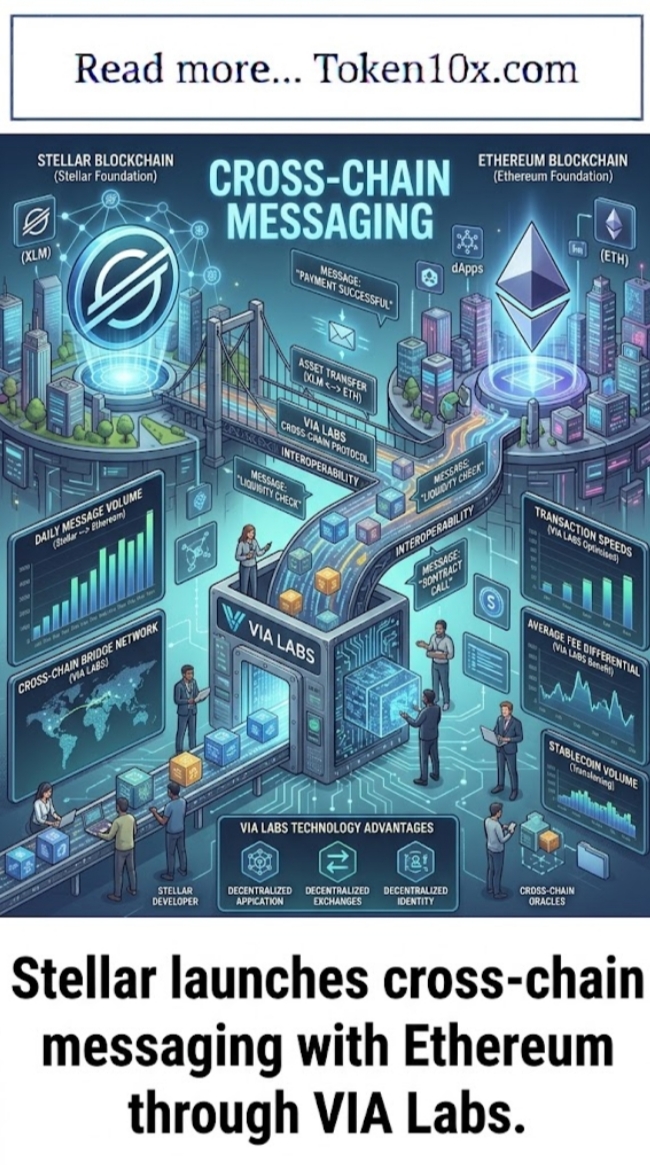
VIA Labs has launched bidirectional cross-chain messaging between Stellar’s Soroban smart-contract platform and Ethereum. The integration went live on mainnet (with corresponding testnet deployments) and was announced around Stellar’s Meridian conference on October 28, 2026. Soroban contracts can now exchange messages with Ethereum Virtual Machine contracts in both directions.
The reference implementation is VIAT, a burn-and-mint token that maintains constant total supply across chains. Transfers involve burning on the source chain, validator signing, and minting on the destination after relay; the process typically completes in one to three minutes. Developers can also send custom data messages or configure transfers for other tokens. VIA operates the validators, gateways, and relayers. Users pay standard network fees (XLM or Ethereum gas), with VIA waiving its protocol fee on Stellar routes during the launch period.
Potential use cases cited include moving stablecoins for cross-border payments, transferring real-world assets (RWAs), and triggering contract actions across chains.
The Drivers of the Current Situation
The main development is the mainnet activation of two-way messaging between Stellar Soroban and Ethereum via VIA Labs infrastructure. Confirmed elements include support for both directions, the VIAT burn-and-mint reference token, approximate transfer times of one to three minutes, VIA’s operation of the intermediate validators and relayers, the availability of testnet versions, and the temporary fee waiver on Stellar routes. The launch coincides with Stellar ecosystem events focused on tokenization and interoperability.
Developer adoption rates and additional token integrations will further define usage.
Impact and Broader Context
The connection expands Stellar’s interoperability options beyond prior bridges or specific asset standards, enabling more flexible cross-chain application logic with Ethereum. It raises questions about the security model of the validator-relayer design, the practical throughput for production use cases such as RWA movement or stablecoin flows, competition with other messaging protocols, and the long-term role of non-EVM chains in multi-chain architectures. Coverage notes the distinction between general contract messaging and specialized asset bridges, as well as the reliance on VIA-operated infrastructure.
Subsequent audits, volume metrics, or expanded chain support will determine the lasting effect.
This analysis draws from VIA Labs documentation, official announcements, and contemporaneous reports. Exact security audit details beyond referenced Soroban contracts, long-term fee structures, and real-world transaction volumes remain subject to further disclosure and on-chain activity.