

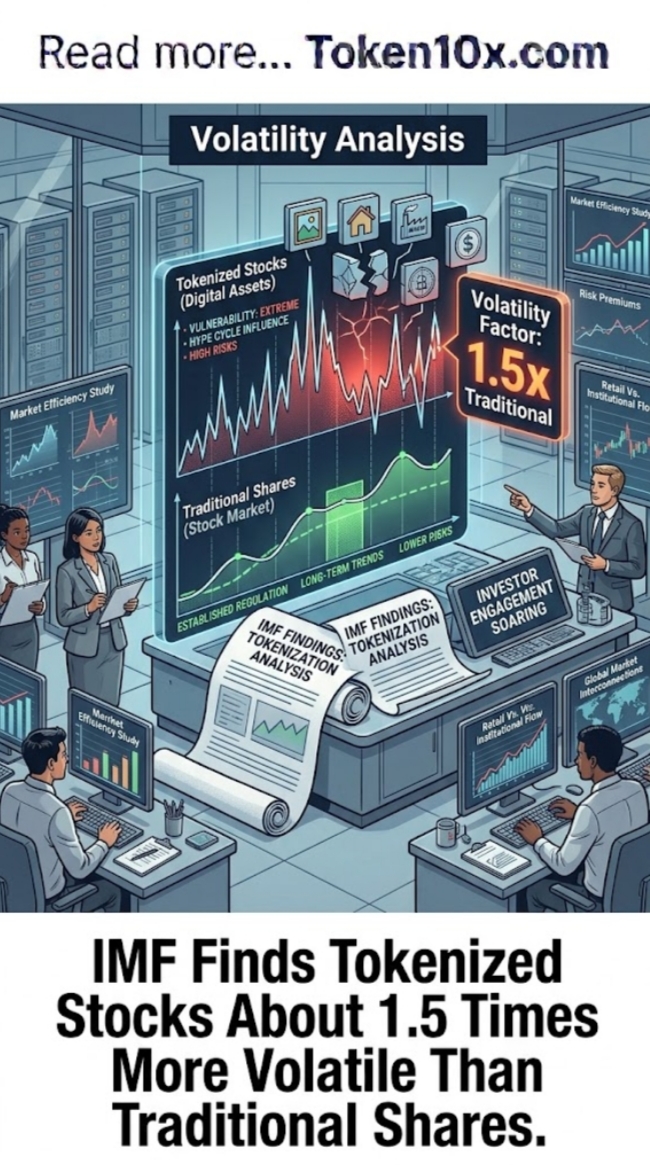
The International Monetary Fund has flagged higher volatility in tokenized equities. As of the October 2026 Global Financial Stability Report, the IMF found that tokenized U.S. stocks in its sample exhibited realized volatility roughly 1.5 times higher than the corresponding traditional shares. The analysis also showed significantly lower liquidity, particularly on decentralized venues. The market for tokenized equities remains small relative to conventional stock markets.
The findings continue to shape discussion of tokenization’s benefits and risks. They have restricted the current assessment to an early-stage market. Existing data cover the most actively traded tokenized U.S. equities across multiple venues. Researchers rely partly on price and volume observations while routing broader conclusions through comparisons with traditional markets. This highlights the difference between 24/7 accessibility and the liquidity and stability characteristics of the underlying assets.
The Drivers of the Current Situation
The main issue is the measured gap in volatility and liquidity. The IMF examined the five most liquid tokenized U.S. equities over an extended period and across centralized and decentralized platforms. Tokenized versions were about 1.5 times more volatile and materially less liquid than their traditional counterparts. No claim was made that the gap is permanent as the market matures.
Related observations have limited the systemic-risk assessment for now. Some data show that more than half of trading in the sample occurred outside regular U.S. market hours and that roughly 80 percent of trades involved less than one full share. Overnight price moves in the tokenized versions were largely absorbed by traditional markets at the open. Only the volatility and liquidity differentials stand out as clear drawbacks. Broader tokenization activity, including fixed-income products, accounts for a larger share of the overall tokenized real-world asset market.
Continued monitoring requires larger scale and improved market structure. Limited current liquidity forms a narrower path for price discovery and exit. Regulators and market participants are actively reviewing the implications. The situation is an empirical assessment of early tokenized equity markets tied to financial-stability considerations.
Impact and Broader Context
Questions about the IMF finding that tokenized stocks are about 1.5 times more volatile than traditional shares keep growing. The results create uncertainty around how these instruments will behave as volumes increase. They also affect how investors, platforms, and supervisors weigh the trade-offs of continuous trading and fractional ownership. Policymakers, exchanges, and asset managers continue to examine the data.
The issue drives debate on the readiness of tokenized equity markets. It raises questions about the sources of the elevated volatility, the limits of liquidity on different venue types, risks of amplified moves during stress, effects on investor protection in a 24/7 environment, and competition between traditional and on-chain trading venues. Stakeholders stress that systemic risks appear limited at the present small scale. The IMF has noted both the genuine demand for off-hours and fractional access and the need for careful attention to market safeguards.
The October report forced formal attention onto these empirical differences. The current analysis shows how further growth, liquidity improvements, or regulatory measures such as circuit breakers will influence the risk profile.
New market data, larger tokenized equity volumes, or updated supervisory guidance will clarify whether the volatility gap narrows over time.
This analysis uses findings from the IMF’s October 2026 Global Financial Stability Report and related coverage. Volatility and liquidity comparisons remain specific to the sample and period examined and are subject to market evolution.