

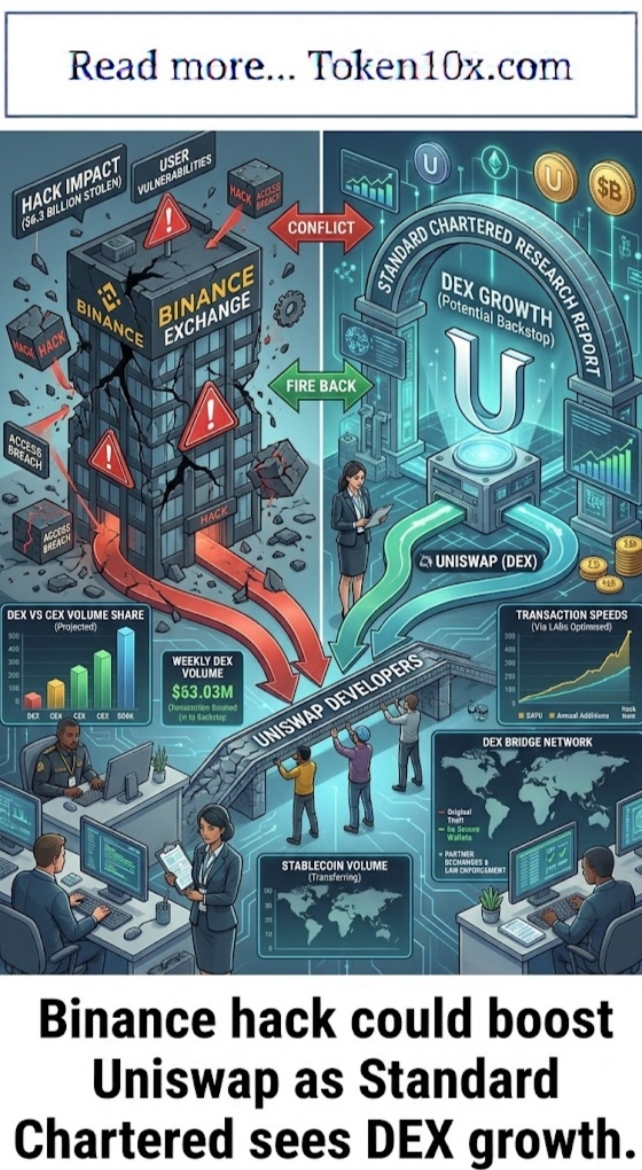
Standard Chartered’s global head of digital assets research, Geoffrey Kendrick, said the approximately $6.3 billion Binance security incident could accelerate a longer-term shift in cryptocurrency trading toward decentralized exchanges (DEXs), with Uniswap positioned as a key beneficiary. In comments shared with media outlets on October 30, 2026, Kendrick stated: “I would encourage investors to re-engage with Uniswap. The decentralized exchange (DEX) has never had any exploits, and the hack of the largest centralized exchange (CEX), in Binance, should see the ratio of DEX to CEX trading continue to increase.”
Kendrick retained his $100 price target for Uniswap’s UNI token by 2030 and suggested the Binance breach provides “another reason why that forecast may end up being too low.” The view builds on Standard Chartered’s earlier projection that assets locked in DeFi could reach $2.7 trillion by 2030, with Uniswap emerging as a major venue for tokenized assets. CoinGecko data cited in related coverage showed the top-10 spot DEX-to-CEX trading ratio at 23.5% in the second quarter of 2026, up 2.1 percentage points from the prior quarter.
Kendrick cautioned that investors should wait until the immediate market impact of the Binance attack settles before adjusting positions. UNI itself declined in the aftermath of the hack amid broader market pressure and reported selling activity linked to the incident.
The Drivers of the Current Situation
The core development is Standard Chartered’s assessment that the record Binance breach could reinforce structural growth in DEX trading relative to centralized platforms. Confirmed elements include Kendrick’s call to re-engage with Uniswap, the emphasis on Uniswap’s lack of prior exploits, the maintained $100 UNI target for 2030 (with upside risk noted), the reference to rising DEX-to-CEX volume share, and the linkage to the bank’s broader DeFi assets-under-management outlook. These comments came shortly after Binance suspended deposits and withdrawals following the incident.
Market digestion of the hack and any measurable volume shifts will provide the next data points.
Impact and Broader Context
The analysis frames the Binance event as a potential catalyst for greater preference for non-custodial trading venues due to reduced counterparty risk. It raises questions about the durability of any volume migration, the competitive positioning of Uniswap versus other DEXs, the timeline for investors to act on the thesis, the interaction with near-term price weakness in UNI and related tokens, and the role of tokenized assets in driving future DeFi activity. Coverage distinguishes between the longer-term structural argument and short-term market volatility triggered by the centralized-exchange incident.
Subsequent trading-volume data, UNI price action, or further bank research will determine the lasting effect.
This analysis draws from comments by Geoffrey Kendrick of Standard Chartered reported via Cointelegraph and other outlets, along with CoinGecko volume statistics. Actual volume migration, price outcomes, and the realization of long-term forecasts remain subject to market conditions and further developments.