

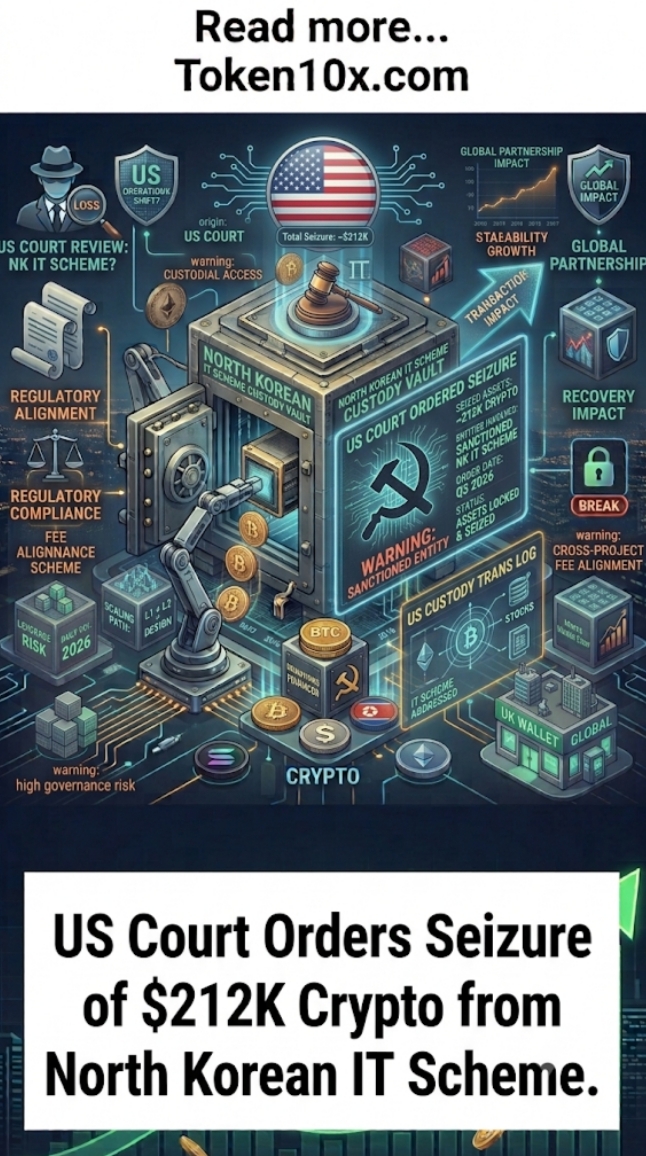
A U.S. federal court has ordered the forfeiture of approximately $212,700 in stablecoins linked to wages earned by North Korean IT workers. The ruling represents a partial victory for the Justice Department in a larger effort to seize more than $7.74 million in digital assets tied to an alleged sanctions-evasion network.
The seized funds consist of 158,123 USDC and 54,574 USDT held in a specific cryptocurrency wallet.
The Drivers of This Development
U.S. District Judge Rudolph Contreras of the District of Columbia ruled that the contents of a wallet beginning with “0x81c4” should be forfeited to the government. Prosecutors traced the stablecoins to payment addresses used by at least 14 North Korean IT workers who obtained remote employment under false or stolen identities. The broader civil forfeiture case, filed in 2025, alleges a wire fraud and money-laundering operation that generated revenue for the North Korean government in violation of U.S. sanctions and the International Emergency Economic Powers Act. While the court granted forfeiture of the identified stablecoin balances, it declined to order immediate forfeiture of certain other assets in the case that had not been sufficiently identified. For perspective, the $212,700 represents only a fraction of the total value the Justice Department is pursuing in connection with the same network of overseas workers and associated laundering activity.
It is important to note the fundamental difference between criminal proceeds from cyber theft or hacking and funds derived from deceptive remote-work schemes: both can support sanctioned regimes, but the latter relies on social engineering and identity fraud within legitimate labor markets rather than direct technical intrusion.
Impact and Broader Context
The order allows the U.S. government to take ownership of the identified stablecoins and continues pressure on North Korea’s efforts to generate hard currency through overseas IT labor. The case forms part of a multi-year campaign targeting the regime’s use of skilled workers who secure remote positions at companies in the United States and elsewhere, then route earnings through cryptocurrency channels. Successful forfeiture of even partial amounts demonstrates the ability of investigators to follow on-chain flows from worker payment addresses into consolidation wallets. At the same time, the court’s refusal to grant the full requested relief highlights evidentiary hurdles in complex, multi-asset crypto forfeiture actions.
This development sparks important discussions about the effectiveness of financial sanctions enforcement in the digital-asset era. Supporters of aggressive forfeiture actions argue that disrupting even modest revenue streams raises the cost of sanctions evasion and deters companies from unwittingly hiring sanctioned workers. Critics caution that the scale of recovered funds remains small relative to the overall estimated activity and that prevention through better identity verification may prove more impactful than after-the-fact seizures. Analysts observe that repeated successful tracing and court actions steadily increase the operational friction for North Korean IT-worker networks.
Looking ahead, further rulings on the remaining assets in the $7.74 million case and any additional related forfeitures will indicate how comprehensively authorities can dismantle these payment channels. This analysis is based on the court ruling, Justice Department filings, and contemporaneous reporting for accuracy and reliability. Additional recoveries and the final disposition of related assets remain subject to ongoing legal proceedings.