

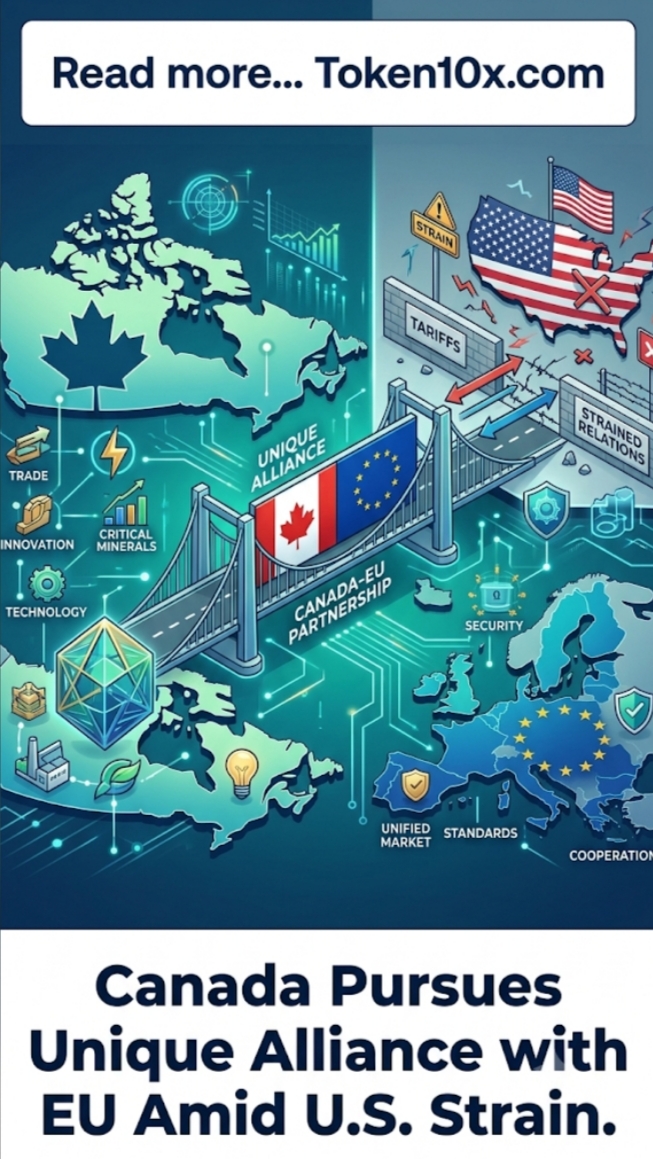
Canadian Prime Minister Mark Carney is advancing talks for a deeper partnership with the European Union as relations with the United States deteriorate sharply. Reports indicate discussions have included the concept of “associate member” status, though Carney has publicly stated Canada is not seeking full EU membership.
Instead, Ottawa is exploring a “unique alliance” focused on closer trade, investment, security, labour mobility and research ties while preserving Canadian sovereignty.
The Drivers of This Pivot
The initiative comes after the collapse of bilateral trade talks with the United States and escalating tariff pressures under the Trump administration, which have heightened Canada’s long-standing vulnerability to its southern neighbour. With roughly three-quarters of Canadian exports traditionally directed to the U.S., Carney’s government is accelerating efforts to diversify economic partnerships. Private and official discussions with European leaders have examined ambitious arrangements short of full membership or single-market accession, covering strategic sectors such as energy, critical minerals, defence, AI and data. For perspective, the push reflects a strategic reorientation of an economy that has been heavily integrated with the United States for decades.
It is important to note the fundamental difference between seeking formal EU membership, which would involve adopting large parts of the acquis communautaire and pooling sovereignty, and negotiating a tailored, high-level partnership that deepens practical cooperation without surrendering autonomy.
Impact and Broader Context
A successful unique alliance could open new markets for Canadian goods and resources, strengthen supply-chain resilience, and enhance Canada’s geopolitical options, while giving the EU greater access to North American energy, minerals and talent. This development sparks important discussions about the future of North American economic integration, the adaptability of EU external relationships, and Canada’s long-term strategic orientation. Supporters argue that closer European ties would reduce over-dependence on the U.S. and align Canada with like-minded partners on values and standards. Critics, including opposition figures, warn against any arrangement that could dilute Canadian independence or provoke further U.S. retaliation, and note that geography and existing supply chains still favour North American links. Analysts observe that the talks remain exploratory and that any concrete framework would require careful design to balance ambition with political and economic realities on both sides of the Atlantic.
Carney is scheduled to address the European Parliament as part of ongoing engagement. This analysis is based on reporting from the Wall Street Journal, Globe and Mail, CBC and Reuters for accuracy and reliability. The scope and eventual form of any new Canada-EU partnership remain subject to further negotiations.