

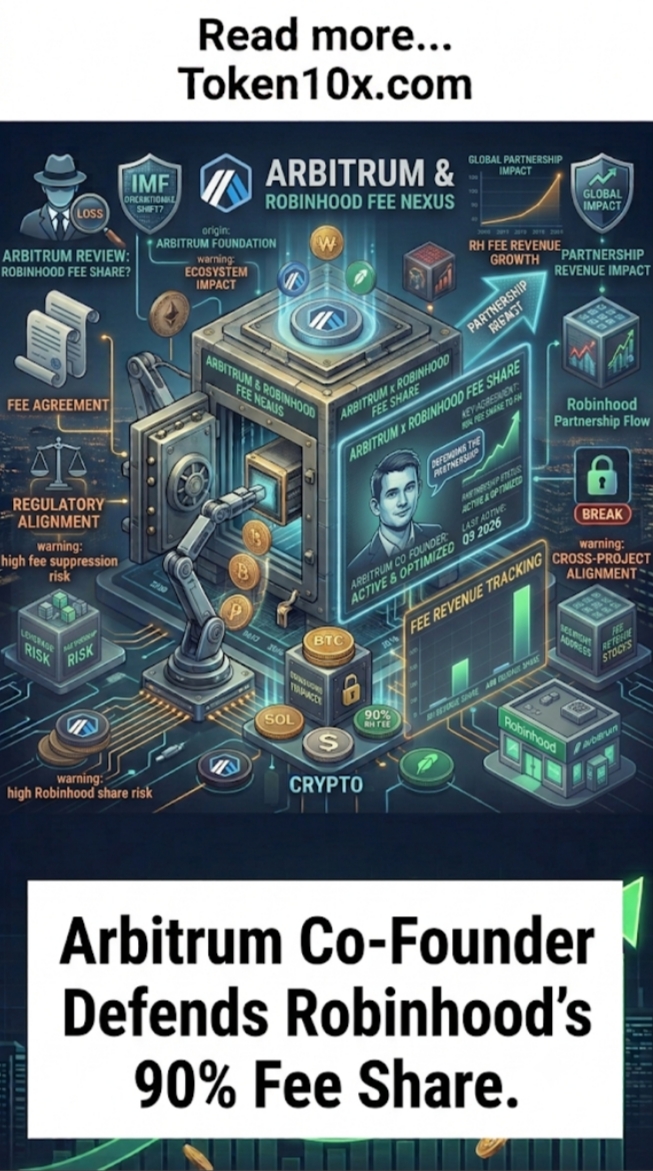
Offchain Labs co-founder Steven Goldfeder has defended Robinhood’s retention of roughly 90% of net revenue on its Arbitrum-based blockchain. The comments came amid a public exchange with Solana co-founder Anatoly Yakovenko over the chain’s fee model.
Goldfeder argued that the arrangement allows Robinhood to act as a “landlord” rather than a “tenant” on the network.
The Drivers of This Development
Robinhood Chain, launched as an Ethereum Layer 2 using Arbitrum’s Orbit technology, operates under the Arbitrum Expansion Program. Under this structure, approximately 10% of the chain’s net protocol revenue is shared with the Arbitrum ecosystem—8% directed to the Arbitrum DAO treasury and 2% to a developer fund—while Robinhood retains the remaining share. Goldfeder emphasized that this model lets Robinhood capture the bulk of sequencer and gas-related revenue generated on its chain. In contrast, he noted that deploying as an application on Solana would mean paying network fees without retaining underlying chain revenue. The debate intensified as Robinhood Chain experienced elevated activity and fee generation in its early months. For perspective, the 90% figure refers to net protocol revenue after certain costs, not necessarily every gross user fee.
It is important to note the fundamental difference between operating an application on a shared base layer and launching a dedicated chain with a revenue-sharing agreement: the latter gives the operator greater control over monetization of on-chain activity, including activity that may not flow through its own frontend.
Impact and Broader Context
The defense highlights competing philosophies on how value should accrue in blockchain ecosystems—whether to application builders who control their own chains or to the base-layer networks and validators. Yakovenko and others have questioned whether the model creates misaligned incentives around congestion and user costs, while Goldfeder presented it as a rational choice for a company seeking to monetize its infrastructure. The arrangement has already directed meaningful revenue to the Arbitrum ecosystem from Robinhood Chain’s early activity. It also underscores the growing appeal of customizable Layer 2 frameworks for large consumer platforms.
This development sparks important discussions about the economics of app-specific chains versus shared Layer 1 networks. Supporters of the Arbitrum Orbit model argue that allowing operators to retain most revenue encourages major companies to build on the stack and still provides upside to the broader ecosystem. Critics contend that such structures can reduce the value capture of underlying networks and may prioritize operator profits over user fee minimization. Analysts observe that the public exchange between the two co-founders crystallizes a larger industry debate over who benefits most…