

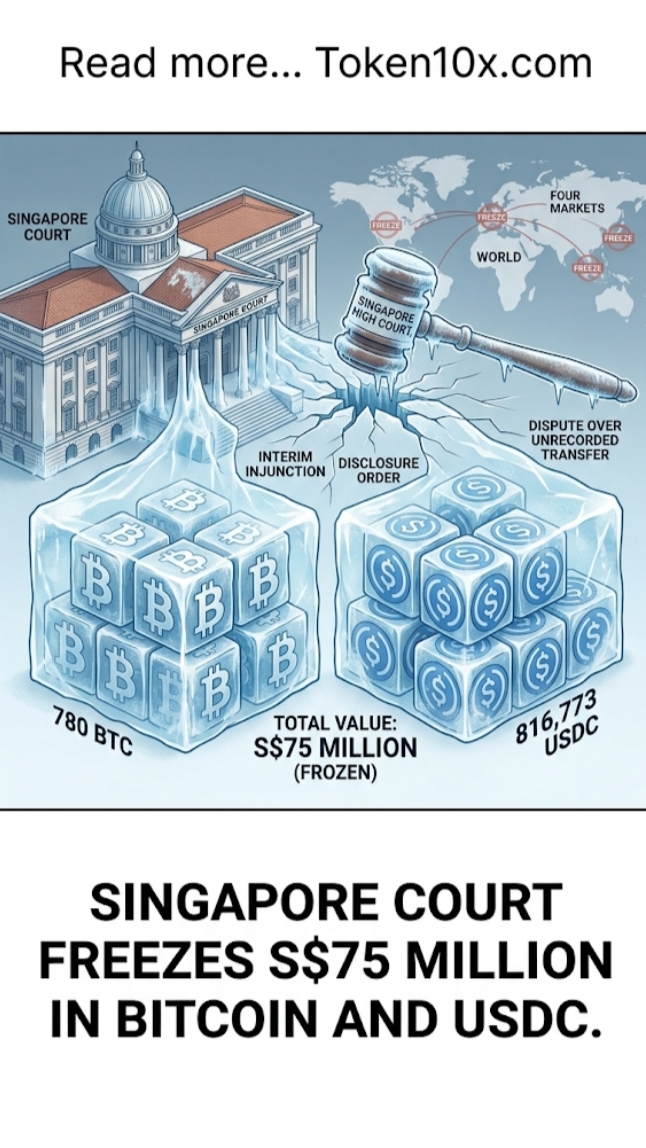
The Singapore International Commercial Court has frozen approximately S$75 million worth of Bitcoin and USD Coin in a dispute between a major cryptocurrency trading platform and a long-time customer. The order prevents the customer from dealing with the disputed assets pending further proceedings.
The case centers on alleged mistaken transfers stemming from an internal ledger error.
The Drivers of This Activity
According to the court’s judgment, the platform claimed that a technical issue caused its internal ledger to fail to record a 2020 transfer of 2,500 BTC and 2,500 BCH out of the customer’s specialised wallets. Believing those wallets were empty, the platform transferred the same amounts into the customer’s other wallets in July 2024.
The customer subsequently converted 20 BTC into about 816,773 USDC and withdrew a total of 780 BTC to external wallets between July and November 2024. After discovering the ledger error in January 2025, the platform froze the remaining balances on its system and recovered 1,700 BTC and 2,500 BCH. It then sought the return of the assets that had left the platform.
On 26 March 2026, a panel including Singapore High Court Justice Aidan Xu and SICC International Judges Anthony Meagher and David Goddard granted an interim proprietary injunction. The order restrains the customer from disposing of, dealing with or diminishing the value of the 780 BTC, the 816,773 USDC and any derived assets or profits. The court also directed the customer to disclose the location of the assets but declined to permit the platform to use that information for similar applications in other jurisdictions.
Impact and Broader Context
The freezing order preserves the disputed assets while the underlying claims— including unjust enrichment and proprietary rights— proceed to determination. It illustrates how Singapore courts are applying traditional proprietary and injunction principles to digital assets in commercial disputes involving large trading platforms.
The case highlights operational risks around ledger accuracy and the challenges of reversing on-chain movements once assets leave a platform’s control. Both sides maintain opposing positions on ownership of the transferred funds.
Further hearings will address the substantive claims and the ultimate disposition of the frozen Bitcoin and USDC.
Source: SICC judgment [2026] SGHC(I) 4