

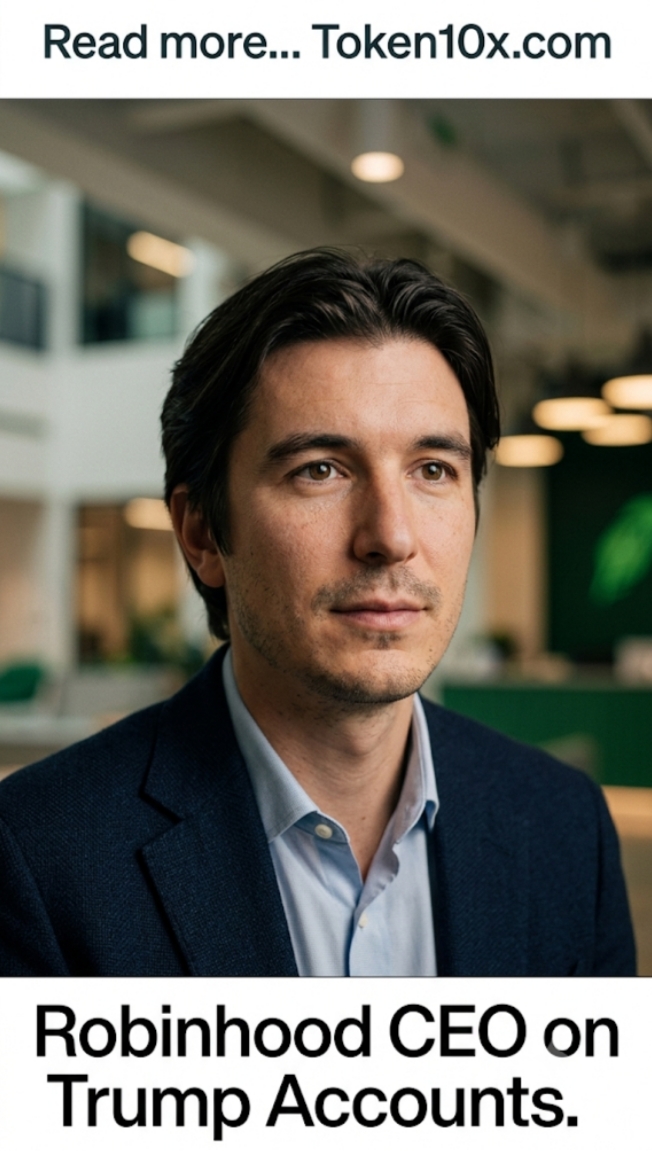
Robinhood CEO Vlad Tenev said Trump Accounts give children a straightforward path into the S&P 500 so they can experience the power of compound interest from birth. Speaking on CNBC’s Squawk Box on August 19, Tenev explained that the accounts currently invest in a low-cost State Street S&P 500 exchange-traded fund and are designed to keep the process simple.
“Right now, you can get the S&P 500 through a low-cost ETF provided by State Street,” Tenev said. “And we wanted to make it as easy as possible for every American, starting at birth, to get access to the great American economy, to get ownership of these companies from birth and see the magic of compound interest.”
Trump Accounts are tax-deferred investment vehicles for children launched by the U.S. Treasury on July 4. Eligible children born between 2025 and 2028 receive a one-time $1,000 seed contribution from the government. Parents, relatives, employers and others may add up to $5,000 per year in after-tax contributions. Funds remain invested until the child turns 18, at which point the account converts into a traditional IRA subject to standard rules.
Investments are restricted to qualifying low-cost index funds that track broad U.S. equity indexes. The default holding is the State Street SPDR Portfolio S&P 500 ETF. Additional options include the iShares Core S&P 500 ETF, Vanguard Total Stock Market ETF and other similar products with expense ratios capped near 0.03 percent or lower. The structure deliberately limits choice in the early years to emphasize long-term market exposure rather than active trading.
Robinhood serves as the initial broker and trustee in partnership with Bank of New York Mellon, which acts as financial agent. The brokerage built the mobile app that families use to open and monitor accounts. Projections shown in the app illustrate potential growth to age 18 and beyond under different contribution scenarios. Several large employers, including Robinhood itself, have pledged to match the federal $1,000 seed for employees’ children.
Tenev framed the program as an extension of Robinhood’s broader mission to democratize finance. By placing ownership of major U.S. companies in the hands of newborns, the accounts aim to introduce equity market participation at the earliest possible stage. Historical S&P 500 returns have compounded at roughly 10 percent annualized over long periods, though past performance is no guarantee of future results and inflation plus taxes will affect real outcomes.
Supporters argue the combination of government seed capital, automatic equity exposure and tax deferral can meaningfully narrow the wealth-building gap for families that start early. Critics note that the $1,000 alone, without additional contributions, grows only modestly by age 18 under realistic return and inflation assumptions. Maximum annual contributions of $5,000 produce far larger balances but remain out of reach for many households.
For the financial industry the accounts represent a new pipeline of long-term investors. Brokerages and asset managers gain a generation of clients whose first market experience is passive index ownership rather than individual stock picks or speculative trading. Whether the program scales into a lasting feature of American household finance will depend on participation rates, contribution levels and the persistence of the underlying equity returns that power the compounding Tenev highlighted.
Parents and guardians can open accounts through the official Trump Accounts portal or the dedicated mobile app. The simple S&P 500 focus, Tenev said, is intentional: reduce complexity, maximize time in the market, and let compound interest do the work.
[…] Robinhood CEO on Trump Accounts […]
[…] Robinhood CEO on Trump Accounts […]
[…] Robinhood CEO on Trump Accounts […]
[…] Robinhood CEO on Trump Accounts […]
[…] Robinhood CEO on Trump Accounts […]