

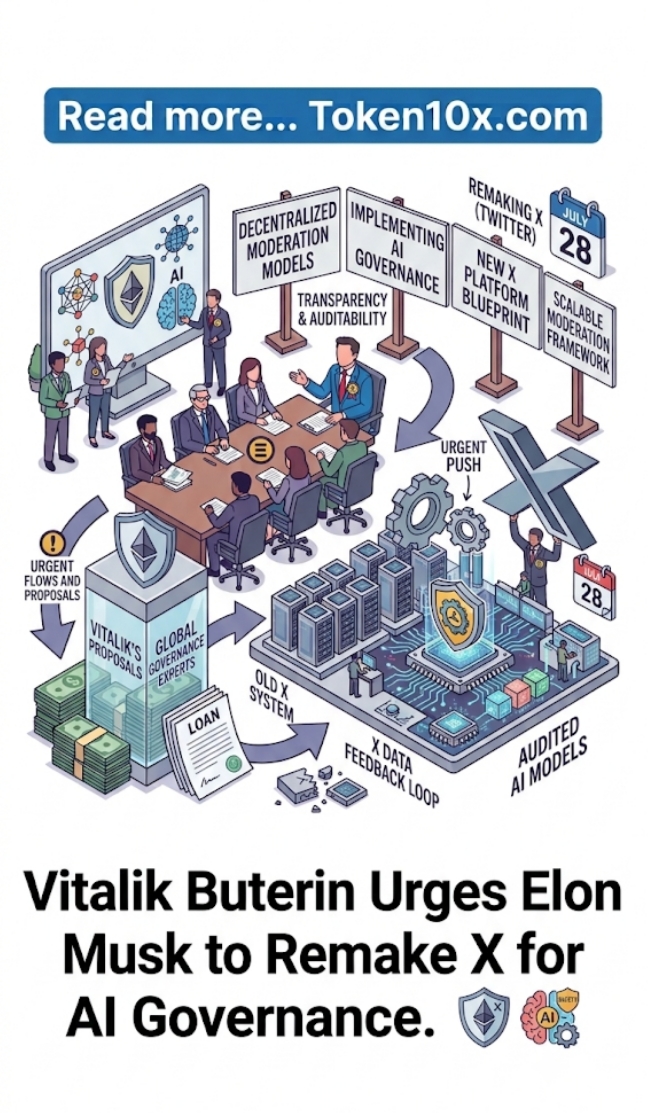
Ethereum co-founder Vitalik Buterin has called on Elon Musk to transform X (formerly Twitter) into a decentralized platform for AI governance, safety oversight, and public deliberation on artificial intelligence. The proposal highlights growing urgency around establishing transparent and inclusive mechanisms to guide the development of increasingly powerful AI systems.
Buterin suggested that X’s massive global user base, real-time information capabilities, and potential for community-driven features could serve as a foundation for open AI governance experiments. He emphasized the need for verifiable, decentralized processes to address alignment, safety, and ethical challenges as AI capabilities advance.
Buterin’s Rationale
The Ethereum founder has long advocated for mechanisms that prevent power concentration in technology and ensure broad participation in decisions affecting humanity’s future. He views blockchain-inspired tools and transparent social platforms as potential solutions for managing AI risks without relying solely on centralized governments or corporations.
Buterin’s comments reflect a philosophical alignment with decentralized principles while acknowledging the practical influence of platforms like X in shaping public discourse on emerging technologies.
Musk’s Role and X’s Potential
Elon Musk, owner of X and founder of xAI, has frequently discussed AI safety concerns and the importance of maintaining open dialogue. Musk has positioned X as a free speech platform and “digital town square,” making Buterin’s suggestion a logical extension of its current trajectory.
X has already integrated AI features for content moderation and recommendations. A deeper focus on governance could expand its role beyond social media into a critical venue for technology policy and collective decision-making.
Broader Implications
The proposal underscores the increasing intersection of social platforms, blockchain technology, and artificial intelligence governance. If pursued, it could position X as a central hub for global conversations on AI ethics, regulation, and safety standards.
The idea may inspire collaboration between key figures in crypto and AI, bridging decentralized finance principles with AI alignment efforts. It also adds to ongoing debates about the appropriate balance between innovation, safety, and democratic oversight in the development of transformative technologies.
The crypto and AI communities are likely to engage actively with Buterin’s suggestion. Any response or follow-up from Musk could significantly influence discussions on the future of AI governance and the role of social platforms in shaping it. Further dialogue on this topic is expected in the coming weeks as the conversation around responsible AI development intensifies.