

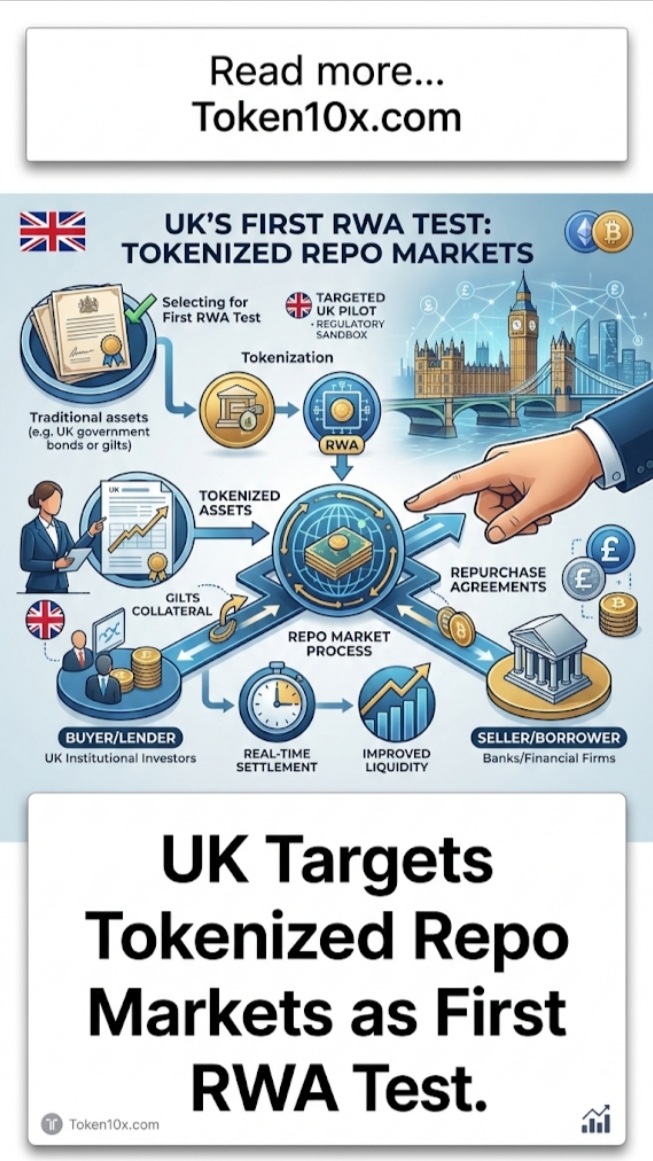
The United Kingdom has selected tokenized repurchase agreement (repo) markets as its inaugural test case for real-world asset (RWA) tokenization, marking a deliberate step toward modernizing core financial infrastructure with blockchain technology. The initiative aims to enhance efficiency in short-term funding markets while building regulatory experience for broader tokenized asset adoption.
Regulators, led by the Bank of England and the Financial Conduct Authority, are collaborating with major banks and technology providers to pilot tokenized repos. These instruments, which facilitate short-term secured lending, are seen as an ideal starting point due to their high volume, standardized nature, and critical role in liquidity management.
Strategic Rationale
Tokenizing repos could deliver faster settlement (potentially near-instantaneous), improved transparency, 24/7 trading capabilities, and better collateral optimization. By beginning with this foundational market, the UK aims to address operational frictions while minimizing systemic risk during the early stages of tokenization.
The approach reflects a measured, test-and-learn strategy designed to generate practical insights before expanding to more complex asset classes such as bonds, equities, or real estate.
Implications for the Financial Sector
A successful tokenized repo pilot could accelerate the integration of blockchain into traditional capital markets and reinforce London’s position as a global fintech and financial innovation hub. It may also attract international participants seeking efficient, regulated on-chain funding solutions.
For the wider RWA ecosystem, the UK’s focus provides a potential blueprint for other jurisdictions and could encourage more traditional institutions to explore tokenization projects.
Broader Context
The move aligns with the UK’s post-Brexit strategy to establish clear, innovation-friendly rules for digital assets while maintaining financial stability. It positions the country competitively against other jurisdictions advancing similar initiatives, such as the EU, Singapore, and Switzerland.
The Bank of England and FCA are expected to release further details on pilot participants, technical standards, and evaluation criteria in the coming months. This development represents a significant milestone in the mainstream adoption of blockchain for traditional finance infrastructure and could influence global standards for tokenized real-world assets. Industry participants will watch the pilot closely for its impact on liquidity, risk management, and settlement efficiency.