

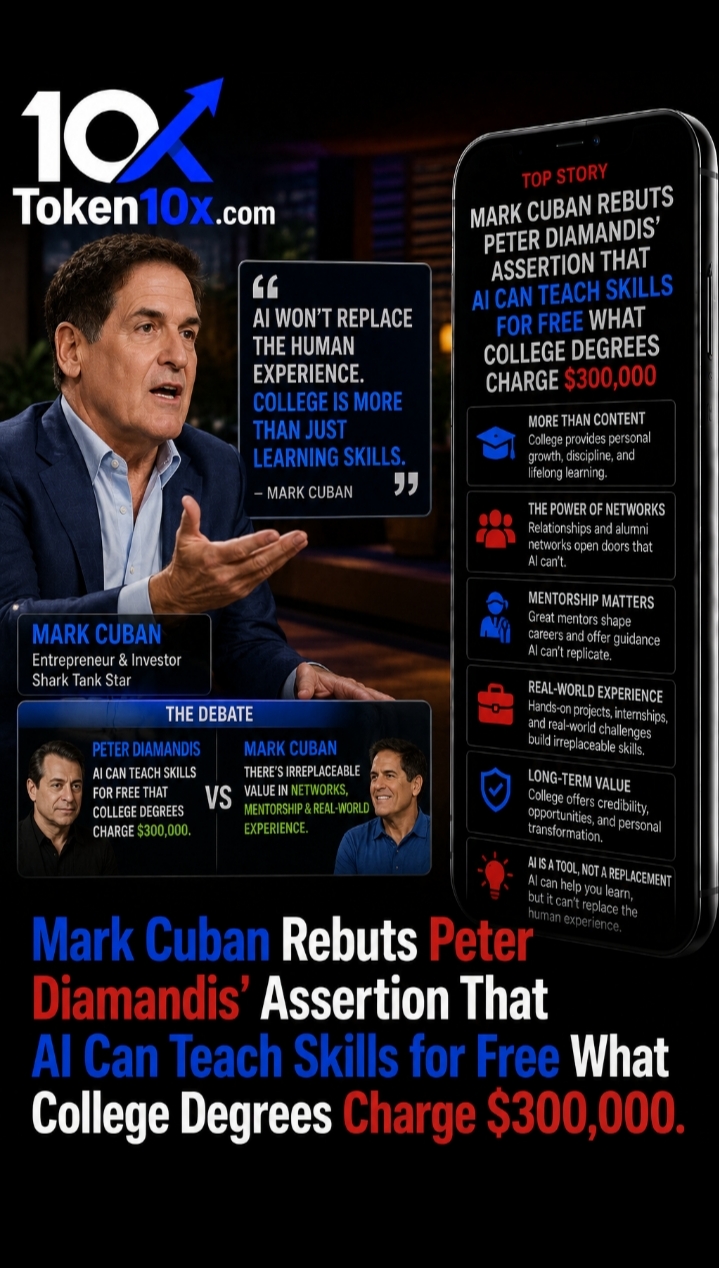
In a high-profile exchange on the future of education, Mark Cuban has rebutted Peter Diamandis’ assertion that AI can teach skills for free that traditional college degrees charge up to $300,000. The exchange in late May 2026 has ignited fresh debate about the role of artificial intelligence in disrupting higher education and professional training.
Peter Diamandis, a prominent futurist and founder of Singularity University, recently claimed that advanced AI systems will soon deliver personalized, high-quality education and skill development at virtually no cost, making expensive university degrees largely obsolete. Mark Cuban pushed back, arguing that while AI is a powerful tool for learning, it cannot fully replace the human elements of education, networking, credentialing, and structured accountability that top-tier colleges provide.
Several factors appear to have shaped Cuban’s rebuttal. Cuban, a successful entrepreneur and investor, emphasized the irreplaceable value of real-world experience, mentorship, peer collaboration, and recognized credentials that employers still prioritize. He acknowledged AI’s potential to democratize access to knowledge but warned against overhyping its ability to deliver the complete educational and career outcomes that elite universities currently offer for six-figure tuition fees.
The news has sparked lively debates across education, technology, and business communities about AI versus traditional college degrees. Some view Diamandis’ optimism as a concerning signal that could devalue formal education, while others regard Cuban’s rebuttal as a realistic and balanced perspective on the limitations of current AI systems.
Mark Cuban’s rebuttal does not indicate opposition to artificial intelligence in education. He has repeatedly praised AI’s transformative potential and invests heavily in the sector. Still, it reignites conversations around the future of higher education, the true cost of skills development, credentialing in the AI era, and how society should balance technological disruption with proven learning models.
For more education technology and AI analysis, visit Token10x Blog https://token10x.blog and explore Token10x https://token10x.com.
As the debate between tech visionaries intensifies, this development provides nuance: while AI promises to make high-value skills more accessible, Mark Cuban’s rebuttal highlights that replacing the full $300,000 college experience remains a complex challenge. Educators, students, and professionals should perform their own research and evaluate learning options carefully, recognizing that AI will likely complement rather than completely replace traditional education pathways.
The coming months will reveal how rapidly AI tools evolve in practical education settings and whether Cuban’s cautious stance or Diamandis’ bold vision better reflects the reality of skills development in the years ahead.