

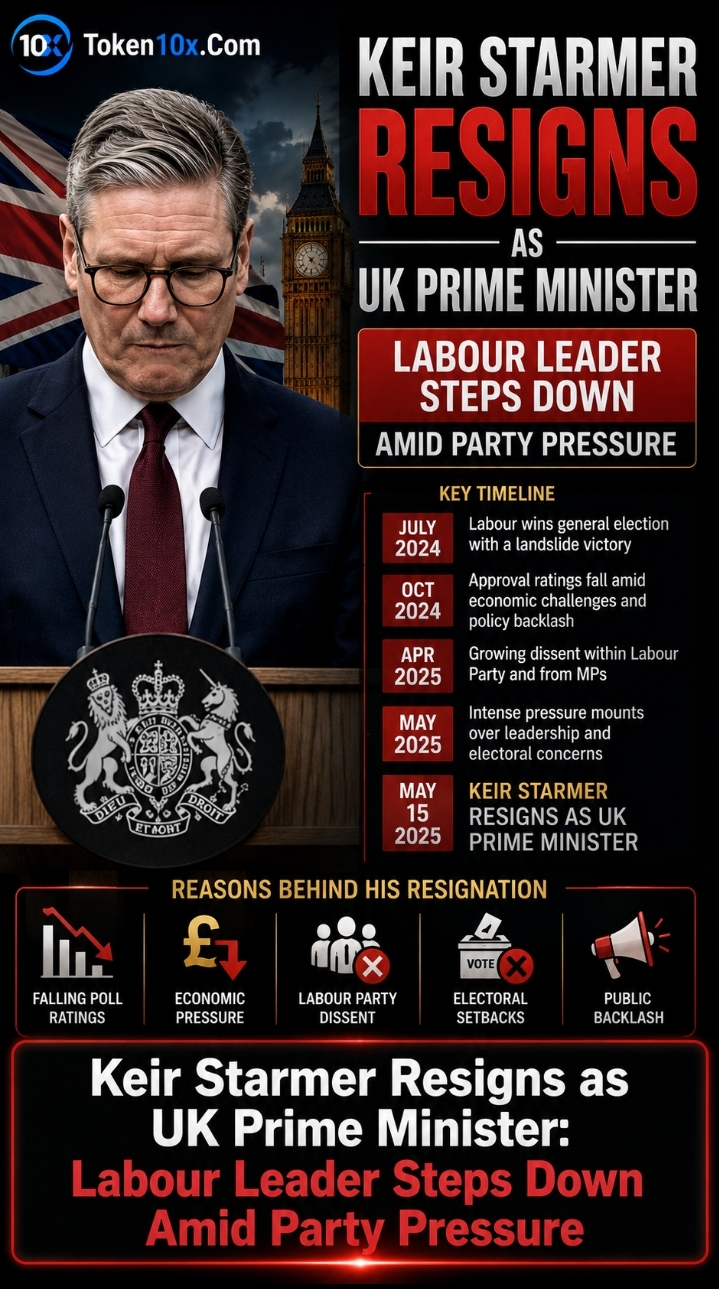
Sir Keir Starmer has announced his resignation as Prime Minister of the United Kingdom and leader of the Labour Party, bringing to an end a tenure that began with a landslide victory in July 2024. Speaking outside 10 Downing Street on June 22, 2026, Starmer stated that he had informed King Charles III of his decision and accepted that he was no longer the best person to lead the party into the next general election.
The move follows mounting internal pressure from Labour MPs, heavy losses in recent local elections, and criticism over key policy areas including immigration, energy costs, and economic challenges. Starmer will remain as caretaker Prime Minister until a new leader is elected, with a fresh contest expected to conclude before Parliament returns in September. Nominations are set to open on July 9.
Background and Triggers
Starmer led Labour to a historic victory less than two years ago, ending 14 years of Conservative rule. However, his government faced ongoing challenges that eroded support within the party. Nearly 90 Labour MPs reportedly called for his departure, citing disappointing local election results and internal divisions. The return of Andy Burnham to Parliament after a strong by-election win in Makerfield has positioned the popular Greater Manchester Mayor as an early frontrunner to succeed him.
In his statement, Starmer emphasized that every decision during his time in office was made with the country’s best interests at heart. He thanked his family and reflected on his commitment to public service, while acknowledging the difficult political realities facing his administration.
What Happens Next
The Labour National Executive Committee will now oversee the leadership contest timetable. Starmer will continue handling government business as Prime Minister during the transition period, which is expected to last through the summer. This development marks the sixth UK prime minister in seven years, underscoring the volatility in British politics since the post-Brexit era.
Potential candidates, led by Burnham, are likely to focus on unifying the party, addressing cost-of-living concerns, and rebuilding public trust ahead of the next general election. The Conservatives and other opposition parties will view this as an opportunity to challenge Labour’s direction.
Broader Implications
Starmer’s resignation highlights the intense pressures on modern UK leaders, where short political honeymoons and rapid shifts in party sentiment can quickly alter the landscape. His time in office delivered stability after the chaos of previous administrations but struggled to deliver visible improvements on key voter priorities fast enough for some within his own ranks.
Economists and political analysts will closely monitor market reactions and any policy continuity during the leadership transition. The coming weeks will shape not only Labour’s future but also the trajectory of UK governance at a time of global economic and geopolitical uncertainty.
This situation remains fluid, with further updates expected as the leadership process unfolds and reactions emerge from across the political spectrum. The transition underscores the democratic mechanisms within the UK system while raising questions about long-term governmental stability.