

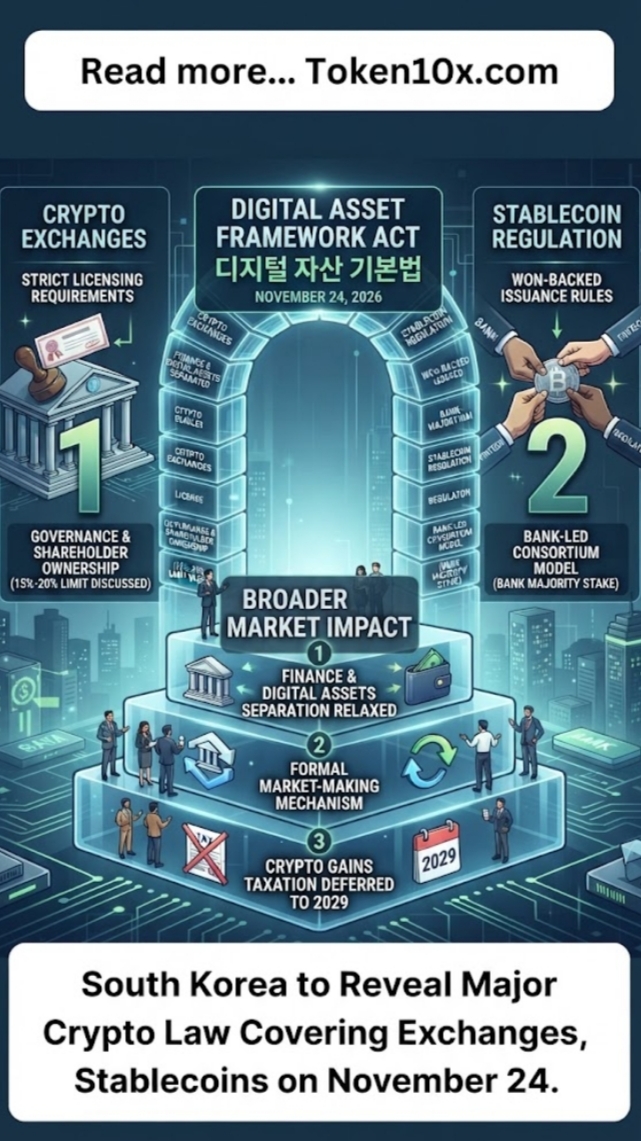
South Korea’s government is scheduled to publish the draft of its Digital Asset Basic Act on November 24, 2026, following review by the Virtual Asset Committee. The comprehensive framework is expected to overhaul regulation of crypto exchanges and establish rules for won-pegged stablecoins. It represents the most significant legislative step yet toward a unified legal structure for the country’s digital-asset market.
Key elements under discussion include moving exchanges from a registration system to a formal licensing regime and introducing a bank-centered model for issuing Korean won stablecoins.
The Drivers of the Current Situation
The main issue is the long-awaited release of a draft law that aims to replace fragmented existing rules with a single basic framework covering business licensing, governance, stablecoin issuance, and user protection. South Korea currently regulates virtual-asset service providers primarily through anti-money-laundering registration requirements and a separate user-protection statute.
Related factors shaped the timing and content. Authorities have sought clearer rules on exchange ownership concentration, with proposals under consideration to limit major shareholders’ stakes (reported ranges of roughly 15–34%) and to apply transition periods. For stablecoins, the draft is expected to prioritize bank-led consortia in which banks collectively hold a majority stake (more than 50% plus one share), while also tightening oversight of foreign-issued tokens such as USDT. Only the scheduled November 24 publication after Virtual Asset Committee review, the shift toward licensing for exchanges, and the bank-majority approach for won stablecoins are verified. Industry consultations and prior presidential emphasis on monetary sovereignty formed the wider backdrop.
Continued monitoring requires observation of the exact wording released on November 24, any subsequent National Assembly amendments, and industry reaction to ownership and stablecoin provisions. Limited final text ahead of the announcement forms a narrower path for assessing implementation timelines. Domestic exchanges, banks, fintech firms, and regulators remain the primary parties tracking residual effects. The situation is the formal unveiling of a foundational regulatory architecture intended to bring greater legal certainty to South Korea’s large crypto market.
Impact and Broader Context
Questions about the practical impact on existing platforms and the competitiveness of the local market keep growing. A clear licensing regime could raise compliance standards and barriers to entry while providing greater certainty for institutional participation. Ownership-cap proposals have already drawn industry pushback over property-rights and market-structure concerns. The bank-led stablecoin model aims to preserve monetary control but may limit non-bank innovation. It also elevates attention on how South Korea’s approach compares with frameworks in the European Union, Hong Kong, and other jurisdictions. Market participants and policymakers continue to assess the implications.
The issue drives debate on the balance between investor protection and market openness. It raises questions about the durability of current exchange ownership structures under potential caps, the limits of bank-dominated stablecoin issuance, risks of reduced liquidity or delayed product launches, effects on foreign stablecoin usage, and competition among Asian regulatory models. Coverage notes that the draft is expected to open pathways for traditional financial institutions to engage in digital-asset custody and related services.
The November 24 release forced renewed focus on the details of licensing thresholds, ownership rules, and stablecoin governance. The current draft process shows how subsequent National Assembly review, industry feedback, and any revisions will determine the lasting effect.
New official text, stakeholder responses, or legislative timelines will clarify the practical contribution of the Digital Asset Basic Act.
This analysis uses contemporaneous reports from South Korean financial authorities and media on the draft’s expected content and timing. Final provisions and implementation schedules remain subject to the November 24 publication and subsequent parliamentary process.


