

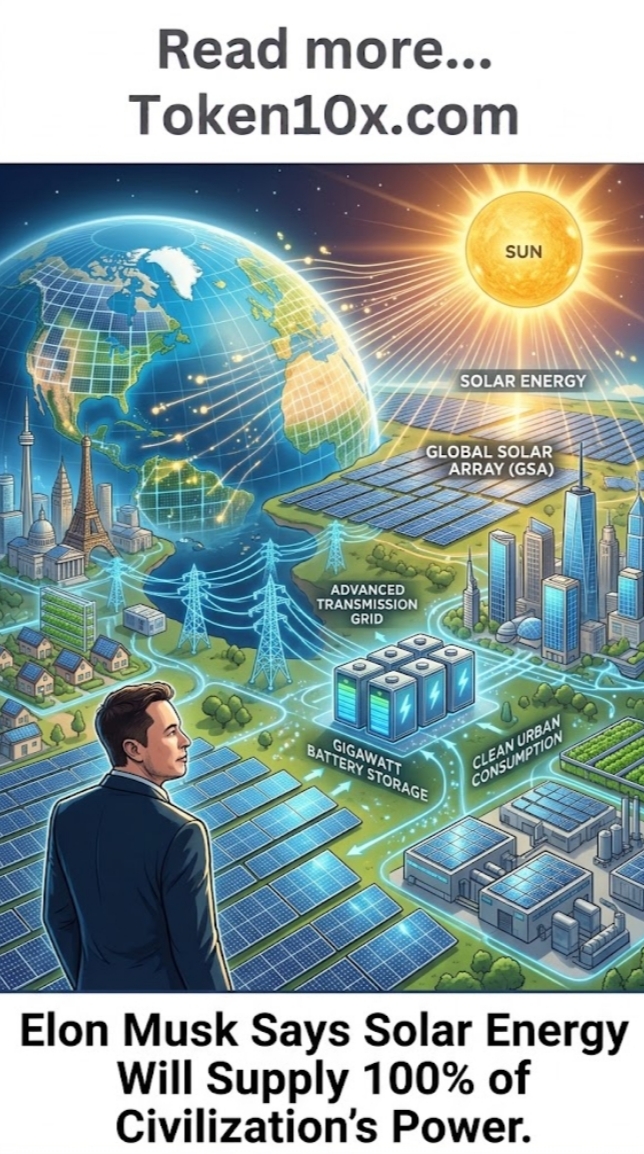
Elon Musk stated on November 16, 2026, that solar energy will ultimately provide essentially all of the energy used by civilization. In a post on X, the Tesla and SpaceX chief executive wrote: “The amount of energy we harness for civilization from the Sun will obviously ultimately round up to 100% of all energy. That math is obvious and trivial.” The comment responded to a post citing his earlier prediction that solar would become by far the largest source of power for civilization and highlighting the more-than-tenfold growth in global solar generation over the past decade.
Musk has made similar long-term forecasts for years, arguing that the physical abundance of sunlight makes solar the inevitable dominant energy source once storage and manufacturing scale sufficiently. Contemporary data cited in related discussion show solar generation rising from roughly 256 terawatt-hours in 2015 to more than 2,700 terawatt-hours by 2025, with strong recent growth and declining battery costs supporting greater daily utilization.
The Drivers of the Current Situation
The main issue is Musk’s renewed public assertion that solar will round to essentially 100 percent of civilization’s energy supply, framed as a straightforward physical and economic calculation rather than a distant aspiration. The statement arrives amid continued rapid expansion of solar capacity and falling storage costs, yet solar still accounts for well under 10 percent of global electricity generation.
Related factors shaped the comment. Historical growth rates, the vast excess of incoming solar radiation relative to human energy demand, and ongoing cost declines in panels and batteries form the quantitative backdrop Musk has repeatedly referenced. Only the confirmed wording of the November 16 post, the reference to earlier predictions, and the cited multi-fold increase in solar output over the past decade are verified. Broader debates over intermittency, grid infrastructure, land use, and the role of other low-carbon sources continue in parallel.
Continued monitoring requires observation of actual deployment rates, storage-cost trajectories, and whether policy or industrial actions align with the projected dominance. Limited near-term detail on precise timelines or the residual role of other sources forms a narrower path for assessing the claim’s practical horizon. Energy analysts, policymakers, solar and battery manufacturers, and investors remain the primary parties tracking residual effects. The situation is a high-profile restatement of a long-held view that solar will become the near-exclusive energy source for civilization.
Impact and Broader Context
Questions about the realism and timeline of a near-100-percent solar energy system keep growing. The statement creates uncertainty about the pace of necessary infrastructure build-out while reinforcing confidence among solar advocates and certain investors. It also elevates attention on the gap between current market share and the physical potential Musk emphasizes. Grid operators, competing energy technologies, climate-policy makers, and capital markets continue to assess the implications.
The issue drives debate on energy-system pathways. It raises questions about the durability of multi-source strategies versus solar-centric ones, the limits of storage and transmission as enabling technologies, risks of under-investment in complementary firm power, effects on near-term capital allocation in the energy sector, and competition among long-term technology roadmaps. Coverage notes that the claim rests on the scale of available sunlight and historical cost curves rather than a detailed deployment schedule.
The November 16 post forced renewed focus on long-term solar dominance narratives. The current commentary shows how subsequent capacity additions, cost data, or policy responses will determine the lasting effect.
New generation statistics, battery-cost reports, or industrial-scale manufacturing announcements will clarify the practical contribution of the 100-percent solar outlook.
This analysis uses Musk’s November 16 X post and contemporaneous reporting on solar-generation trends. Actual energy-mix outcomes and the ultimate share of solar remain subject to technological, economic and policy developments.