

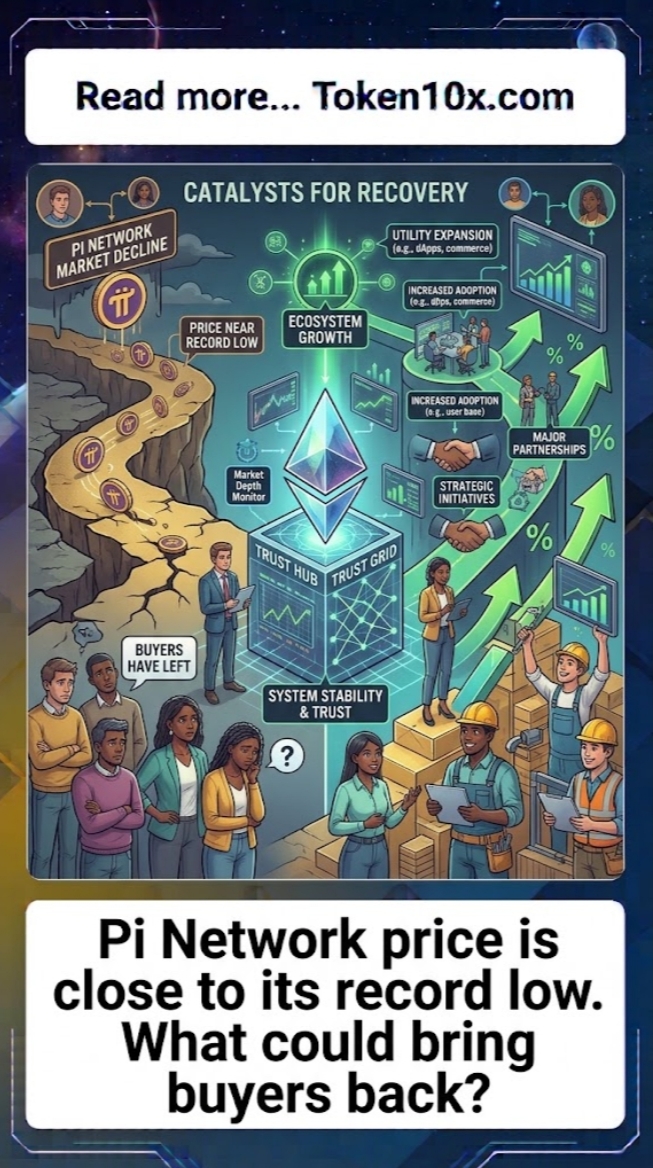
Pi Network (PI) is trading near its record low levels in early November 2026, with prices recently around $0.07–$0.08 after declining more than 95–97% from its all-time high near $2.90–$3.00 in early 2025. The token has faced persistent selling pressure amid ongoing token unlocks that add significant supply, relatively thin trading liquidity, and limited sustained demand.
Despite a large user base and ongoing ecosystem development, price has remained subdued. Potential catalysts that observers say could attract buyers include successful protocol upgrades, expanded smart-contract and app functionality, major exchange listings that improve liquidity, stronger real-world utility or lockup mechanisms, and high-profile events such as the Pi Ecosystem Summit (scheduled for mid-November 2026).
The Drivers of the Current Situation
The main issue is the divergence between Pi Network’s large community and technical progress on one side and its price sitting close to all-time lows on the other. Confirmed factors include the steep decline from the 2025 peak, continuous token unlocks that increase circulating supply, thin 24-hour trading volumes relative to market capitalization, and the absence so far of demand strong enough to absorb the new supply. Related elements include recent developer tool releases, protocol upgrades, and the upcoming Ecosystem Summit, which some market participants view as possible turning points if they deliver measurable adoption or liquidity improvements.
Further price action, unlock schedules, or concrete adoption metrics will determine whether these elements shift the balance.
Impact and Broader Context
Pi’s price behavior highlights the challenge of converting network growth and user numbers into sustained buying pressure when supply continues to expand and liquidity remains limited. It raises questions about the effectiveness of ecosystem expansion in driving demand, the role of major exchange listings in improving market depth, the impact of unlock schedules on price discovery, the potential of events and upgrades to reset sentiment, and the broader difficulty of maintaining value in community-driven projects after initial listing enthusiasm fades. Coverage distinguishes between documented on-chain and development progress and the still-unproven assumption that these will translate into meaningful price recovery.
Subsequent unlock data, summit outcomes, listing announcements, or shifts in trading volume will clarify whether buyers return in force.
This analysis draws from market price data, on-chain supply observations, project development updates, and contemporaneous commentary. Exact future price direction, the impact of any specific catalyst, and the sustainability of demand remain subject to evolving market conditions and further project execution.