

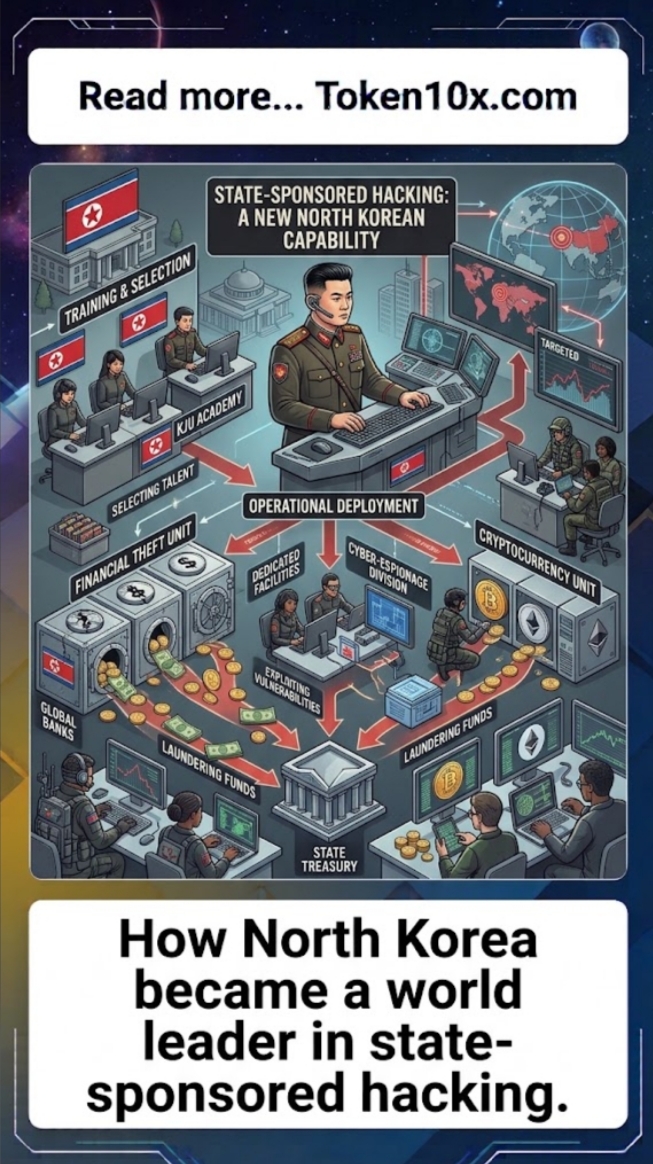
North Korea has developed one of the world’s most capable and prolific state-sponsored cyber programs, evolving from early domestic computing efforts into a major source of revenue and strategic capability. U.S. authorities and blockchain analytics firms have linked groups under the broader Lazarus umbrella—including the unit known as TraderTraitor—to major cryptocurrency thefts, most recently attributing the October 29, 2026 Binance hot-wallet breach (approximately $6.3 billion) to TraderTraitor with high confidence.
The program’s roots date to the 1980s–1990s, when North Korea established computing infrastructure, the Korea Computer Center (1990), and formal military cyber directives under Kim Jong-il. Education in computers became compulsory, and elite students skilled in mathematics and science are selected young for specialized military-linked training institutions. Estimates place the number of trained cyber personnel in the range of several thousand (around 6,000–8,400 in recent assessments). Operations expanded from early South Korea-focused attacks in the 2000s to global campaigns, including the 2014 Sony Pictures hack, the 2016 Bangladesh Bank heist attempt, the 2017 WannaCry ransomware, and a sustained focus on cryptocurrency platforms since around 2017–2018.
The Drivers of the Current Situation
The core issue is North Korea’s transformation of cyber operations into a primary tool for generating hard currency under international sanctions, alongside espionage and disruption. Confirmed elements include the long-term state investment in talent selection and training, the shift toward financially motivated attacks (especially crypto heists) after tighter sanctions, repeated high-confidence attributions by the FBI, TRM Labs, Chainalysis and others to Lazarus-linked units such as TraderTraitor, and the scale of recent thefts that have made North Korea responsible for a large share of global crypto-related cyber losses. These activities are widely assessed as funding regime priorities, including weapons programs.
Further attributions, recovery of stolen assets, or shifts in operational tactics will continue to shape assessments of the program’s trajectory.
Impact and Broader Context
North Korea’s cyber apparatus illustrates how a resource-constrained, isolated state can achieve outsized impact through systematic talent development, low operational risk relative to conventional forces, and adaptation to high-value digital targets. It raises questions about the effectiveness of sanctions in curbing revenue streams, the challenges of attributing and disrupting state-backed laundering networks, the vulnerability of centralized crypto platforms, the long-term sustainability of such operations, and the implications for global cybersecurity norms. Coverage distinguishes between documented historical evolution and training systems on one hand, and specific incident attributions (which rely on intelligence and on-chain analysis) on the other.
Ongoing investigations into recent large-scale thefts, international coordination on freezes and sanctions, or new technical assessments will clarify the continuing evolution of these capabilities.
This analysis draws from public reports by U.S. agencies, blockchain analytics firms, academic and policy research on North Korea’s cyber program, and contemporaneous attributions related to major incidents including the 2026 Binance breach. Exact personnel numbers, precise revenue figures, and the full extent of state direction remain subject to the limits of open-source intelligence and official disclosures.