

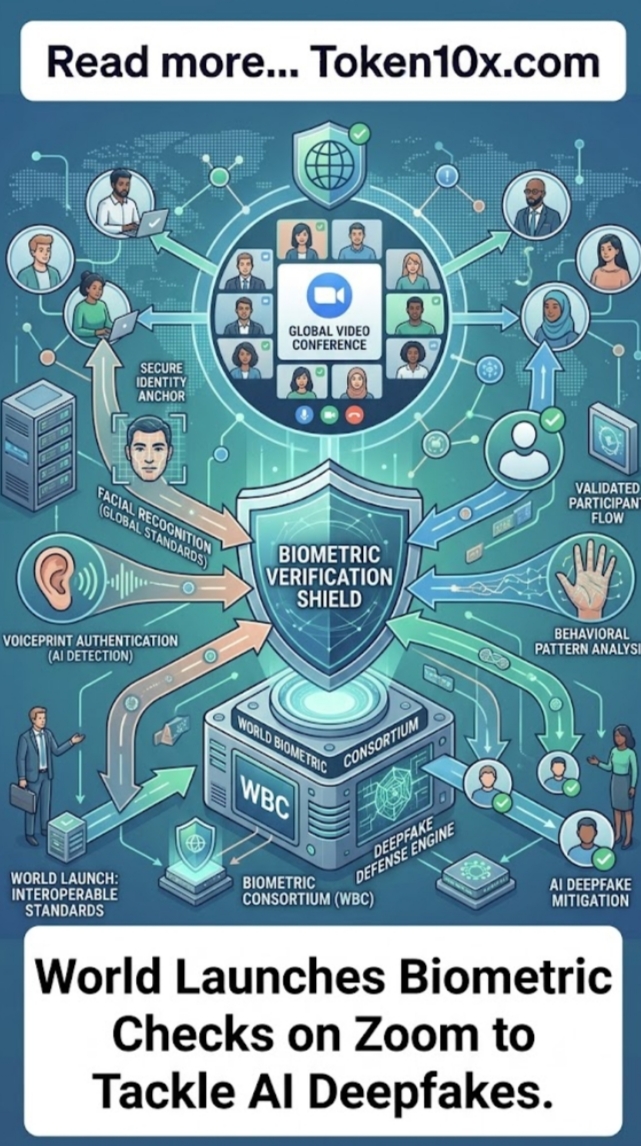
World, the identity network co-founded by Sam Altman and operated by Tools for Humanity, has made World ID for Zoom generally available in the Zoom App Marketplace. The feature uses iris-scan biometrics from the company’s Orb devices to confirm that video-call participants are real, unique humans rather than AI-generated deepfakes. As of mid-October 2026, the tool has moved from limited beta into broader enterprise availability. Co-founder Alex Blania highlighted the release alongside a new industry-specific World ID suite for banking and finance, noting that traditional frame-by-frame deepfake detection is increasingly unreliable as generative models improve.
The system leaves a user’s existing World ID intact while adding a real-time “Proof of Human” check. Compatible Zoom enterprise accounts can enable the app; successful verification displays a “Verified Human” or “Human Badge” on the participant’s video tile. The design requires no changes to Zoom’s core infrastructure beyond the marketplace integration.
The Drivers of the Current Situation
The main issue is the rapid rise of deepfake-enabled fraud on video calls. High-profile cases, including a 2024 incident in which an engineering firm employee transferred roughly $25 million after scammers impersonated executives, and later attacks involving fabricated feeds targeting crypto and fintech firms, have shown that visual and voice impersonation can bypass conventional safeguards. A 2025 Gartner survey found that 62 percent of cybersecurity leaders reported their organizations had faced a deepfake attack in the prior year.
Related factors have shaped the response. Purely algorithmic deepfake detectors face an escalating arms race with generation models; a single undetected fake can produce large losses. World’s approach instead anchors verification to a cryptographically signed reference image captured during Orb enrollment, then matches it against a live selfie taken on the user’s device and a frame from the actual Zoom video stream. Only when all three align does the badge appear. Participants can request mid-call verification, and hosts can require checks via a dedicated waiting room. Design partners including Bain Capital, VanEck Funds and Pantera Capital are exploring the broader suite, which also packages the World ID app (an identity wallet for “Proofs”) and tools for AI agents. No major bank customer has yet been publicly named. Only the general-availability announcement, the three-image matching method, and the initial design-partner list are confirmed. Broader concerns about AI-driven impersonation in finance and the practical limits of detection-only solutions contributed to the constructive framing.
Continued monitoring requires observation of actual enterprise adoption rates, any regulatory scrutiny of Orb enrollment, and further technical refinements. Limited immediate disclosure on exact rollout numbers or bank contracts forms a narrower path for precise forecasting. World and its partners are actively advancing related proof-of-human tools. The situation is a targeted biometric verification layer that closes a real-time deepfake risk on Zoom while preserving the user’s existing World ID credential.
Impact and Broader Context
Questions about World’s biometric Zoom checks and the accompanying banking suite keep growing. The design creates uncertainty about how quickly enterprises will enroll employees at Orb devices and how widely the badge will be required in high-stakes meetings. It also elevates attention on “harvest now, spoof later” risks that arise when video platforms become vectors for AI impersonation. Users, financial institutions, competing identity providers and regulators continue to assess the implications.
The issue drives debate on biometric proof-of-human systems for privacy- and security-focused platforms. It raises questions about the durability of video-call trust under advancing generative AI, the limits of client-side and marketplace mitigations before platform-wide standards emerge, risks of similar exposure on other collaboration tools, effects on near-term confidence in remote financial and corporate interactions, and competition among post-deepfake identity roadmaps. World stresses that the check isolates verification to a cryptographic three-way match and that biometric data remains local. Coverage notes that the feature could reach enterprise users ahead of broader industry standards for human verification.
The mid-October general-availability announcement and Money20/20 presentation forced renewed focus on practical defenses against deepfake fraud. The current rollout shows how subsequent bank integrations, additional platform partnerships, or further deepfake incidents will determine the lasting effect.
New enterprise deployments, updated technical specifications, or competing verification proposals will clarify the practical contribution of the Orb-anchored Zoom check.
This analysis uses World’s engineering and product announcements together with contemporaneous reporting. Adoption timelines and the ultimate effectiveness against future generative models remain subject to software releases, enrollment scale and technological developments.