

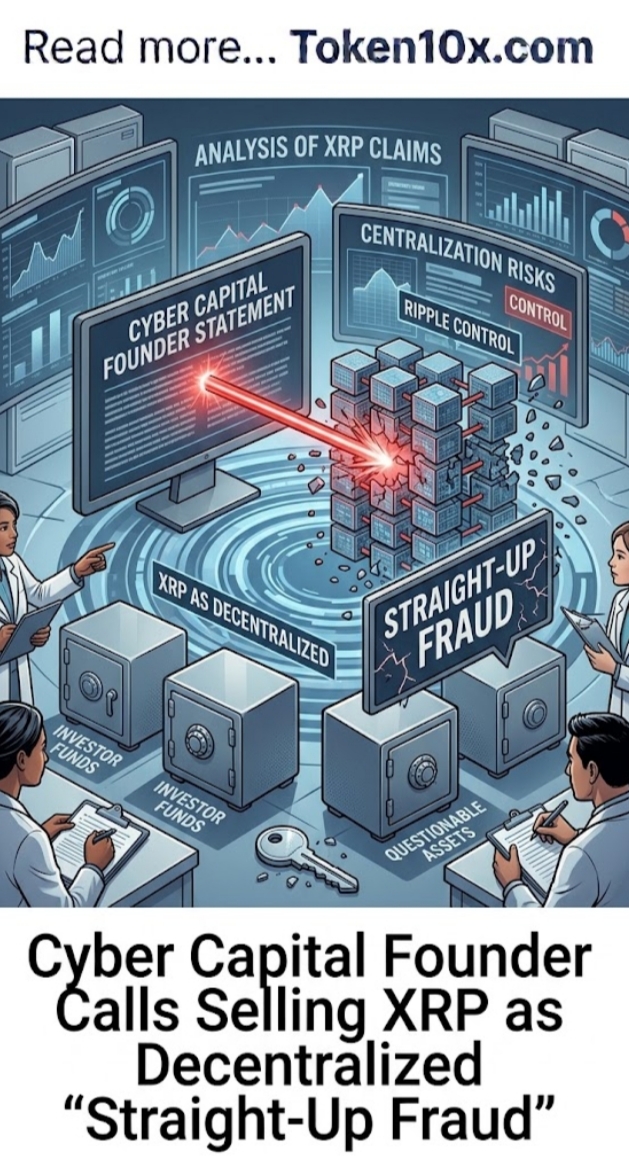
Cyber Capital founder Justin Bons has sharply criticized claims that XRP is decentralized. As of early October 2026, Bons stated that selling XRP to retail investors while describing the network as decentralized amounts to “straight-up fraud.” His comments center on the XRP Ledger’s recent emergency software process and its reliance on recommended validator lists. The remarks renew a long-running debate over the network’s governance model.
Bons continues to challenge the decentralization narrative. He has restricted his strongest language to the marketing of XRP to the public. Existing technical features of the ledger, including the Unique Node List approach, form the basis of his critique. Critics of his view rely partly on the ability of anyone to run nodes and validators while routing discussions through differing definitions of decentralization. This highlights the difference between permissioned validator recommendations and fully open, permissionless consensus systems.
The Drivers of the Current Situation
The main issue is transparency and control in the XRP Ledger’s recent upgrade process. An emergency release (xrpld 3.4.1) issued in late September addressed security-sensitive issues and was initially distributed as binaries while the corresponding source code was withheld. Bons argued that the code had been running in closed-source form and was becoming mandatory, limiting the ability of operators to inspect changes. No evidence of exploitation of the underlying issue has been reported by developers.
The critique has limited new technical revelations beyond the temporary closed-source period. Some of Bons’ points focus on the recommended validator lists published by Ripple and the XRP Ledger Foundation, which he says concentrate influence. Network participants can choose different lists, though documentation notes that insufficient overlap can cause divergence. Only Bons’ characterization of retail marketing as fraud represents the sharpest claim. Broader historical criticisms of XRP’s supply distribution and Ripple’s role also appear in his comments.
Continued debate requires responses from developers and independent analysis of the upgrade. Limited public source-code availability during the emergency window forms a narrower path for verification. Market participants and governance observers are actively discussing the implications. The situation is a decentralization and transparency dispute tied to the XRP Ledger’s operational model.
Impact and Broader Context
Questions about the Cyber Capital founder calling the sale of XRP as decentralized “straight-up fraud” keep growing. The strong language creates uncertainty around how retail investors should interpret decentralization claims. It also affects ongoing discussions of XRP’s governance relative to other networks. Analysts, developers, and token holders continue to examine the validator and software processes.
The issue drives debate on what constitutes meaningful decentralization. It raises questions about the role of recommended validator lists, the limits of temporary closed-source security practices, risks of concentrated influence over network upgrades, effects on investor perceptions, and competition between different consensus and governance designs. Stakeholders on the other side stress that nodes and validators remain open to participation. Official developer materials frame the emergency release as a necessary security response.
The October comments forced renewed public scrutiny of XRP Ledger governance. The current discussion shows how subsequent source-code releases, validator behavior, and further technical disclosures will shape the narrative.
New developer statements, full source availability, or independent audits will clarify the practical degree of decentralization and transparency on the network.
This analysis uses Justin Bons’ public statements, coverage of the XRP Ledger software release, and related commentary on validator lists. Characterizations of fraud remain the opinion of the speaker and are not established legal findings. Network governance details remain subject to ongoing development and community practice.