

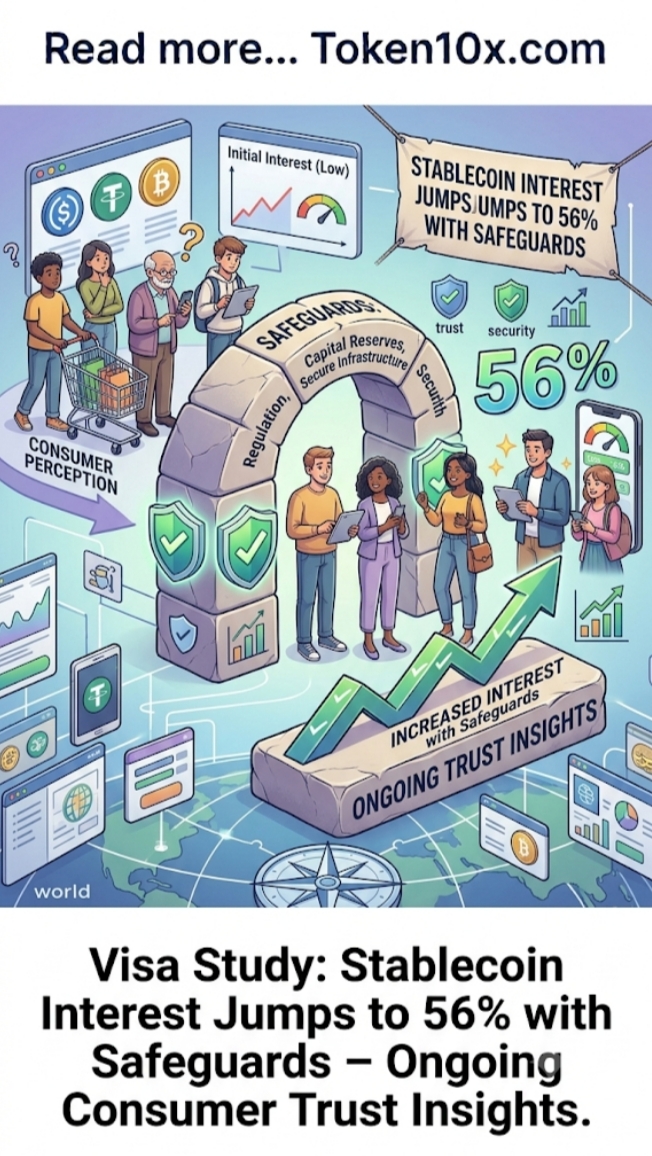
Visa continues to examine evolving payment preferences, with its latest research highlighting how consumer protections could significantly increase openness to stablecoins. As of the Money Travels 2026 report released on September 23, 2026, a survey of U.S. adults found that stated willingness to use stablecoins rose from 36% to 56% when respondents were presented with a hypothetical scenario including bank-level fraud protection and deposit insurance.
The findings still reflect attitudes toward digital currencies pegged to stable values such as the U.S. dollar, particularly in the context of cross-border remittances and everyday payments. Nearly two-thirds of respondents indicated that trust depends more on the provider than on the underlying technology. This comparison underscores the importance of familiar safeguards in driving potential adoption.
The Drivers of the Survey Results
The key factor remains the impact of perceived security features on consumer intent. Conducted by Morning Consult between February 24 and March 2, 2026, the research surveyed 2,192 U.S. adults (part of a broader global sample). Baseline interest stood at 36%. That figure increased to 45% when stablecoins were described as being offered through an existing financial provider, and climbed further to 56% with the addition of bank-style fraud protection and deposit insurance.
This stacks with related insights showing that 56% of U.S. respondents had never heard of stablecoins prior to receiving definitions in the survey. Traditional commercial banks earned trust from 61% of respondents for providing digital currency services, while global payment networks were trusted by 60%. Visa also noted that its own stablecoin settlement volume has surpassed a $20 billion annualized rate. Only hypothetical scenarios incorporating established consumer protections produced the higher interest levels; actual current usage remains lower and more limited.
It is essential to distinguish: the 56% figure represents stated adoption intent under specific protective conditions, whereas it does not reflect observed real-world usage rates or guaranteed future behavior. The results are mostly survey-based insights linked to Visa’s broader examination of remittances, payment security, and technology adoption.
Impact and Broader Context
As a leading global payments company, Visa’s findings advance understanding of the conditions under which mainstream consumers may become more receptive to stablecoins. Highlighting the jump from 36% to 56% with safeguards grows the case for integrating familiar protections into digital-asset offerings. The report also addresses related concerns, including worries about AI deepfakes in money transfers and experiences with cross-border payment scams.
This sustained research fuels discussions on the role of trust, regulation, and established financial institutions in accelerating stablecoin adoption for remittances and payments. Advocates point to the clear lift in interest when bank-level features are present. Observers note the persistent awareness gap—more than half of respondents were unfamiliar with the concept—and the preference for trusted providers over novel technology alone.
Industry participants recognize that bridging the gap between crypto-native tools and traditional consumer expectations remains a central challenge. Visa’s September 2026 study offers insight into how safeguards and provider credibility can influence willingness to engage with stablecoins.
As further consumer research, regulatory developments, and real-world product launches emerge, the translation of stated intent into actual usage will become clearer.
This analysis draws from Visa’s official Money Travels 2026 report and related coverage for precision. Survey results reflect stated preferences under hypothetical conditions and are subject to the methodology and sample of the underlying research.