

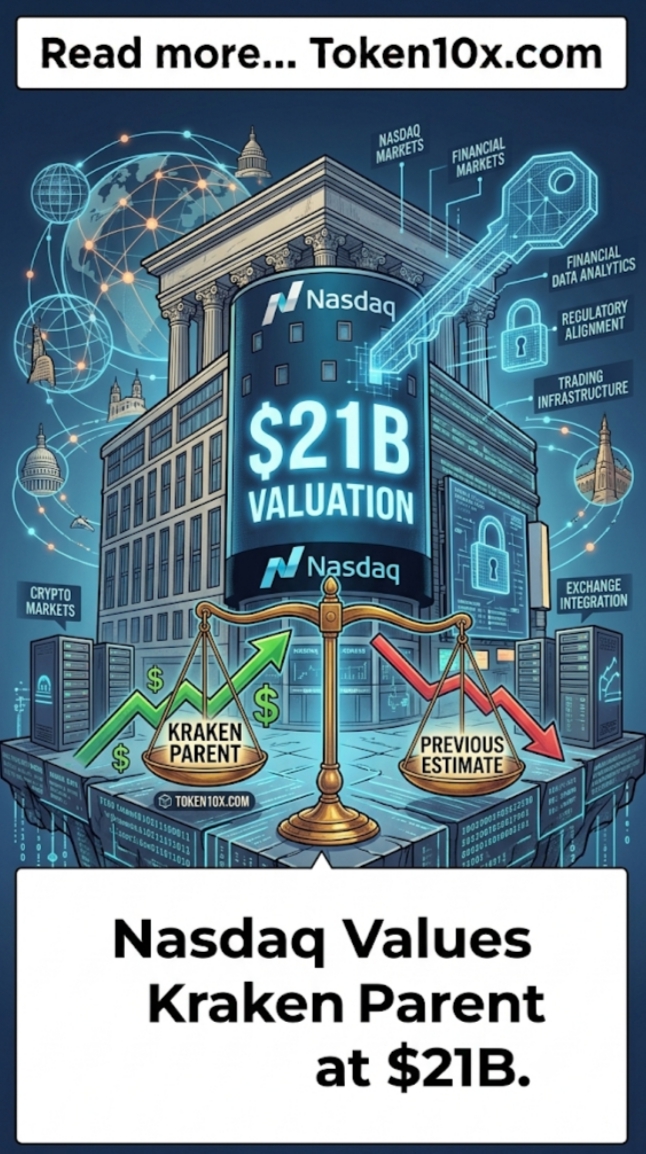
Nasdaq’s venture arm is investing $100 million in Payward, the parent company of cryptocurrency exchange Kraken, according to Bloomberg and subsequent reports. The deal values the crypto firm at $21 billion.
The investment expands a partnership announced in March focused on infrastructure for tokenized stocks and marks another traditional exchange operator taking a stake in a major crypto platform.
The Drivers of This Investment
Nasdaq is advancing its push into tokenized equities that can trade around the clock while preserving features such as voting rights equivalent to traditional shares. Payward already operates relevant technology through its xStocks service, which has processed substantial volume, making it a natural partner for distribution, settlement, and market infrastructure. The capital also provides Payward additional runway ahead of a delayed IPO now targeted no earlier than 2027. For perspective, the $21 billion figure represents a modest step up from Payward’s prior $20 billion valuation in late 2025 fundraising involving firms such as Citadel Securities, Jane Street, and DRW.
It is important to note the fundamental difference between pure venture capital bets and this strategic investment: Nasdaq is not only supplying capital but deepening operational collaboration, including Kraken’s distribution of Nasdaq Equity Tokens and Payward’s planned adoption of Nasdaq’s market-surveillance technology across crypto, equities, and related venues.
Impact and Broader Context
The deal strengthens the bridge between traditional finance and on-chain markets, potentially accelerating the launch of tokenized Nasdaq-listed stocks expected in the second quarter of 2027. This development sparks important discussions about the future of 24/7 equity trading, regulatory treatment of tokenized assets, and the competitive positioning of crypto exchanges as multi-asset platforms. Supporters view it as validation of institutional demand for blockchain-based market infrastructure and a signal of growing convergence, while critics caution that tokenized products still face unsettled regulatory, custody, and liquidity questions that could slow widespread adoption. Analysts observe that the investment continues a pattern of traditional exchanges—including earlier moves by Deutsche Börse—taking stakes in crypto firms to secure technological and distribution advantages in tokenized markets.
Further details on the tokenized products and any formal public announcements are expected as the partnership progresses toward the 2027 target. This analysis is based on Bloomberg reporting and subsequent coverage from CoinDesk, Cointelegraph, and related outlets for accuracy and reliability. Specific terms of the investment and product launch timelines remain subject to ongoing developments and formal disclosures.