

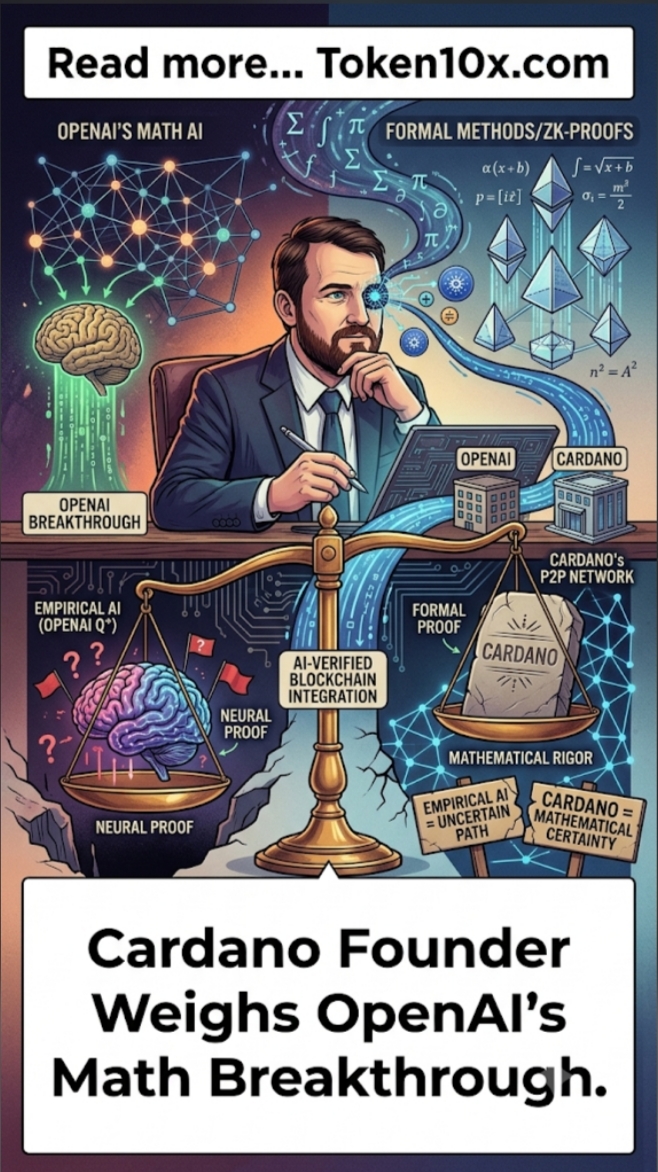
Cardano founder Charles Hoskinson has commented on recent claims of major progress by OpenAI in advanced mathematics. He said artificial intelligence has advanced further in formal mathematics than he previously expected.
Hoskinson’s remarks followed OpenAI’s announcements regarding AI-generated work on difficult open problems, including approaches related to the Navier-Stokes equations.
The Drivers of This Development
In a recent broadcast, Hoskinson described the reported capabilities as “pretty remarkable.” He noted that he had not anticipated large language models generating complete or substantial proofs so soon. “We never anticipated the extent to which AI would come in,” he said, adding that the idea of AI fully writing a proof had earlier seemed “pretty far out.” His comments came against the backdrop of OpenAI’s claims involving AI systems producing solutions or significant advances on long-standing mathematical challenges. One focus of recent discussion has been the Navier-Stokes existence and smoothness problem, a Clay Mathematics Institute Millennium Prize Problem that remains officially unsolved pending rigorous publication, peer review, and broad acceptance. Hoskinson, who in 2021 donated $20 million to establish the Hoskinson Center for Formal Mathematics at Carnegie Mellon University, also raised practical concerns about researchers submitting unpublished work to centralized AI systems and the associated confidentiality risks. For perspective, rapid AI progress in formal mathematics sits at the intersection of automated reasoning, large-scale model capabilities, and the traditional culture of mathematical discovery and attribution.
It is important to note the fundamental difference between AI systems that assist human mathematicians by searching literature, checking steps, or suggesting approaches and systems that generate substantial original proofs with limited human guidance: the latter raises new questions about verification, credit, and the evolving role of human researchers.
Impact and Broader Context
Hoskinson’s reaction highlights growing attention within both the technology and blockchain communities to AI’s expanding role in foundational scientific work. Progress on problems of the difficulty of Navier-Stokes, if fully validated, would represent a significant shift in how mathematical research is conducted. At the same time, the episode underscores unresolved issues around attribution, the status of AI-generated results prior to formal community acceptance, and the risks of feeding proprietary or unpublished research into commercial AI platforms. For projects like Cardano that emphasize formal methods, such developments also reinforce the long-term relevance of machine-checkable proofs and rigorous verification techniques.
This development sparks important discussions about the pace of AI capability in pure mathematics and its implications for research practices. Supporters of rapid AI adoption see the potential to accelerate discovery on problems that have resisted human effort for decades. Critics and cautious observers emphasize the need for independent verification, clear provenance of ideas, and safeguards for researchers’ unpublished work. Analysts observe that statements from figures such as Hoskinson help bridge conversations between the cryptocurrency ecosystem, formal methods communities, and broader AI research.
Looking ahead, formal publication, independent verification, and any official response from bodies such as the Clay Mathematics Institute will determine how these claims are ultimately assessed. This analysis is based on Charles Hoskinson’s public comments and contemporaneous reporting on OpenAI’s mathematical claims for accuracy and reliability. The scientific status of specific results remains subject to ongoing review and community evaluation.