

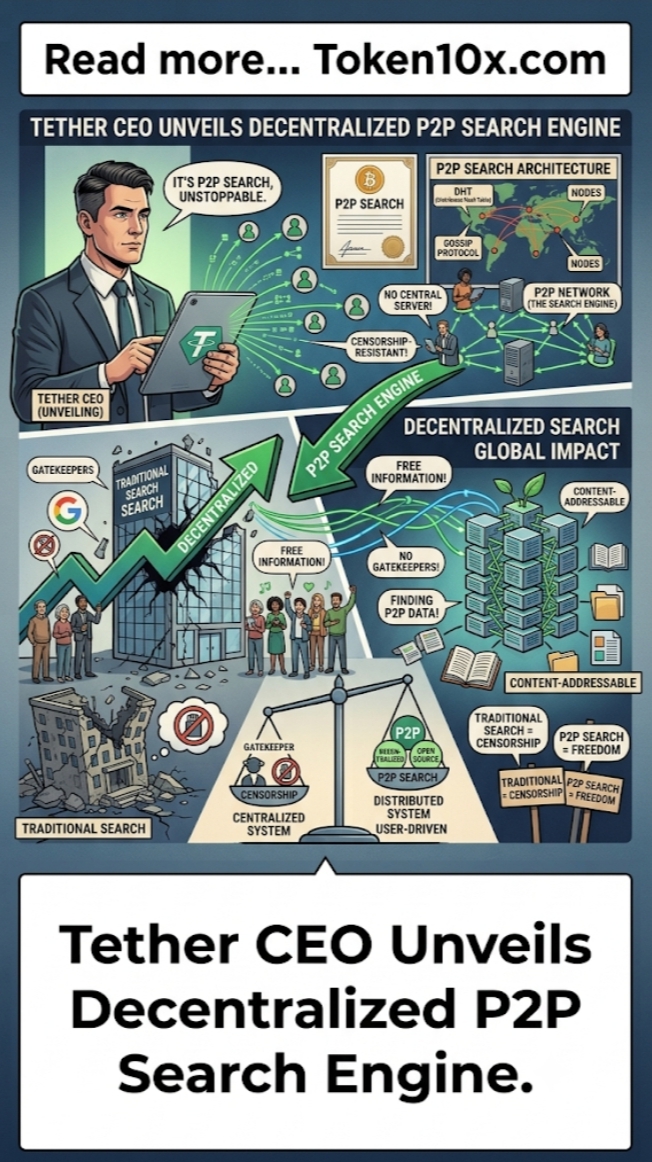
Tether CEO Paolo Ardoino has revealed that the company’s peer-to-peer team is developing a decentralized search engine designed to operate without centralized infrastructure. The project aims to deliver high availability and censorship resistance by distributing data across a network of nodes.
In recent tests, the full Wikipedia archive was stored and made searchable across 100 distributed nodes.
The Drivers of This Development
Ardoino described the system as an “Unstoppable Search Engine” that can scale to thousands of nodes while using self-organizing, fault-tolerant data structures. The goal is to keep information available even if individual nodes go offline or face external pressure. The September 2026 update showed a working search interface connected to a 100-node test network that successfully hosted and queried the complete Wikipedia archive, with Ardoino calling the performance impressive. The initiative builds on Tether’s existing work in peer-to-peer software, including tools such as the Keet messaging app and other privacy-focused applications. For perspective, distributing a large public dataset like Wikipedia across a relatively small number of nodes serves as an early proof-of-concept for a broader, more resilient search architecture.
It is important to note the fundamental difference between conventional search engines that rely on centralized data centers and indexing systems and a peer-to-peer model that spreads storage and query handling across independent nodes: the latter prioritizes resilience and resistance to single points of failure or control over the speed and comprehensive ranking features users currently expect from major platforms.
Impact and Broader Context
The project extends Tether’s expansion beyond stablecoins into decentralized infrastructure and consumer-facing tools. If successfully scaled, a censorship-resistant search layer could appeal to users and organizations concerned about content availability, platform moderation, or regional restrictions. At the same time, the technology remains in the testing phase, and significant challenges around performance at scale, result quality, spam resistance, and user adoption lie ahead. The effort aligns with a wider industry interest in decentralized alternatives to core internet services.
This development sparks important discussions about the trade-offs between centralized efficiency and decentralized resilience in information retrieval. Supporters view it as a meaningful step toward more robust public knowledge infrastructure that cannot be easily disrupted by any single entity. Critics question whether a distributed system can match the relevance, speed, and usability of established search engines while remaining practical for everyday use. Analysts observe that Tether’s financial resources and existing P2P engineering experience give the project a stronger foundation than many earlier decentralized search experiments.
Looking ahead, further progress reports on node scaling, real-world testing, and any public release plans will clarify the project’s trajectory. This analysis is based on statements from Tether CEO Paolo Ardoino and contemporaneous reporting for accuracy and reliability. Technical performance and eventual availability remain subject to ongoing development.