

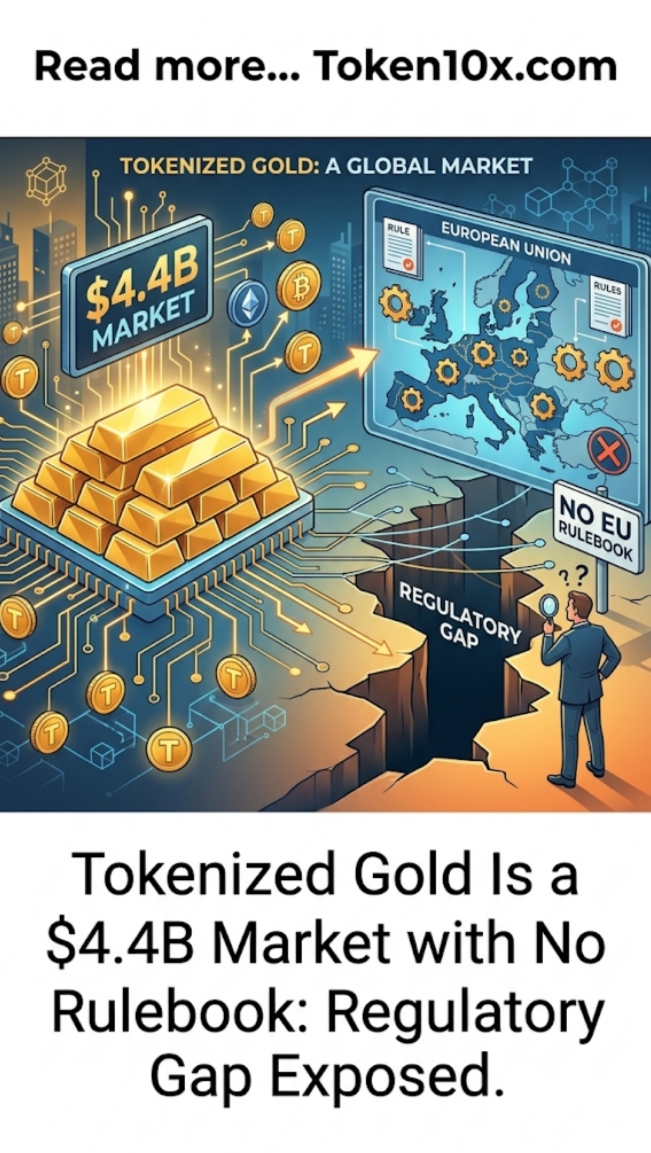
Tokenized gold has expanded into a $4.4 billion market without a dedicated regulatory framework in the European Union, leaving issuers, investors, and platforms navigating uncertainty. The asset class combines physical gold backing with blockchain efficiency for trading and ownership.
This growth demonstrates strong demand for digitized real-world assets even as the absence of specific rules creates compliance challenges and potential risks across the bloc.
The Drivers of This Market Development
Platforms tokenize physical gold reserves to enable fractional ownership, instant settlement, and improved liquidity. The $4.4 billion valuation reflects investor interest in stable, inflation-hedging assets delivered through blockchain rails, yet the lack of an EU rulebook leaves key aspects like custody standards, redemption processes, and transparency requirements unaddressed.
For perspective, tokenized real-world assets are gaining traction globally, with gold standing out for its tangible backing and historical reliability. The market size highlights momentum despite operating in a regulatory gray area.
It is important to note the fundamental difference: tokenization brings accessibility and programmability to gold, while the missing rulebook exposes gaps in investor safeguards and market oversight.
Impact and Broader Context
Tokenized gold projects have modernized access to a traditional safe-haven asset, appealing to both retail users and institutions seeking diversified portfolios with digital advantages. Current EU frameworks offer limited coverage but do not fully address commodity token specifics.
This situation sparks important discussions about real-world asset innovation, regulatory adaptation, and capital market evolution. Supporters highlight efficiency gains, lower barriers, and broader participation. Critics stress the urgency of clear rules to prevent misuse and protect participants.
Analysts observe that regulatory gaps frequently accompany emerging high-growth sectors where technology advances faster than policy. The EU is likely to consider extensions of MiCA or new commodity-focused measures.
As tokenized gold volumes grow and more players enter, the lack of a dedicated rulebook will shape adoption strategies and risk profiles. Future regulatory clarity will determine the asset class’s full potential in Europe.
This analysis is based on market capitalization data, industry reports, and regulatory assessments for accuracy and reliability. Market figures remain subject to ongoing fluctuations and developments.