

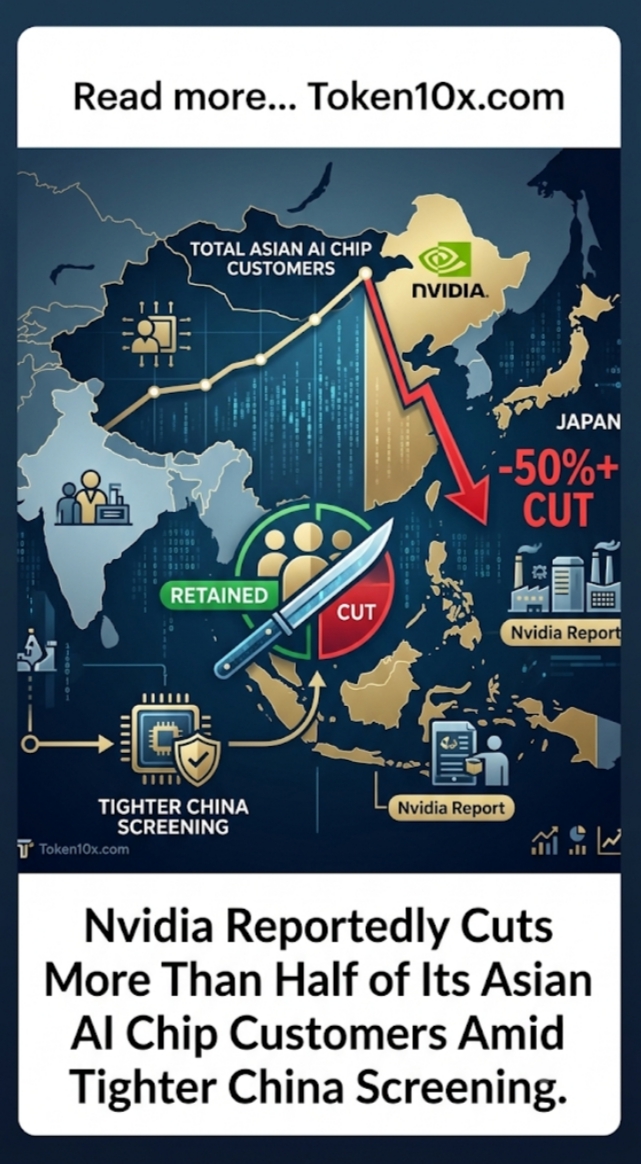
Nvidia has reportedly reduced its customer base in Asia by more than half as U.S. export restrictions and tighter screening on advanced AI chips to China intensify. The move reflects the growing impact of geopolitical tensions on the semiconductor supply chain and Nvidia’s efforts to comply with evolving U.S. regulations.
According to industry sources, Nvidia has significantly scaled back sales of its high-performance AI accelerators, such as the H20 and other China-specific variants, to numerous Asian customers. The reductions are driven by stricter licensing requirements and concerns over potential diversion of advanced chips to restricted Chinese entities.
Strategic Response
Nvidia is prioritizing compliance while protecting its core business in unrestricted markets. The company continues to develop compliant products for the Chinese market but has reportedly culled relationships with partners showing higher compliance risks or insufficient end-use verification.
This shift allows Nvidia to focus resources on high-margin customers in the United States, Europe, and other allied regions where demand for AI infrastructure remains extremely strong.
Broader Industry Impact
The reduction in Asian customers highlights the challenges semiconductor companies face navigating U.S.-China technology decoupling. Many suppliers are caught between lucrative Chinese demand and the risk of severe penalties for non-compliance with export controls.
The situation is accelerating efforts by Chinese firms to develop domestic alternatives, though gaps in advanced AI chip capabilities remain significant. It also benefits competitors and partners in non-restricted markets as Nvidia reallocates supply.
Implications for Global AI Supply Chain
Nvidia’s actions underscore the increasing fragmentation of the global semiconductor industry along geopolitical lines. While short-term revenue from China may be impacted, the company’s dominant position in AI accelerators positions it to capture substantial growth in compliant markets.
Analysts expect continued volatility in semiconductor stocks as companies adjust to shifting regulatory landscapes. The longer-term outcome will depend on the evolution of U.S. export policies and the success of China’s domestic chip development initiatives.
Nvidia is expected to provide more details on its regional sales strategy and compliance efforts in upcoming earnings reports. This development further illustrates how U.S.-China technology competition is reshaping global supply chains and influencing corporate decision-making in the artificial intelligence era.