

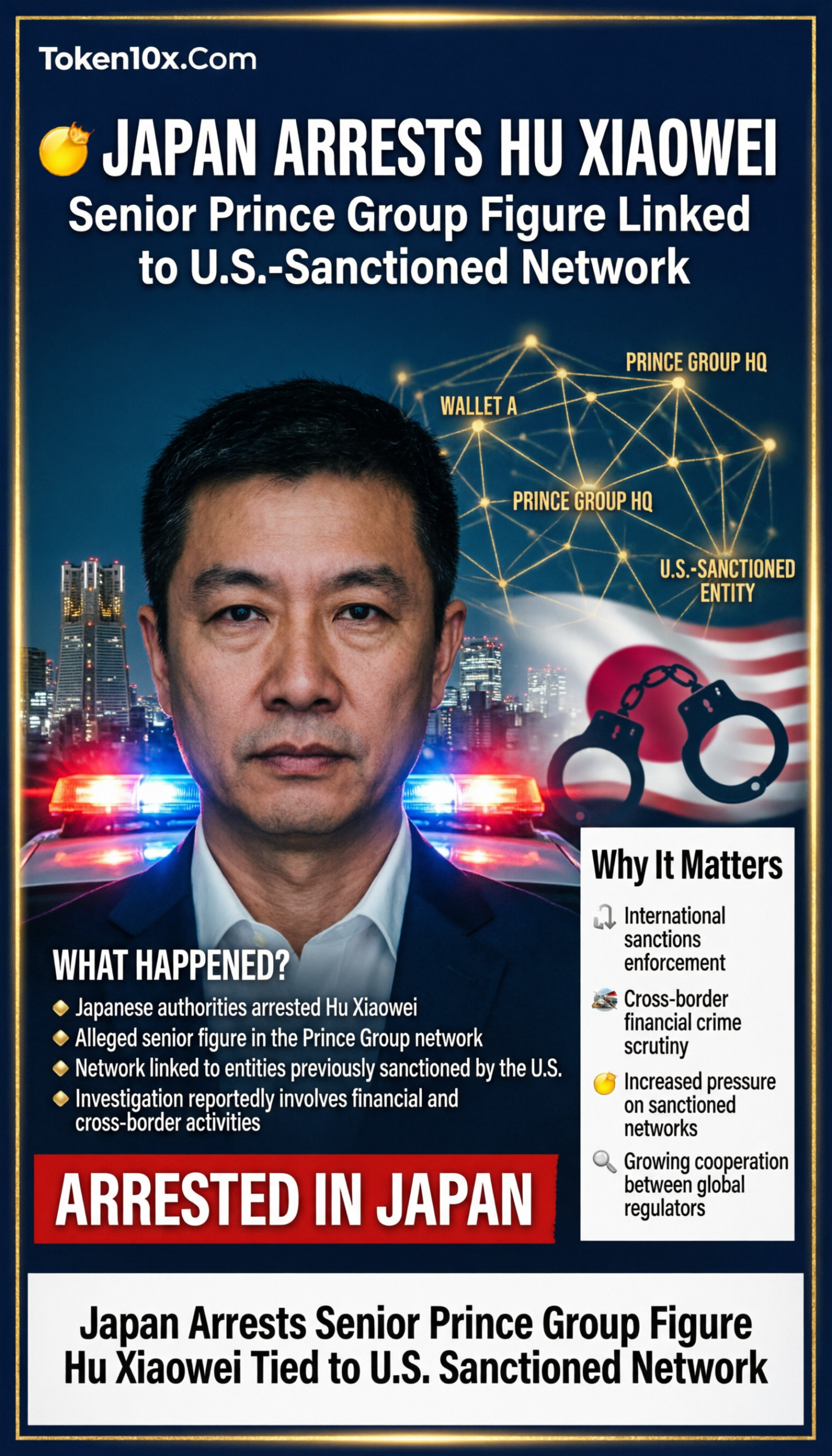
Japanese authorities have arrested Hu Xiaowei, a senior executive linked to Cambodia’s Prince Group, on suspicion of submitting false residency registration documents in Tokyo. The arrest, carried out by Tokyo’s Metropolitan Police Department on June 22, 2026, targets a figure connected to a transnational criminal network sanctioned by the United States and United Kingdom for alleged involvement in large-scale cyber fraud, money laundering, and related activities.
Hu Xiaowei, a 44-year-old Cypriot national of Chinese descent also known as Hu Shi or by other aliases, was detained alongside two associates. Police allege the group conspired to file a false move-in notification at Chuo Ward office in April 2026 to support an application for permanent residency in Japan. Investigators plan to examine the Prince Group’s broader activities and assets within the country.
Details of the Arrest and Alleged Ties
Hu is believed to be one of the top executives in the Prince Group (also known as Prince Holding Group), a Cambodia-based conglomerate. U.S. authorities have designated the organization as a significant transnational criminal organization involved in online investment scams, forced labor compounds, and money laundering operations that allegedly defrauded victims worldwide of billions of dollars. The U.S. Treasury and UK imposed sweeping sanctions on the group and its associates in 2025.
Hu has reportedly used multiple identities and maintained international business interests, including properties in the UK that were later frozen. Reports indicate he made repeated trips to Japan via private jets, raising questions about potential asset movement or safe haven activities following sanctions. The current charges focus on immigration-related false declarations rather than the underlying fraud allegations directly.
Background on the Prince Group
The Prince Group has faced intense international scrutiny. Its chairman, Chen Zhi, was previously arrested and extradited. Authorities in multiple countries, including the U.S., UK, Taiwan, and others, have taken actions to seize assets and disrupt the network. The group’s operations have been linked to cyber scam compounds in Southeast Asia, human trafficking concerns, and sophisticated financial schemes involving cryptocurrency and investment fraud.
Japan’s move signals growing cooperation in global efforts against transnational crime. Police will use the case to probe potential money laundering or illicit financial flows connected to sanctioned entities operating or holding assets in the country.
Broader Implications
This arrest highlights the challenges of enforcing international sanctions and tracking high-profile figures who use multiple identities and complex corporate structures. It strengthens international collaboration in combating cyber-enabled fraud that preys on victims globally. For Japan, the case underscores the need for stronger oversight of residency applications and real estate investments potentially linked to foreign criminal proceeds.
The development may accelerate asset tracing and further regulatory measures in the Asia-Pacific region. As investigations continue, authorities are expected to share information with partners in the U.S., UK, and other affected jurisdictions. The incident serves as a reminder of the evolving nature of transnational organized crime and the importance of coordinated law enforcement responses in an interconnected world.
This situation remains active, with potential for additional charges or international requests as the probe into Hu Xiaowei and associated networks deepens.