

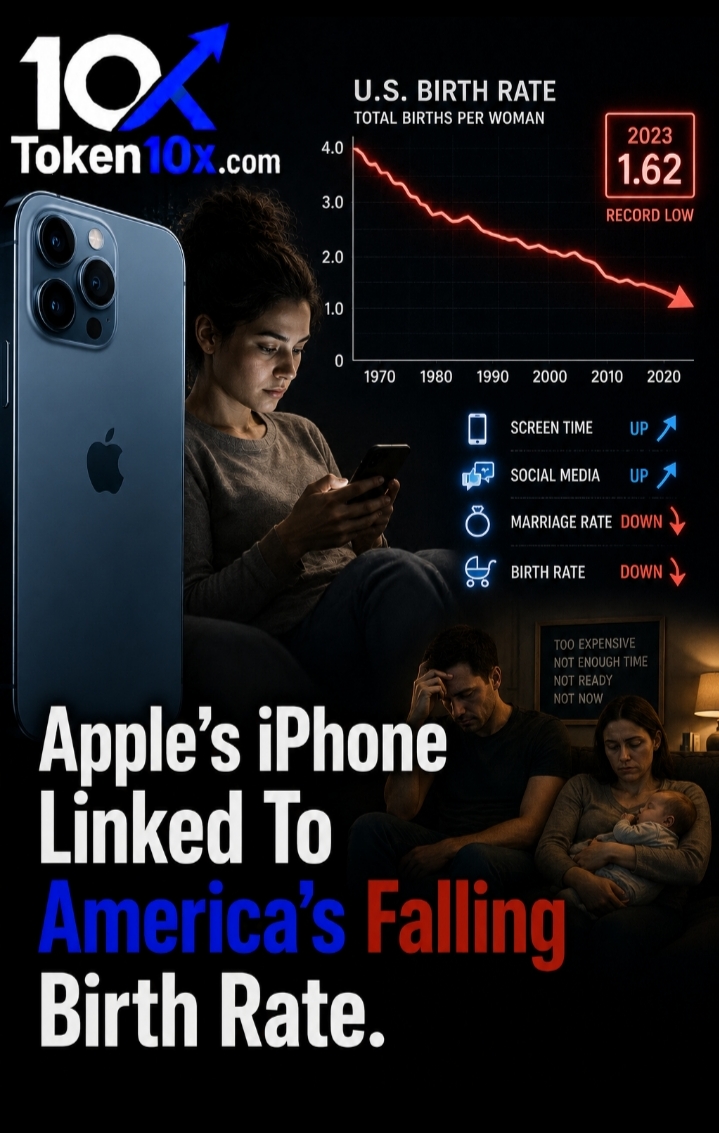
A new economic study has linked the launch of Apple’s iPhone in 2007 to a significant portion of the long-term decline in U.S. birth rates, suggesting smartphones have reshaped social behaviors in ways that reduce fertility.
The working paper, published by the National Bureau of Economic Research, was authored by Middlebury College economist Caitlin Myers and co-author Ezekiel Hooper. It exploits a natural experiment from the iPhone’s early years, when the device was available exclusively through AT&T from 2007 to 2011. Researchers compared county-level birth data in areas with strong AT&T coverage, where iPhones spread rapidly, to those with limited or no coverage.
The findings are striking. Access to the iPhone was associated with birth rate reductions of 4.5% to 8% among teens aged 15-19 and 3.2% to 6.6% among women in their early 20s. Overall, the diffusion of the iPhone accounts for an estimated 33% to 52% of the decline in the general fertility rate for women aged 15-44 during that period. Birth rates fell faster in high-coverage counties even after controlling for economic factors like the Great Recession, education, income, and contraceptive policies. Placebo tests using other carriers showed no similar effects.
Researchers point to several behavioral shifts. Smartphones appear to have reduced in-person social interactions, increased time spent alone on devices including doomscrolling and pornography consumption, and made information on contraception more readily available. National survey data on time use and sexual behavior supports these channels, with evidence of lower sexual frequency in the smartphone era.
The U.S. general fertility rate has dropped roughly 23% since 2007, reaching historic lows. While economists have long cited economic pressures, housing costs, and shifting social norms, this study adds compelling causal evidence tying the timing and geography of the decline to the smartphone revolution.
The paper, which has not yet undergone full peer review, has sparked debate. Critics note fertility trends predated the iPhone and emphasize multifaceted causes, but the research highlights how technology may be quietly influencing intimate life decisions. As smartphones evolve with new features like advanced AI, the conversation about their broader societal impacts is likely to intensify.