

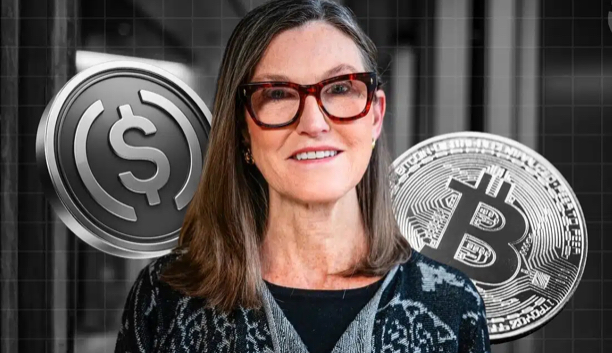
Ark Invest CEO Cathie Wood, one of Bitcoin’s most vocal supporters, has revised her long-term Bitcoin price target downward by $300,000. She cited the rapid rise of stablecoins as a major factor reshaping the crypto landscape.
Speaking to CNBC on Thursday, Wood said she now expects Bitcoin to reach $1.2 million by 2030, down from her earlier prediction of $1.5 million, as stablecoins begin to take over some of the functions she once believed Bitcoin would fulfill.
Wood explained that stablecoins, digital assets pegged to fiat currencies like the U.S. dollar are increasingly being used in emerging markets for payments, savings, and cross-border transactions.
“Stablecoins are usurping part of the role that we thought Bitcoin would play,” she said. “Stablecoins are scaling here, I think, much faster than anyone would have expected.”
Originally viewed as a bridge for crypto traders, stablecoins such as Tether (USDT) and USD Coin (USDC) have evolved into vital financial tools in countries struggling with inflation, sanctions, or limited banking access.
In places like Venezuela and Argentina where the local currency is still losing value, individuals are resorting to stablecoins as a way of maintaining their purchasing power and avoiding stringent currency restrictions.
A 2025 report by Standard Chartered Bank projected that the dollar-pegged stablecoins would drain more than $1 trillion out of the conventional banking system in developing countries by 2028.
This growing adoption is now forcing analysts, and even Bitcoin’s biggest bulls, to reconsider the cryptocurrency’s long-term utility as a medium of exchange.
The global stablecoin movement gained new legitimacy in July when the U.S. President Donald Trump signed the GENIUS Act into law, creating the first federal framework of issuing and trading stablecoins in the U.S.
The law opened the door to banks, large companies such as Meta and Amazon, and even states of the U.S. to consider blockchain-based payment systems.
As the institutional interest increases, stablecoins are ceasing to be perceived as digital dollars, they are becoming a component of the new financial system.
Despite cutting her forecast, Wood remains firmly bullish on Bitcoin’s future, calling it a “Bitcoin is a global monetary system” and a modern store of value akin to gold.
She still expects the cryptocurrency to capture at least half of the gold market’s $14 trillion valuation, driven by institutional adoption and its growing reputation as a hedge against monetary inflation.
Bitcoin’s recent performance reflects a market caught between innovation and uncertainty. As of Friday, Bitcoin traded at $101,565, according to CoinMarketCap, down over 19% from its October all-time high of $126,080. The decline below the $100,000 mark earlier this week, the first in six months, has been attributed to macroeconomic turbulence and tightening liquidity.
Wood’s revised target echoes a broader shift in sentiment among Bitcoin bulls. Earlier this week, Galaxy Digital reduced its own 2025 Bitcoin target from $185,000 to $120,000, describing a new “maturity era” for Bitcoin marked by institutional participation, regulatory clarity, and reduced volatility.
Still, not all investors are tempering expectations. Prominent Bitcoin advocates Michael Saylor of Strategy and Robert Kiyosaki, author of Rich Dad Poor Dad, both recently predicted Bitcoin could hit $150,000–$200,000 by the end of 2025.
They are optimistic because institutional accumulation and ETF inflows are increasing, and the fixed supply of Bitcoin is still appealing to those who are concerned about the inflationary nature of fiat currencies.
Bitcoin and stablecoins redefine the future of money
The forecast change by Wood points to a notable change in the crypto narrative. Although Bitcoin is still the most popular digital store of value, stablecoins are becoming an increasingly popular instrument to use in real-world financial transactions, particularly in developing economies.
This dual growth suggests that the crypto ecosystem is evolving, not shrinking. The future of Bitcoin might be in preserving wealth rather than paying, and stablecoins might drive the digital payments revolution across the globe.
As Wood summed it up, “I think the whole space gets bigger. This is, you know, a global monetary system really going digital without government oversight, very private. So it’s a very big idea.”
When Bitcoin is still hovering in the six-figure range and stablecoins are transforming the world economy, a recalibration by Wood is an indication that even the most ardent crypto believers are adjusting to a rapidly shifting digital economy.