

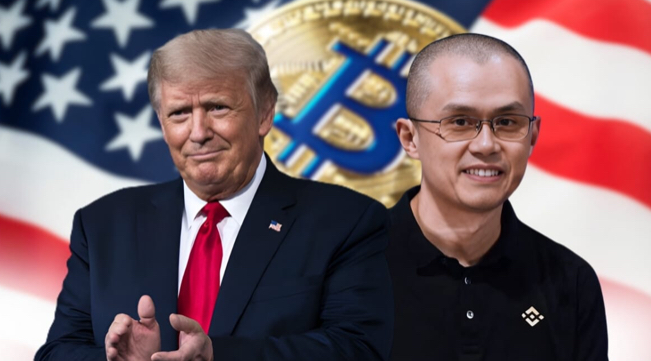
The U.S. President Donald Trump’s administration has ignited a political firestorm after defending its controversial pardon of Binance Co-Founder Changpeng Zhao (CZ).
The decision, announced just days after Trump claimed he did not know Zhao, has been positioned by the White House as a turning point in U.S. crypto policy. They have hailed it as one that ends former U.S. President “Joe Biden’s war on cryptocurrency.”
White House Press Secretary Karoline Leavitt told reporters on Tuesday that the pardon reflects President Trump’s commitment to “utmost seriousness” when dealing with pardons and new policies. She accused the previous administration of waging an unfair regulatory crusade.
“He’s (Trump) the ultimate final decision maker. and he was very clear when he came into office that he was most interested in looking at pardoning individuals who were abused and used by the Biden Department of Justice and were overprosecuted by a weaponized DOJ. And the individual you’re referring to, that was certainly the case. Even the judge in his case said that the sentencing that the Biden administration was asking for was egregious and went too far. And so the president is correcting that wrong and he has officially ended the Biden administration’s war on the cryptocurrency industry,” Leavitt said.
CZ, who previously pleaded guilty to compliance failures and served a four-month prison sentence, remains a divisive figure in global finance. Critics say the pardon undermines efforts to strengthen crypto oversight, while supporters see it as a symbolic victory for innovation and financial inclusion.
Despite the White House’s strong defense, Trump has publicly distanced himself from CZ. When asked about the Binance executive, Trump said in a recent interview, “I don’t know who he is. I know he got a four-month sentence or something like that. And I heard it was a Biden witch hunt.”
The comments have drawn scrutiny, with many pointing out the contradiction between Trump’s denial and his administration’s decision to pardon Zhao. The issue has added fuel to an already heated political environment, especially as the U.S. government remains paralyzed by a historic funding standoff.
The announcement came as the U.S. government entered its 35th day of shutdown, the longest in history. The federal agencies have been closed for more than five weeks in a funding standoff between the White House and the congressional democrats.
According to The Kobeissi Letter, the government has taken loans amounting to more than $600 billion since the shutdown commenced on October 1. Market analysts say the prolonged standoff has rattled both equity and crypto markets, causing heightened volatility and investor uncertainty.
The political tension around crypto has also deepened with fresh allegations from Senator Chris Murphy, who accused Coinbase of benefiting from Trump favoritism. Murphy claimed the exchange’s political donations influenced the U.S. Securities and Exchange Commission’s (SEC) decision to drop its lawsuit against Coinbase earlier this year.
Coinbase’s Chief Policy Officer Faryar Shirzad dismissed the claims as “ridiculous,” stating that the company’s donations were made through Fairshake, a bipartisan political action committee. He defended the SEC’s decision to drop the case, calling it “the right decision on the merits.”
Murphy also criticized Coinbase’s $46 million in political spending and its donations to Trump-linked initiatives, calling it evidence of “Trump’s corruption factory.”
Meanwhile, Binance.US is facing its own political storm after Murphy alleged that the exchange’s listing of USD1, a stablecoin issued by Trump-linked World Liberty Financial (WLFI), was payback for CZ’s pardon.
Binance.US denied the charge, saying the listing was approved long before the pardon. “To be clear, this was a business decision on the part of BinanceUS and nothing more,” the exchange said, noting that USD1 and WLFI tokens are also listed on Coinbase, Kraken, and Robinhood.
The controversy has spurred new calls for ethics reform in Washington. Representative Ro Khanna (D-CA) announced plans to introduce a resolution banning the U.S. President, senior officials, members of Congress, and their immediate family members, from trading cryptocurrencies or stocks. The move aims to restore public trust and reduce conflicts of interest in policymaking.
The proposal by Khanna comes after growing criticism of the Democrats like Maxine Waters who claim that the pardon of CZ and association with WLFI is rewarding crypto criminals and crossing the border between governance and personal gain.
The CZ pardon is no longer a legal action, it is a political action. It is viewed as the dawn of a new age of crypto in America, the era of digital innovation and privatization, by its proponents.
Critics, however, warn that the decision could weaken enforcement efforts and embolden bad actors in an already volatile industry. As Trump repositions himself as the most pro-crypto U.S. president, Washington’s policy divide on digital assets has never been sharper.
Whether the pardon accelerates growth or deepens political division will depend on how the administration balances innovation with accountability in the months ahead.