

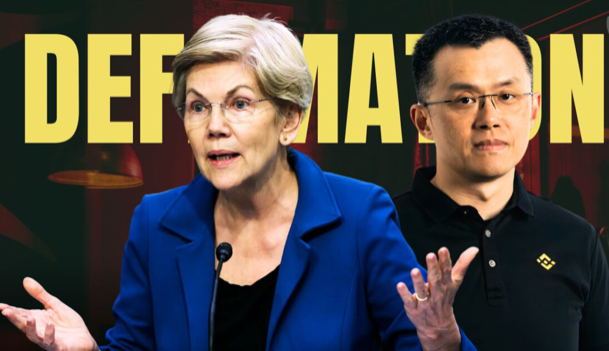
Senator Elizabeth Warren’s legal team has fired back at Binance founder Changpeng “CZ” Zhao, rejecting his defamation threat as “without merit” and accusing him of trying to silence a public official.
The dispute follows Warren’s criticism of Zhao’s presidential pardon and highlights the widening rift between Washington lawmakers and the cryptocurrency industry.
The post that sparked a legal clash
The confrontation began on October 23, when Warren wrote on X that “CZ pleaded guilty to a criminal money-laundering charge and was sentenced to prison.”
Her statement came just days after President Donald Trump pardoned Zhao, who had served a short prison term for violating U.S. anti–money laundering laws under the Bank Secrecy Act.
In November 2023, Zhao pleaded guilty in federal court to “willfully failing to maintain an effective anti–money laundering program” at Binance, the world’s largest cryptocurrency exchange. The plea deal led to over $4 billion in corporate fines, a $50 million personal penalty, and Zhao’s resignation as CEO.
Though the offense focused on compliance failures rather than direct money laundering, the U.S. Department of Justice described it as a “criminal violation” carrying prison penalties, language Warren cited in her post.
CZ’s lawyers demand a retraction
Five days later, Zhao’s attorney, Teresa Goody Guillén of BakerHostetler, accused Warren of defamation. In her letter, Guillén argued that the senator’s post “falsely implied” that Zhao personally laundered money. She insisted he had only accepted responsibility for “compliance failures,” not direct involvement in criminal laundering.
The letter demanded that Warren retract the post, warning that her words “caused serious harm” to Zhao’s reputation. Sources close to Binance said Zhao felt compelled to respond publicly to protect his image amid renewed political attacks on the crypto industry.
Warren’s legal team: “True in all respects”
In a detailed six-page reply dated November 2, Warren’s attorney Ben Stafford dismissed the threat. “Senator Warren’s post is true in all respects and therefore cannot be defamatory,” he wrote.
“She accurately represented publicly available and widely reported facts. The ‘charge’ referenced in Senator Warren’s post refers to the same charge Mr. Zhao pled guilty to and for which President Trump granted a pardon.”
Stafford cited Zhao’s plea deal in United States v. Changpeng Zhao, which clearly identifies the violation as criminal under Title 31, Section 5322 of the U.S. Code — the statute titled “Criminal Penalties.” He pointed out that the Justice Department itself had described Zhao’s conduct as a willful violation of anti–money laundering law.
“Simply put,” Stafford wrote, “any threatened defamation claim would be without merit.”
Warren’s lawyers also emphasized that her statement was protected political speech. As a sitting U.S. senator overseeing financial regulation, her comments were part of her legislative duties, they said.
Even if her official immunity didn’t apply, Stafford noted, Zhao would have to prove “actual malice”, that she knowingly made a false statement — a standard courts rarely find met. “Here, her statement was completely accurate,” he added.
The letter closed by accusing Zhao of trying to intimidate critics. “Your client’s actions reveal a pattern of attempting to suppress accountability rather than accept responsibility,” Stafford wrote. The letter concluded that Warren would not be intimidated or silenced by powerful interests in the cryptocurrency industry.