

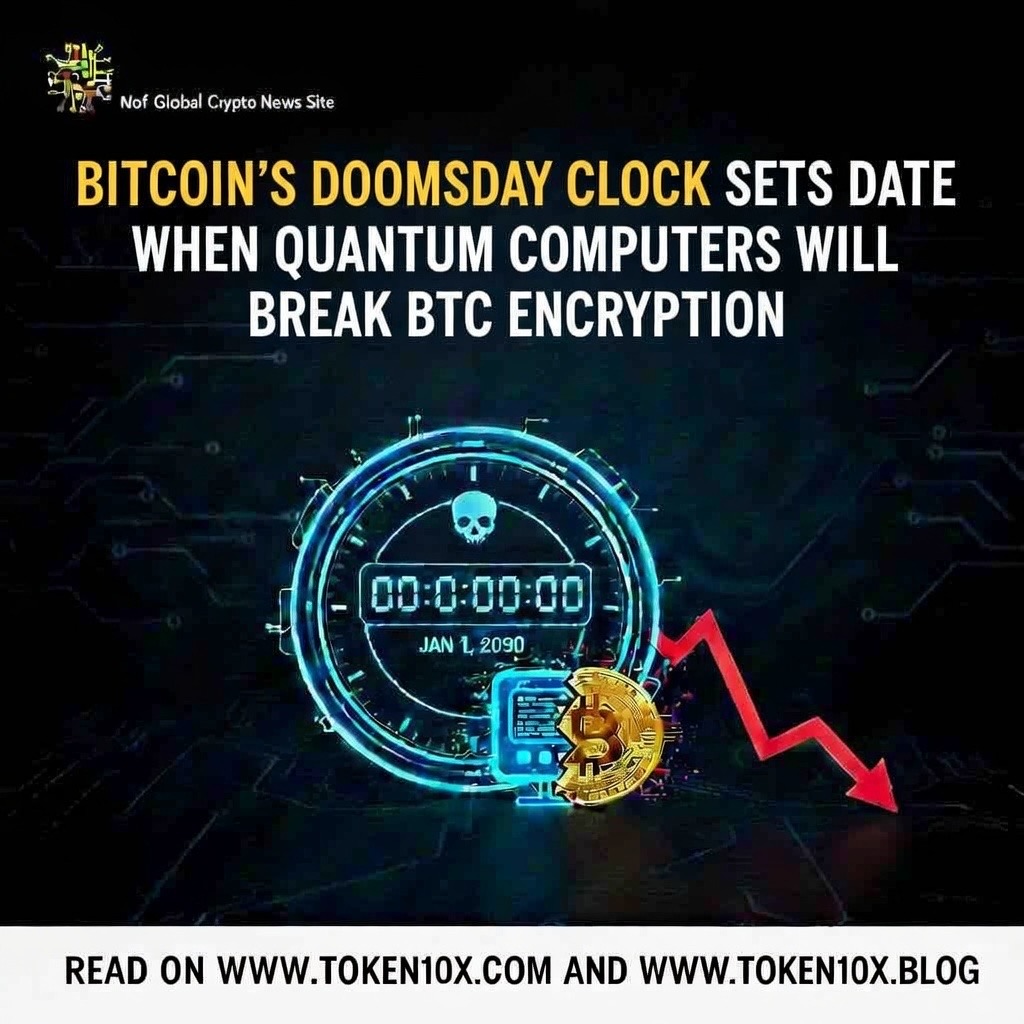
A provocative new online tool dubbed the Quantum Doomsday Clock has set March 8, 2028, as the projected date when quantum computers could gain sufficient power to crack Bitcoin’s elliptic curve cryptography (ECDSA secp256k1), raising alarms across the crypto community about the urgent need for quantum-resistant upgrades in the face of accelerating hardware progress and escalating quantum computing threats to Bitcoin.
The countdown, developed by researchers analyzing qubit scaling trends from IBM, Google, and academic papers, estimates that roughly 1,673 logical qubits would suffice to run Shor’s algorithm fast enough to derive private keys from exposed public keys—targeting vulnerable legacy addresses like P2PK and reused P2PKH/SegWit outputs. While unspent Taproot and modern addresses remain safer due to hash-only exposure, the clock’s aggressive timeline has sparked heated debate, with some experts calling it overly optimistic and others viewing it as a timely wake-up call for the industry.
As crypto analyst Charles Edwards highlighted in coverage of the tool: “The clock is ticking toward March 8, 2028, at exactly 11:23 a.m.—the moment quantum computers could theoretically decrypt the private keys protecting every Bitcoin wallet.”
Major institutions place a credible quantum threat window between 2028 and 2035, with IBM’s Starling fault-tolerant system targeted for 2029 and recent papers compressing qubit requirements dramatically. Solana co-founder Anatoly Yakovenko has warned networks must migrate to post-quantum cryptography within five years, while critics like Blockstream’s Adam Back argue serious risks remain decades away. Bitcoin’s decentralized nature complicates upgrades, but proposals like BIP-360 and soft forks could enable gradual transitions to quantum-safe signatures before any real breach materializes.
To stay ahead of quantum computing developments and get real-time alerts on threats to Bitcoin security or upgrade proposals, be sure to follow our WhatsApp channel for instant updates and expert breakdowns.
Though the 2028 date remains speculative and contingent on breakthroughs, the clock serves as a stark reminder that Bitcoin’s long-term resilience depends on proactive evolution against emerging existential risks.
The countdown has ignited fierce discussions on timelines and solutions. Connect with us and weigh in on the future. Follow us on TikTok, YouTube, X, and Instagram.
#Bitcoin #QuantumThreat #DoomsdayClock #QuantumComputing #BTCEncryption #CryptoNews
Do you think Bitcoin has enough time before 2028 to implement quantum-resistant upgrades, or is the doomsday clock ticking too fast for the network to adapt? Share your thoughts in the comments below. Bookmark the site and always return to www.Token10x.blog for the latest crypto news and market insights. Visit our homepage now!