

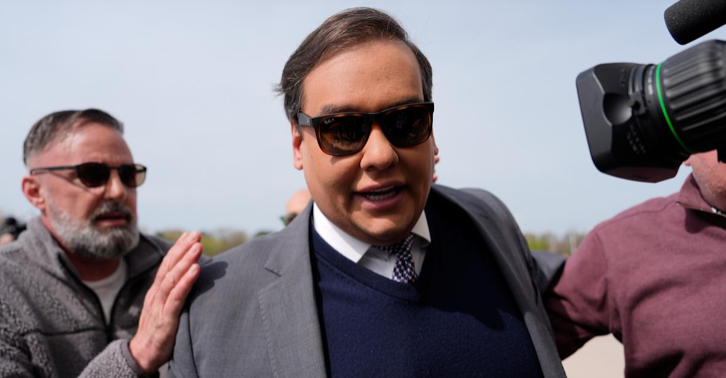
In a dramatic turn of events, former U.S. Representative George Santos was sentenced to 87 months in prison on April 25, 2025, for federal charges of wire fraud and aggravated identity theft. The disgraced New York Republican, once a rising star in Congress, faced a stunning downfall after his web of lies and fraudulent schemes unraveled, leading to his expulsion from the House of Representatives in 2023.
The Rise and Fall of George Santos
George Santos burst onto the political scene in 2022, flipping a congressional district in New York’s Long Island and Queens for the Republican Party. Presenting himself as a wealthy businessman with an impressive resume, Santos claimed to have graduated from top universities, worked at prestigious Wall Street firms, and owned a valuable real estate portfolio. However, these assertions were soon exposed as fabrications, sparking intense scrutiny.
Investigations revealed that Santos had misled voters and donors, using a fictitious biography to gain trust. His campaign was marred by allegations of financial misconduct, including falsifying reports to the Federal Election Commission (FEC) and misusing campaign funds for personal luxuries like designer clothing, Botox treatments, and OnlyFans subscriptions. These revelations led to a scathing House Ethics Committee report, culminating in Santos becoming only the sixth congressperson in U.S. history to be expelled from the House.
The Crimes: Fraud and Identity Theft
Santos’ legal troubles escalated when he was indicted in 2023 on 23 federal charges, including wire fraud, money laundering, and aggravated identity theft. In August 2024, he pleaded guilty to two counts—wire fraud and aggravated identity theft—admitting to a range of deceptive practices. Prosecutors detailed how Santos defrauded campaign donors, stole identities (including those of family members), and charged over $44,000 to contributors’ credit cards without authorization.
Among his most egregious acts was falsifying a $500,000 personal loan to his campaign, when in reality, he had less than $8,000 in his accounts. This deception helped his campaign meet fundraising benchmarks, securing significant financial support from the Republican Party. Santos also fraudulently claimed unemployment benefits during the COVID-19 pandemic while employed, further highlighting his pattern of deceit.
The Sentencing: A Tearful Plea and a Stern Judgment
On April 25, 2025, Santos appeared before U.S. District Judge Joanna Seybert in Central Islip, New York, for sentencing. In a tearful courtroom statement, Santos expressed regret, stating, “I cannot rewrite the past, but I can control the road ahead.” He apologized for betraying his constituents’ trust and appealed for leniency, citing his lack of prior criminal record and personal hardships, including growing up in a “broken home.”
However, Judge Seybert remained unmoved, questioning Santos’ remorse and noting his tendency to blame others. “Where is your remorse? Where do I see it?” she asked, before handing down an 87-month prison sentence—the maximum recommended by prosecutors. Santos was also ordered to pay $373,749.97 in restitution and $205,002.97 in forfeiture, with a surrender date set for July 25, 2025.
Prosecutors, led by U.S. Attorney John J. Durham, emphasized the severity of Santos’ “unparalleled crimes,” which they argued “made a mockery” of the U.S. election system. They pointed to his exploitation of vulnerable donors, including elderly individuals with cognitive impairments, and his lack of genuine accountability, as evidenced by defiant social media posts.
The Aftermath: Public Reaction and Political Implications
The sentencing has sparked widespread discussion about accountability in politics. Nassau County District Attorney Anne Donnelly called the sentence a “just ending” for a “weaver of lies,” while New York State Department of Labor Commissioner Roberta Reardon condemned Santos’ “callous disregard” for defrauding unemployment benefits during a time of crisis. Public sentiment, reflected in social media and news reports, has largely viewed the sentence as a necessary consequence of Santos’ actions.
Santos’ case raises critical questions about the vetting of political candidates and the vulnerabilities in campaign finance systems. His ability to rise to Congress on a foundation of lies underscores the need for greater transparency and oversight. As one constituent wrote in a letter to Judge Seybert, the fraud committed by Santos was an outrage to the voting public, eroding trust in democratic institutions.
What’s Next for George Santos?
While Santos has claimed he will not seek a presidential pardon, he has left the door open, stating he would be “humbly grateful” if President Donald Trump were to offer clemency. However, his focus in recent months has been on generating income through his podcast Pants on Fire and appearances on Cameo, where he reportedly earned significant sums. Despite these efforts, Santos has struggled to meet his financial obligations, prompting a three-month sentencing delay earlier in 2025 to raise funds for restitution.
As Santos prepares to serve his sentence, his story serves as a cautionary tale about the consequences of unchecked ambition and dishonesty. His brief political career, marked by scandal and infamy, will likely be remembered as a low point in American political history.
The sentencing of George Santos to over seven years in prison marks the end of a tumultuous chapter for the former congressman. From his meteoric rise to his spectacular fall, Santos’ case highlights the dangers of deception in politics and the importance of holding public officials accountable. As the nation reflects on this saga, the hope is that it will inspire reforms to safeguard the integrity of the electoral process.
For those following this story, stay tuned for updates on Santos’ next steps and the broader impact of his case on political accountability. Share your thoughts in the comments below—what do you think this sentencing means for the future of American politics?