

“Art is the most intense mode of individualism that the world has known.” – Oscar Wilde.
It is often said that art mirrors life, and artists are sentinels of our times.
When Pakistan’s iconic singer Iqbal Bano draped herself in a black saree and sang, “hum dekhenge,” at Lahore stadium in 1986, she was not just reciting a popular Urdu poem penned by Faiz Ahmed Faiz; she was performing in protest against the jailing of Faiz and also reciprocating the pain and suffering of ordinary citizens under the authoritarian regime of military dictator Zia-ul-Haq.
It was the fusion of Faiz’s poetry, Bano’s haunting voice, and her daring gesture against Faiz’s arrest, juxtaposed with the suffering of people, that made her performance a “work of art.”
When Dutch post-impressionist painter Vincent Van Gogh drew his most memorable artwork, “The Starry Night,” while being locked up in a mental asylum in 1889, he wasn’t just depicting his personal agony but also speaking on behalf of millions of humans who suffered mental health crises yet were misunderstood as “lunatics.” For Van Gogh, personal became political, and political became personal.
But yeah, let’s turn you into an “artist” in under 5 seconds with a prompt on artificial intelligence (AI) chatbots.
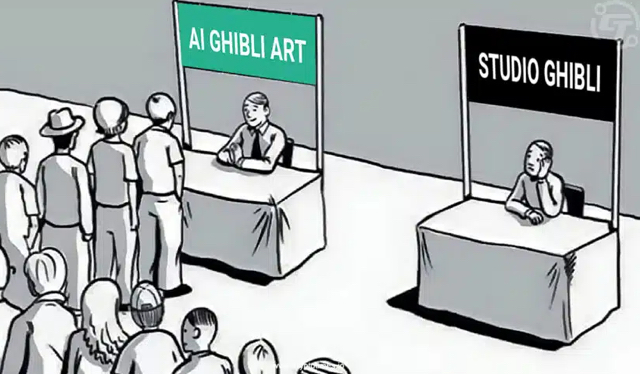
In the past week, millions of people worldwide have converted their real-life images into an art form in seconds, all thanks to the new photo feature of the ChatGPT application, where users may make images with Ghibli-style animation.
Behind the fanfare of Ghibli art, however, there are legitimate worries about how artificial intelligence algorithms replicate the original artworks. By simply feeding the AI models with the original art forms and massive data, the AI chatbots are able to produce replicas, diluting the years of laborious hard work put in for the original work.
Globally, artists have denounced AI businesses for pilfering their creative material without pay, and even media houses have taken legal action against them.
The current passion about Ghibli art centers on the same moral question: whether everyone’s being an artist with artificial intelligence is appropriate and whether it is greatly unfair to the original content producers whose data have been taken by the AI models.
But, welcome to the 21st century. Times when pizzas get delivered in 30 minutes, instant noodles can be made in 2 minutes, and original art, which is made using years of hard work and perseverance, can be replicated in under 30 seconds. In the wake of artificial intelligence (AI), it has become effortless to replicate original artworks in seconds, and everyone is an artist in the virtual world of social media.
AI turning everyone into an artist is problematic!
Ever since the Ghibli fever has been all over social media, several artists have condemned the use of AI for generating copied art. Many big-shot artists and amateur artists have come together to showcase their concerns regarding AI copying the original artworks.
Leonardo da Vinci had rightly said, “The artist sees what others only catch a glimpse of.”
Original works of art represent the human condition, inventiveness, and identity. An art piece like a painting, sculpture, or sketch carries the artist’s perspective, emotions, and experiences of years, which AI can never match.
In the present-day debate, many art critics say reducing hand-drawn masterpieces to AI-generated replicas is sheer disrespect for the years of craftsmanship behind Studio Ghibli’s iconic creations.
A few years ago, in 2016, Hayao Miyazaki had a similar say on technology creating artworks: “I am utterly disgusted.” I would never wish to incorporate this technology into my work at all. I strongly feel that this is an insult to life itself. I feel like we are nearing the end of times. We humans are losing faith in ourselves.”
AI, using the original work, dilutes the years of work of artists. Due to their creativity, hard work, and perseverance, the artists are unable to get their due.